A World-Wide Proclamation—The World Marvelously Prepared to Receive It—“And Then Shall the End Come”
By Calvin P. Bollman
Elder Bollman gives us, in this, the conclusion of seven articles on our Lord’s great prophecy in the twenty-fourth chapter of Matthew. Each article has been an independent treatment of some phase of the prophecy; and it is not essential to have read the previous articles, in order to enjoy this one.
Editor.
In the first part of the wonderful twenty-fourth chapter of Matthew, our Lord gives a very brief outline of events down to the end of time and the dawning of eternity, reaching the climax in verse 14: “And this gospel of the kingdom shall be preached in all the world for a witness unto all nations; and then shall the end come.”
The question the Master was answering was, “What shall be the sign of Thy coming, and of the end of the world?” The reply admirably fits the question.
The kingdom was the great thing in their minds. All down through the ages, from the fall of man, God’s people had looked forward to the time when that which was lost in Adam should be restored in and to the seed of the woman; when should be fulfilled the promise, only dimly understood for centuries, until so beautifully voiced by inspiration: “And thou, O tower of the flock, the stronghold of the daughter of Zion, unto thee shall it come, even the first dominion.” Micah 4:8.
The Dominion That Was Lost
When man was created, dominion was given him over the earth and over all things therein. Under God, the supreme Ruler, Adam was king of one of the states of the universe. His dominion was lost in the fall; it is restored in Christ, the second Adam. This was the meaning of Gen. 3:15. It was all bound up in the promise to Abraham, “All the land which thou seest, to thee will I give it, and to thy seed forever.” Gen. 13:15.
An everlasting inheritance means also everlasting life. The apostle tells us, in Rom. 4:13, that the promise to Abraham embraced the whole world. Blessed promise! And to us the divine word comes, “If ye be Christ’s, then are ye Abraham’s seed, and heirs according to the promise.” Gal. 3:29.
It was for this the children of Abraham had lived, hoped, prayed, labored, and even died; and Jesus put its realization definitely before His followers as an incentive to earnest faithful labor in doing the work He was soon to leave with them, the work of giving the gospel not to the Jews alone, but to all nations.
It Means More to Us
“This gospel of the kingdom” means more to us who live to-day, perhaps, than it meant to any past generation. To us it means, first of all, the gospel as it has always been preached. But now, conjoined with the gospel as the apostles preached it, is the announcement of the advent near; and to-day we see the Christian world afire with the inspiration of the thought of the speedy accomplishment of this work.
After foretelling the signs that would in due time show His coming near, the Saviour, speaking from the standpoint of the future, when the signs He had given should be fulfilled, said: “Verily I say unto you, This generation shall not pass, till all these things be fulfilled. Heaven and earth shall pass away, but My words shall not pass away.” Matt. 24:34, 35.
May Know When He Is Near
Everything foretold by our Saviour in this line of prophecy as signs, everything that could possibly serve as a timely warning, has been fulfilled. And to those who would be in a position to recognize these things as signs, our Saviour says: “Now learn a parable of the fig tree: When his branch is yet tender, and putteth forth leaves, ye know that summer is nigh: so likewise ye, when ye shall see all these things, know that it is near, even at the doors.” Matt. 24:32, 33.
The coming of the Lord cannot therefore be a matter of indifference to this generation; for Jesus has said of the generation that would be in a position to learn “a parable of the fig tree,” “This generation shall not pass, till all these things be fulfilled.” Truly,
“We are living, we are dwelling,
In a grand and awful time,
In an age on ages telling,
To be living is sublime.”
The writer recalls hearing years ago, as a small boy, a number of Presbyterian ministers discussing informally in his father’s home the question of how long it would take93to finish the work of giving the gospel to all the world. All who participated in the discussion were in their prime, but not one hoped to live to see the work accomplished. But during less than the last score of years, practically the whole Christian world has adopted as its slogan, “The gospel to all the world in this generation.” Why this change? Ah, we have reached the generation that is to see this work finished, the generation that shall not pass till all these things be fulfilled.
A Century of Changes
Think of the wonderful changes that have taken place in the world within the last century. A hundred years ago, a large part of the world was closed against the gospel. The interior of Africa was practically unknown. Japan, Korea, and China were for the most part sealed books. India was locked, bolted, and barred by caste. In Turkey, Mohammedanism barred the way. In Russia, the Greek Church seemed an impassable obstacle to the giving of the gospel to the millions in that land. In Italy, Spain, Portugal, Austria, and Belgium, Roman Catholicism sternly forbade the preaching of the gospel, as it did also in South America and many of the islands of the sea. Even Mexico, our near neighbor on the south, was unapproachable.
It Has Gone Everywhere
But a new day has dawned; and now there is scarcely a corner anywhere into which the light of gospel truth has not penetrated. Bible societies are printing and circulating the Bible by millions of copies every year. All who will, may buy at a price within their means; while to those who have nothing, the Bible, in whole or in part, is freely given. The meaning of it all is that God has set His hand to the work. The work of giving the gospel to all the world is soon to be finished, and then comes the end, “the end for which we sigh.”
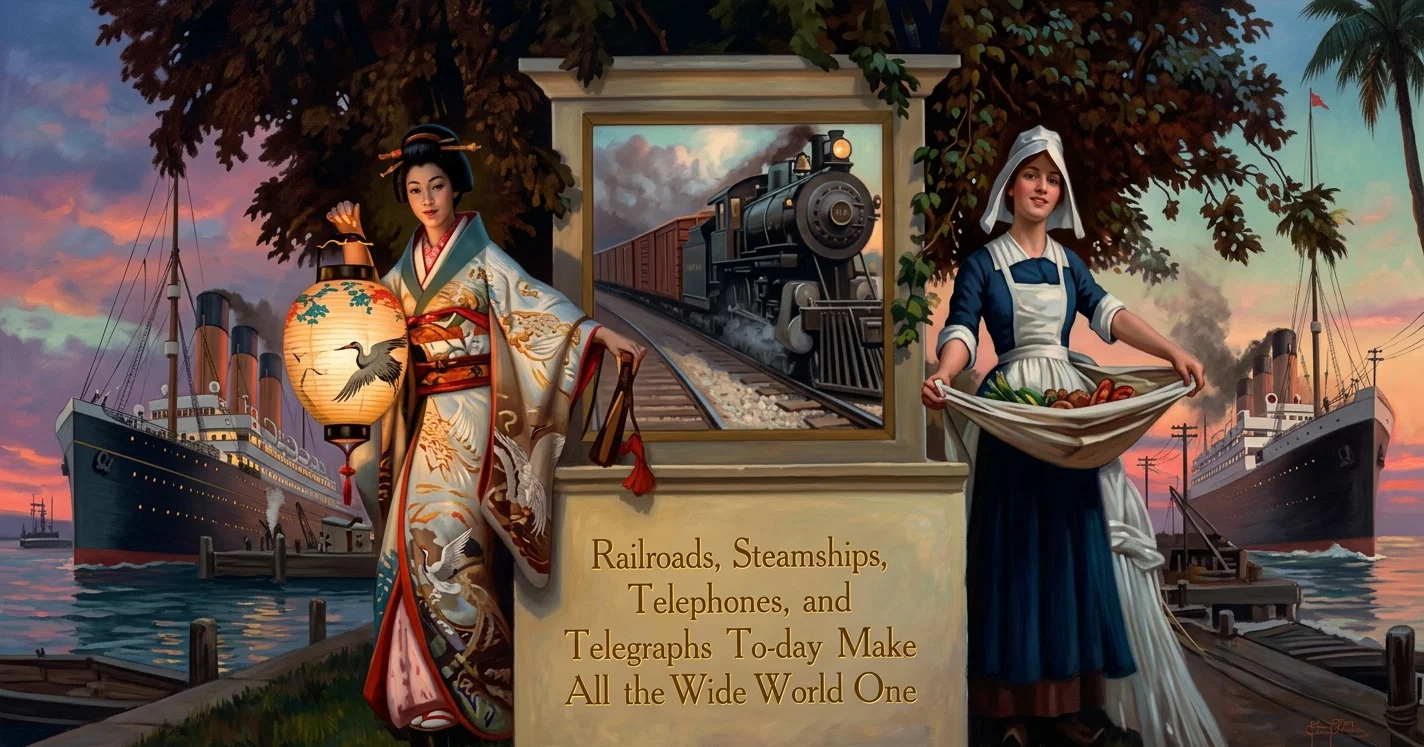
Think, too, how modern invention has made it easy to do this work, and to do it speedily. Rapid transit by means of steam and electricity has made even the most distant nations near neighbors, until to-day there is scarcely a nook or corner in all this world which is not in close touch with every other part—if by no other means, at least by wireless telegraphy.
“Many Shall Run”
Less than seventy-five years ago, telegraphy was unknown. But more than five hundred years before Christ, an angel of God had said to the prophet Daniel, “Many shall run to and fro, and knowledge shall be increased”; and to-day we see that word fulfilled—literally, strikingly fulfilled. This is a most significant sign of our times, for it means that the work of giving this gospel of the kingdom to all the world is almost accomplished. “And then shall the end come.” Reader, are you ready for the issue?