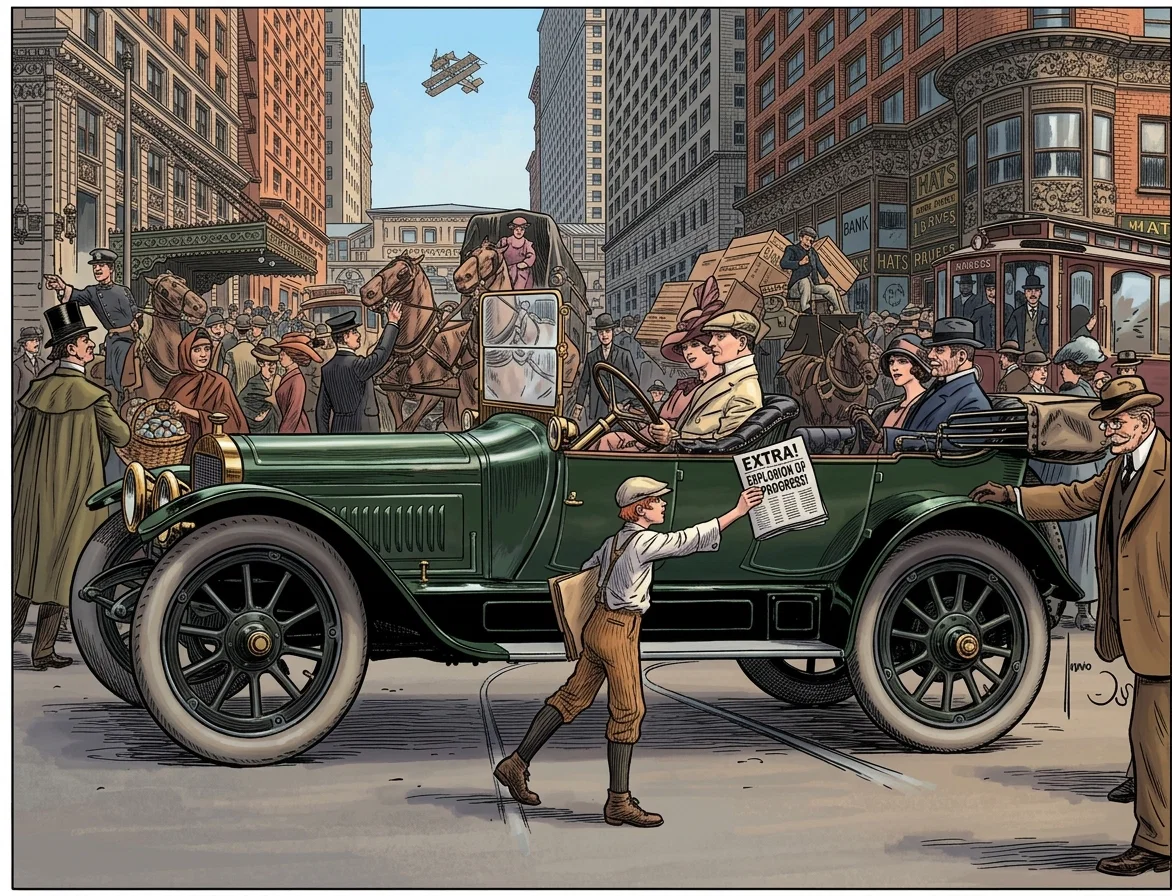
It Was Foreseen and Foretold—A Prediction That Is Twenty-Five Hundred Years Old—But It Accurately Describes Us To-Day
By E. B. Nelson
“BUT thou, O Daniel, shut up the words, and seal the book, even to the time of the end: many shall run to and fro, and knowledge shall be increased.” Dan. 12:4.
There are in this verse three tokens of the time of the end: first, certain words that had been spoken to Daniel should be closed, or not understood, until the time of the end; second, at that time, many should run to and fro; and third, knowledge should be increased. A period of time in which these conditions prevail must indisputably be the time of the end.
CLOSED AND SEALED TILL A GIVEN TIME
Has such a time been known? Have the words which so greatly perplexed Daniel, and which he said he understood not, been made plain to the men of any time since then? To Daniel’s inquiry, “O my Lord, what shall be the end of these things?” the angel replied, “Go thy way, Daniel: for the words are closed up and sealed till the time of the end.” Dan. 12:8, 9.
“Many shall run to and fro, and knowledge shall be increased”
Daniel’s day was not this time. His other visions had been explained to him; but this one, which pertained solely to the end of time, was left a mystery to him. God does not reveal the knowledge of a particular epoch to men living a long time before that epoch. Such knowledge would be useless. Forty years before Israel was delivered from Egypt, they knew nothing of their deliverance. Moses “supposed his brethren would have understood how that God by his hand would deliver them: but they understood not.” Acts 7:25.
But when the time is at hand, then God gives to men the knowledge essential for that time. So we may expect that as the time of the end draws near, men’s minds will be turned to the prophecies of the end, and understanding be given concerning them.
THE PROPHECY UNSEALED
Has such ever been the case? In answer, I quote from a book entitled “The Time of the End,” which was published in 1856, and which is the testimony of over a hundred eminent men concerning the nearness of Christ’s second advent. The following words are by the compiler, a Congregationalist:
“It is not to be truthfully disputed that during the last half century the attention of the church has been called to the study of the prophetic Scriptures, in a manner never before witnessed, and with an intensity and earnestness of investigation that is irreconcilable with any theory that denies that God is thus moving upon the people, and preparing His chosen ones for some manifestation of His dealings with them, the nature of which can only be known by a careful and prayerful study of His word.”
And attention was especially turned to this prophecy in Daniel that was to be sealed till the time of the end. During the early years of the nineteenth century, men in every quarter of the globe began to study the prophecy, and entirely independent of one another, gave to it the same interpretation. Among these men were William Miller in America, Edward Irving and William Cuninghame in England, Hans Wood in Ireland, Archibald Mason in Scotland, and Joseph Wolff in Asia. By the authority of God’s word, this particular portion of Daniel was to be sealed till the time of the end; and this movement in the first half of the nineteenth century can mean nothing else than that this time had been reached.
“SHALL RUN TO AND FRO”
To strengthen this conclusion is the fulfillment of the second and third tokens of the end revealed to Daniel by the angel,—“Many shall run to and fro, and knowledge shall be increased.” If a person wished to deny that the prophecies of Daniel have been unsealed and can be understood, he could not gainsay the fact that since the beginning of the nineteenth century there has been an increase in all lines of knowledge, Biblical and secular alike, such as no previous century ever witnessed.
THE MARCH OF INTELLECT ITS NAME
In his lecture on “The Signs of the Second Advent,” delivered at Exeter Hall, London, in 1848, Dr. John Cumming said:
“The march of intellect is the name with which the present age has christened itself. Let that chemist work in his laboratory; encourage that astronomer, who spends the night in cataloguing groups of stars; let that mathematician pore over books, and waste the midnight oil; let that schoolmaster prosecute his work; let all men work hard, and work constantly. They are unconsciously under an impulse of which they see not the end. That impulse is a divine one; they are opening channels for the gospel.”
Dr. Arthur T. Pierson says: “This is the world’s golden age so far as invention and discovery, intelligence and material progress, can bring it. Measured by achievement, each year is a century.”
“One decade of years from 1875 to 1885 witnessed a forward stride of the race more gigantic than all the previous ages of history,” are the words of Gladstone.
“OUTBREAK OF INVENTIVENESS”
Robert Mackenzie, in his history of the “Nineteenth Century,” says, “The great outbreak of inventiveness by which our century is distinguished has left no province of human affairs unvisited.”
James P. Boyd speaks of the age as follows: “The nineteenth century has achieved triumphs and accomplished wonders equal if not superior to all other centuries combined.”
Previous to this century, each succeeding generation accepted the manner in which its fathers had lived as the most perfected one. No attempt was made to improve methods of labor or to better the conditions of living in any way. But with the dawn of the nineteenth century came a new order of things. The old methods were made obsolete by the improvements that were made in every industry and in all phases of life.
COMMON THINGS NOT KNOWN BEFORE
Nor did the work stop with one round of improvements. There has been one series after another, until to-day there could be given a list of over one hundred things which are commonplaces to us that were not known thirty-five years ago.
To enumerate a few of the nineteenth-century discoveries and inventions: The large number of ways in which electricity is used to-day has come from discoveries made by Volta, which were first publicly described in 1800. It was in 1814 that the first successful use of the steam engine was made, when George Stephenson’s “Puffing Billy” was put to work on a mine railroad in England. In 1819 the first ocean steamer plowed its way across the Atlantic. In 1844 a telegraph message was sent for the first time, and its words were the fitting ones, “What hath God wrought?” In 1846 Elias Howe perfected his experiments that gave us the sewing machine. In 1866 was completed the laying of the Atlantic cable, “that whispers in a minute from continent to continent.”309
Material Progress Precedes the Coming Kingdom
Especially noticeable in these improvements are the ones affecting means of travel and communication. This is most significant. We have seen how the sealed prophecies of Daniel were opened to men’s minds during the first half of this century. This was evidence that the time of the end had come, which meant that the world must be warned. This would have been practically impossible with the methods then existing; so the minds of men were worked upon by God until there have been given to the world the most highly perfected systems for travel and communication that have ever existed.
What striking evidences that our day is the time of the end! The great increase of scientific knowledge which was to mark that time is the leading characteristic of our day. Those prophecies of Daniel which were to be closed up and sealed until the last days of time, have been opened within the last century. The great clock of time is about to strike the closing hour of earth’s history. Wherever one turns, one may see written in glowing letters, by the finger of God, “Behold, I come quickly;”