THE IMPASSABLE GULF

4%

Pacific Press Publishing Association · Mountain View, California · Jun 1, 1915

FromSigns of the Times, Vol. 42, No. 22.

Read the full edition

THE IMPASSABLE GULF

The Beggar and the Rich Man—The Wise and the Unwise Choice—At Death Destiny Is Eternally Fixed
By Mrs. E. G. White
“He was selfishly indifferent to the needs of his suffering brother.”
In the parable of the rich man and Lazarus, Christ shows that in this life men decide their eternal destiny. During probationary time the grace of God is offered to every soul. But if men waste their opportunities in self-pleasing, they cut themselves off from everlasting life. No other probation will be granted them. By their own choice they have fixed an impassable gulf between them and their God. This parable draws a contrast between the rich who have not made God their dependence, and the poor who have made God their dependence. Christ shows that the time is coming when the position of the two classes will be reversed. Those who are poor in this world's goods, yet who trust in God and are patient in suffering, will one day be exalted above those who now hold the highest positions the world can give, but who have not surrendered their life to God.

Rich Man and the Beggar

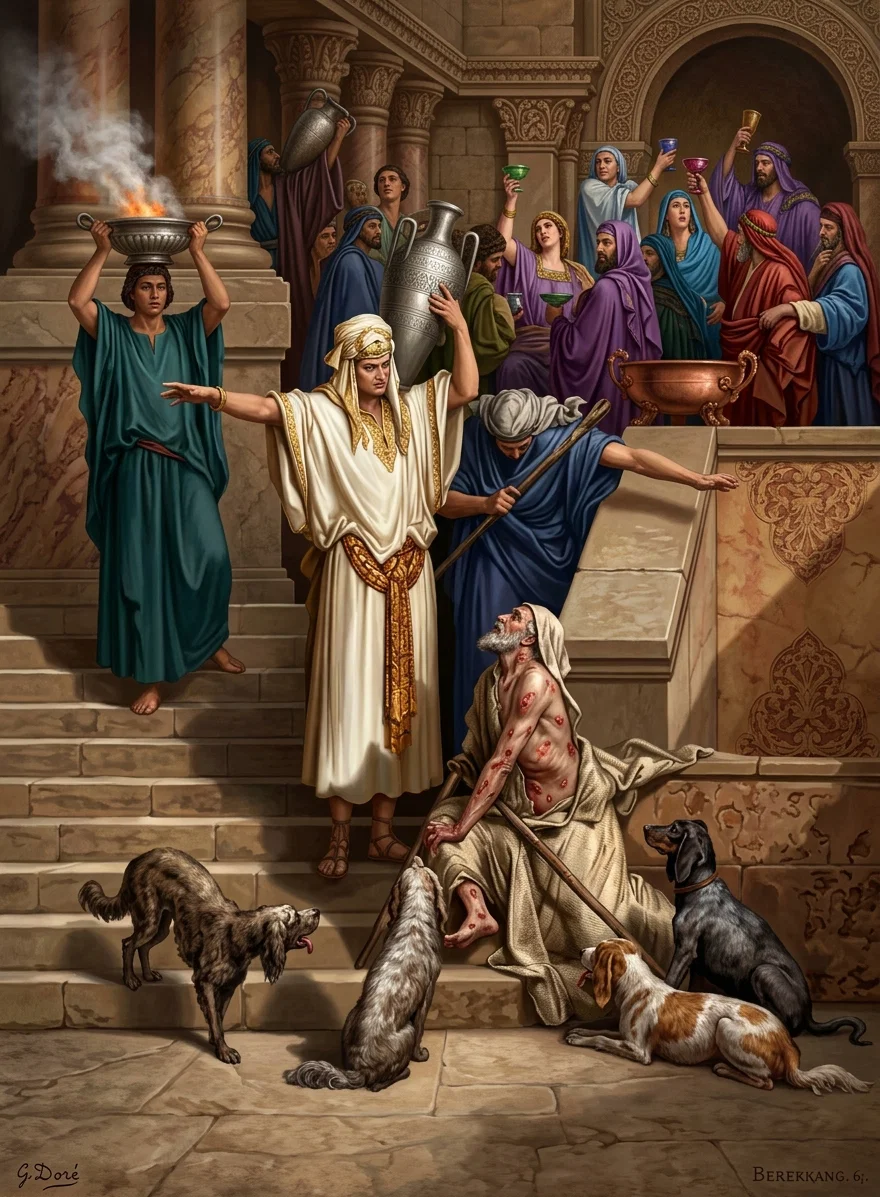
“There was a certain rich man,” Christ said, “which was clothed in purple and fine linen, and fared sumptuously every day: and there was a certain beggar named Lazarus, which was laid at his gate, full of sores, and desiring to be fed with the crumbs which fell from the rich man's table.” Luke 16: 19-21.
The rich man did not belong to the class represented by the unjust judge, who openly declared his disregard for God and man. He claimed to be a son of Abraham. He did not treat the beggar with violence, or require him to go away because the sight of him was disagreeable. If the poor, loathsome specimen of humanity could be comforted by beholding him as he entered his gates, the rich man was willing that he should remain. But he was selfishly indifferent to the needs of his suffering brother, who was allowed to remain in this condition day after day, while the wealthy nobleman had every want supplied. The one who was abundantly able to relieve the sufferings of his fellow creature, lived to himself, as many live to-day.

Should Have Cared for Him

God had made the rich man a steward of His means, and it was his duty to attend to just such cases as that of the beggar. In proportion to his abundance was his obligation to use his gifts for the uplifting of humanity. This was the Lord's command, but the rich man had no thought of his obligation to God. He lent money, and took interest for what he loaned; but he returned no interest for what God had lent him. He had knowledge and talents, but did not improve them. Forgetful of his accountability to God, he devoted all his powers to pleasure. The time came when a change took place in the condition of the two men. The poor man had suffered day by day, but he had patiently and quietly endured. In the course of time he died and was buried. There was no one to mourn for him; but by his patience in suffering he had witnessed for Christ, he had endured the test of his faith, and at his death he is represented as being carried by the angels into Abraham's bosom.
“The rich man also died, and was buried; and in hell he lift up his eyes, being in torments, and seeth Abraham afar off, and Lazarus in his bosom. And he cried and said, Father Abraham, have mercy on me, and send Lazarus, that he may dip the tip of his finger in water, and cool my tongue; for I am tormented in this flame.” Verses 23-24.

Held the Mirror Before Them

In this parable, Christ was meeting the people on their own ground. The doctrine of a conscious state of existence between death and the resurrection was held by many of those who were listening to Christ's words. The Saviour knew of their ideas, and He framed His parable so as to inculcate important truths through these preconceived opinions. He held up before His hearers a mirror wherein they might see themselves in their true relation to God. He used the prevailing opinion to convey the idea He wished to make prominent to all,—that no man is valued for his possessions; for all he has belongs to him only as lent by the Lord. A misuse of these gifts will place him below the poorest and most afflicted man who loves God and trusts in Him.

No Salvation After Death

Christ desired His hearers to understand that it is impossible for men to secure the salvation of the soul after death. “Son,” Abraham is represented as answering, “remember that thou in thy lifetime receivest thy good things, and likewise Lazarus evil things: but now he is comforted, and thou art tormented. And beside all this, between us and you there is a great gulf fixed: so that they which would pass from hence to you cannot; neither can they pass to us, that would come from thence.” Verses 25, 26. Thus Christ represented the hopelessness of looking for a second probation. This life is the only time given to man in which to prepare for eternity.

Reflecting Upon God

When the rich man solicited additional evidence for his brothers, he was plainly told that should this evidence be given, they would not be persuaded. His request cast a reflection on God. It was as if the rich man had said, If You had more thoroughly warned me, I should not now be here. Abraham, in his answer to this request, is represented as saying: Your brothers have been sufficiently warned. Light has been given them, but they would not see. Truth has been presented to them, but they would not hear. “If they hear not Moses and the prophets, neither will theybe persuaded, though one rose from the dead.” Verse 31. These words were proved true in the history of the Jewish nation. Christ's last and crowning miracle was the raising of Lazarus of Bethany, after he had been dead four days. The Jews were given this wonderful evidence of the Saviour's divinity, but they rejected it. Lazarus rose from the dead, and bore his testimony before them; but they hardened their hearts against all evidence, and even sought to take his life. John 12: 10, 11.
The conversation between Abraham and the once rich man is figurative. The lesson to be gathered from it is that every man is given sufficient light for the discharge of the duties required of him. Man's responsibilities are proportionate to his opportunities and privileges. God gives to every one sufficient light and grace to do the work He has given him to do. If man fails to do that which a little light shows to be his duty, greater light would only reveal unfaithfulness, neglect to improve the blessings given.

Miracles Would Not Reach Them

“He that is faithful in that which is least is faithful also in much; and he that is unjust in the least is unjust also in much.” Luke 16: 10. Those who refuse to be enlightened by Moses and the prophets, and ask for some wonderful miracle to be performed, would not be convinced if their wish were granted.
The parable of the rich man and Lazarus shows how the two classes represented by these men are estimated in the unseen world. There is no sin in being rich, if riches are not acquired by injustice. A rich man is not condemned for having riches; but condemnation rests upon him if the means intrusted to him is spent in selfishness.

Not the Right Kind of Wealth

The rich man had all that money could procure, but he did not possess the riches that would have kept his account right with God. He had lived as if all that he possessed were his own. He had neglected the call of God and the claims of the suffering poor. But at length there comes a call which he cannot neglect. By a power which he cannot question or resist he is commanded to quit the premises of which he is no longer steward. The once rich man is reduced to hopeless poverty. The robe of Christ's righteousness, woven in the loom of heaven, can never cover him. He who once wore the richest purple, the finest linen, is reduced to nakedness. His probation is ended. He brought nothing into the world, and he can take nothing out of it.
Christ lifted the curtain, and presented this picture before priests and rulers, scribes and Pharisees. Look at it, you who are rich in this world's goods, and are not rich toward God. Will you not contemplate this scene? That which is highly esteemed among men is abhorrent in the sight of God. Christ asks, “What shall it profit a man, if he shall gain the whole world, and lose his own soul? or what shall a man give in exchange for his soul?” Mark 8: 36, 37.