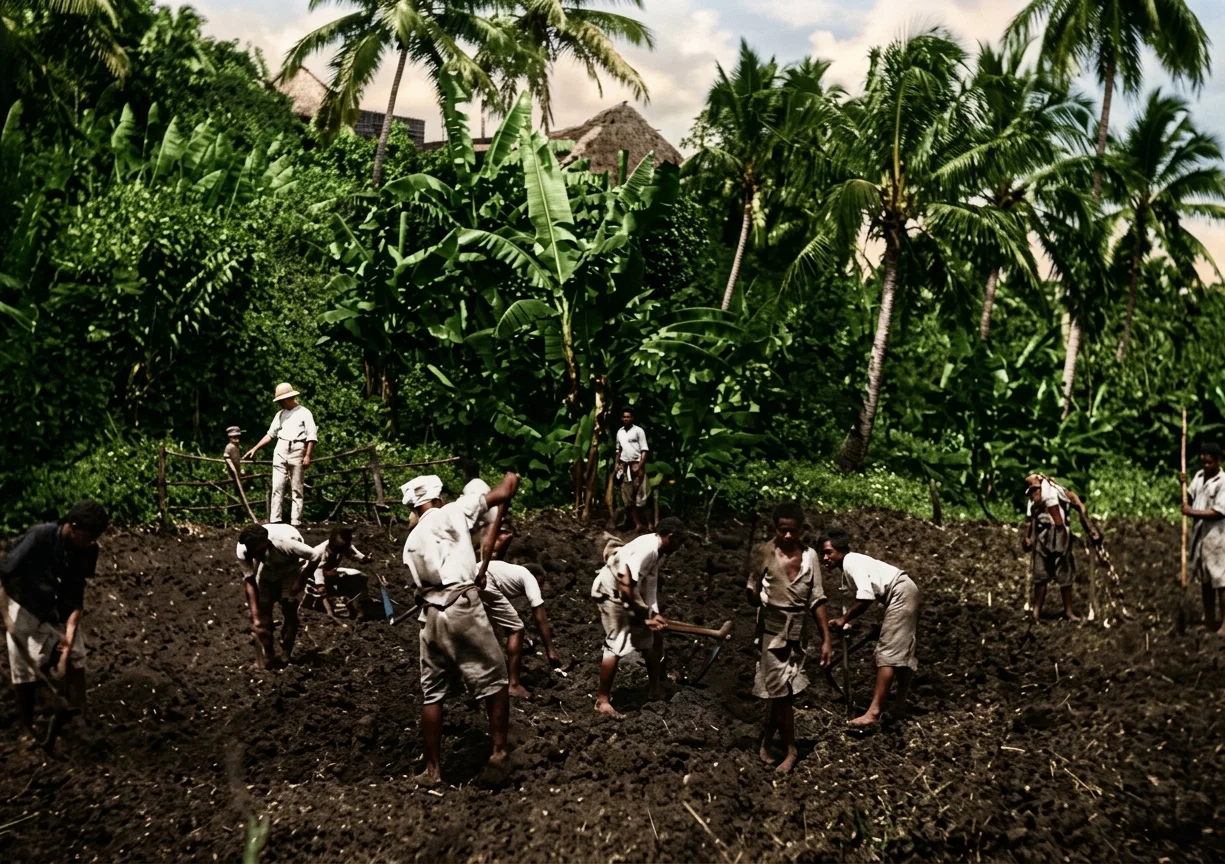
The Islands of Fiji and Their Great Natural Resources — Climate of the Finest in the World — Marvelous Transformations Wrought Among the Natives
This article is just what the busy man or woman is looking for. It gives, in small space, a general view of Fiji, that most interesting group of the numerous islands of the Pacific. The information that is here afforded by a few moments’ reading is the result of extensive study and several visits among the islands during the last twenty years.
It should be said, by way of explanation, that the author of the article, Elder A. G. Daniells, who is the president of our General Conference, is making an extensive tour among our mission stations in Oceania and the Orient. This article, together with several others equally interesting, was mailed to us from the Royal Mail Steamer Osterly several months ago; but the war has complicated communication, and by some means the matter has been delayed. The delay, however, has had no effect on its value or interest. After reading this article, you will be looking forward to the others to follow in each issue for several weeks.
Editor.
We sailed from Honolulu Wednesday, June 17, on the steamer Marama, bound for Australia. The discomfort from heat formerly experienced while crossing the equator is greatly reduced now by electric fans with which the dining saloon, the social halls, and the cabins are equipped.
Embraced in the Group
Early Friday morning, the twenty-sixth, we found ourselves sailing among the numerous islands of Fiji. Two hundred and thirty is the exact number as given by the official documents. These, with the waters in which they stand, constitute the territory of Fiji.
Many think of Suva or one of the islands as being Fiji. Suva is not Fiji. It is a town in Fiji. Nor is Viti Levu, the island on which Suva is built, Fiji. It is but one of the islands of Fiji. To think of Suva or Viti Levu as being Fiji is as great an error as to think of San Francisco or California as being the United States.
The Fijian archipelago includes all the islands of the Pacific lying between latitude 15° and 22° south, and longitude 176° east and 178° west. The international day line, which is located on the 180th parallel, runs through this archipelago. These islands are scattered over 120,000 square miles of water. Their land area is about 7,435 square miles, or about 5,000,000 acres.
Fertility and Abundant Rivers
Many of the islands are little more than barren rocks, “where only screeching sea birds find homes.” Others are large, containing345mountain ranges, broad valleys, and navigable rivers. The largest island is Viti Levu, 50 miles wide and 90 miles long, with a mountain range rising 5,000 feet above the sea. Its principal river, Rewa, is navigable for some 60 miles. Suva, the seat of government, is located on this island. Vanua Levu, the second island in size, is 25 by 100 miles. This island has forty distinct streams, some of which are very large, and navigable for a considerable distance.
The soil of the largest islands, whether on the hills or on the lowlands, is of excellent quality. But until recent years, very little use has been made of the land. Ten years ago, not more than 100,000 acres had been brought under cultivation, leaving nearly 5,000,000 acres unimproved. However, a great change has taken place during the last decade. Legislation has been effected by which land can be purchased and leased by Europeans. As a result, something like 125,000 acres is being brought under cultivation at the present time. Yet, there are large areas untouched.
Valuable Possession and Strategic Center
Fiji has become an important center and a valuable British possession in the southern Pacific. It “is most favorably and centrally situated in the Pacific, and its importance must be measured rather by its strategic position than by the actual size of its islands. It is in the line of some of the most important trade routes in the world, and is, moreover, the natural center of Polynesia. The British government has already recognized this, and has made it the governing point of the western Pacific. The ecclesiastical authorities also have noted the fact, and the Anglican church has stationed its new bishop of Polynesia at Suva. The islands are, roughly speaking, 1,100 miles from Auckland, New Zealand; 1,700 miles from Sydney, in the Commonwealth of Australia; and a similar distance from Brisbane. They fall across the track of the steamers between the two continents of Australia and America; and when the Panama Canal opens, their geographical position will be even more advantageous.”
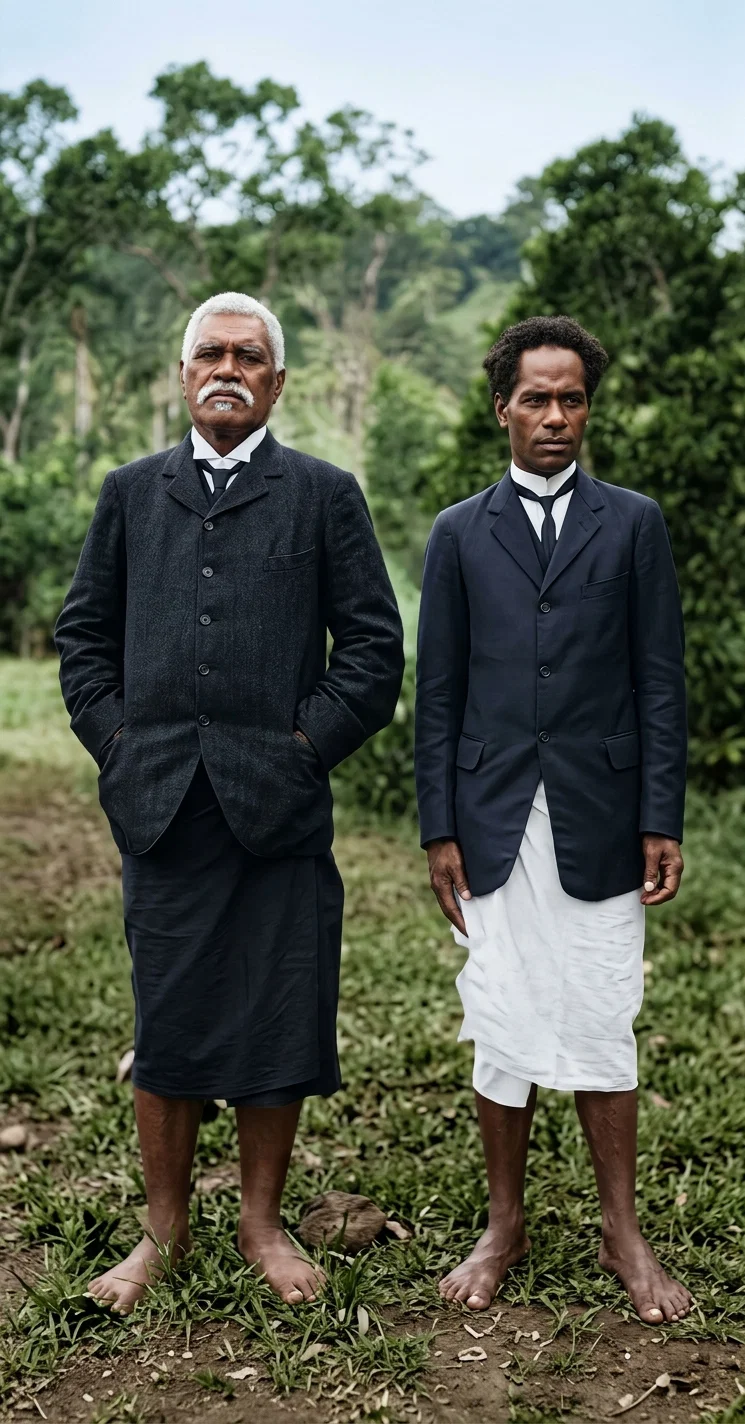
A FIJIAN CHIEF WHO IS ALSO ELDER OF ONE OF OUR CHURCHES
The Splendid Climate
Although Fiji lies within the tropics, the climate for the most part of the year is good. The thermometer seldom falls below 60° nor rises above 90° F. The average temperature is about 80°. The mountain ranges, the forests, and the trade winds make it possible to live there in fair comfort the year around. December, January, and February are the hot months. Fortunately there is no malaria in Fiji.
The Resources and Commerce
A resident of Fiji, writing of the outlook for commerce, says: “The commercial importance of the country is rapidly developing; and because of many singular advantages, it is likely to extend still more in the near future. The days of prosperity have only commenced. Vast areas of land lie under a genial sun and abundant rainfall, awaiting the coming of enterprise. Mineral wealth is locked up in the earth, and needs the magic key of industry to give it release. Manufactures will grow and add their quota to the prosperity of the country; and the islands of Fiji will be recognized by the world as one of the contributors to its material advance.”
The annual export trade runs close to $15,000,000, and it is increasing rapidly. The products exported are rice, tea, sugar, bananas, and copra. Copra is the dried kernel of the coconut, and is used chiefly in the manufacture of oils and soaps. The sugar industry takes the lead at present. Several large mills have been erected and equipped at a cost of about $20,000,000. There are 50,000 Indian coolies employed to carry on this industry. The experimental station recently established will do much to develop the agricultural resources of Fiji.
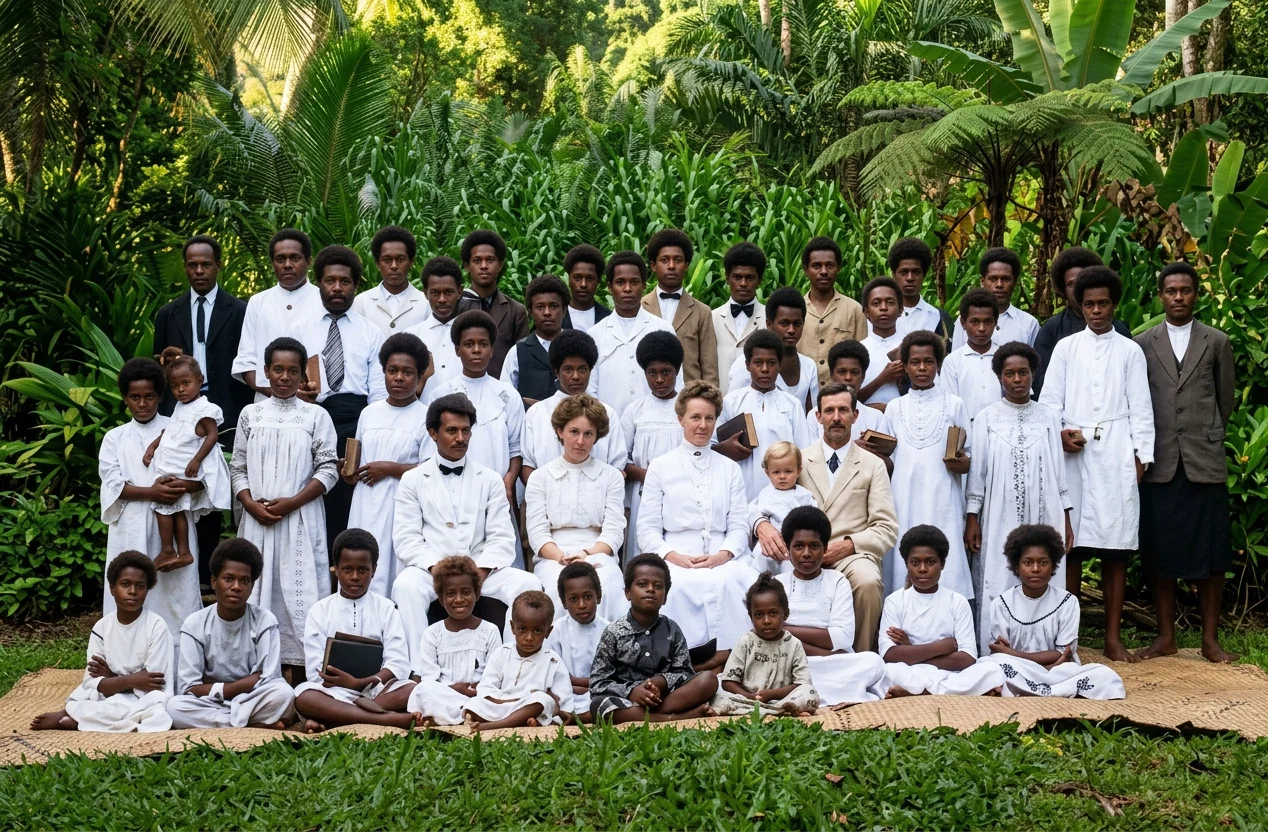
TEACHERS AND STUDENTS OF OUR FIJI SCHOOL AT BURESALA, OVALAU
Origin of the Fijians
No one knows exactly where the Fijians came from, nor how they reached the islands in which they were found. They were there when Abel Jansen sighted the islands in 1643, and when Captain Cook sailed by in 1773. As they had no written language, they were unable to write history, and thus make permanent records of events. Unlike the Hawaiians, the New Zealand natives, and some other island peoples, they have few legends of their origin and migrations.
In color, features, language, and characteristics, they seem to be a cross between the eastern and the western Polynesians. They are darker than the Samoans and the Tongans, just east of them, but lighter than the Papuans, and other natives in the islands of New Britain and the Solomons, to the west. It is supposed that long ago, both Tongans and Papuans drifted in their canoes to the islands lying between them, and being unable or disinclined to return, became permanent residents.
The Original Savagery
The writers of Fijian history all agree that these people, when discovered, were the most savage, degraded race ever found in any part of the world.
One writer says that “in character they occupied a preeminence of degradation unrivaled by that of any other islanders.”
Another says: “Even at the risk of producing horror, we must look for a moment over the edge of the pit whence the native has been digged; and though we shrink back with loathing and disgust, we shall have a fuller sympathy with him. We shall be more inclined to pity than despise, if there is still some mire from the pit adhering to his person. The real difficulty is to give any adequate picture of old Fiji without descending into descriptions so abominable as to outrage decency and to stain permanently the imagination. . . . The ink dries on our pen as we try to frame sentences such as will not sully and smirch other souls.”
The degradation of the Fijians was manifested in their cruelty, their cannibalism, and their vile sensuality. Their cruelty led to a wanton, dreadful waste of human life. “Cruelty was glorified into a virtue, torture was made a science, and murder was a fine art.” Infanticide, strangling of widows, dispatching the sick and the aged, and the utter extinction of the vanquished in war—all this was the common and universal way of the country.346
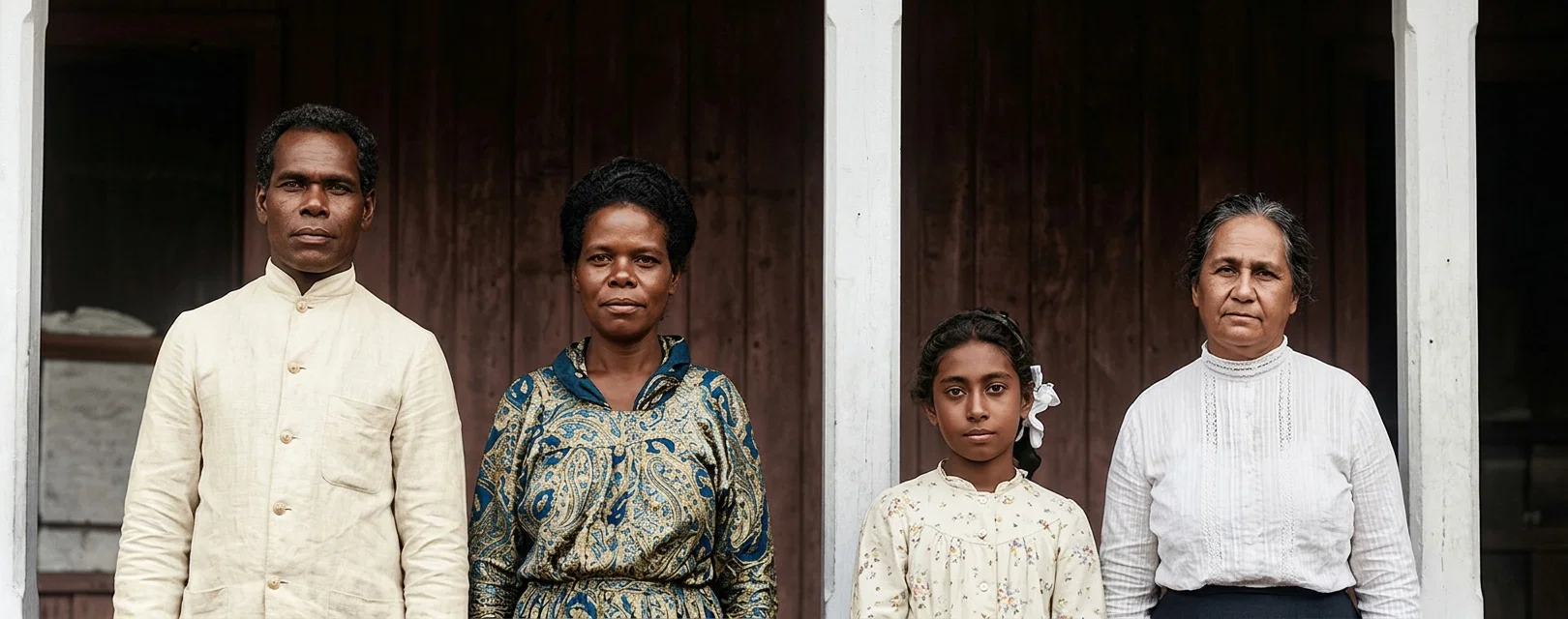
Mrs. Meyers, in Charge of Our Mission for Indians in Fiji, and Some of Our Native Workers
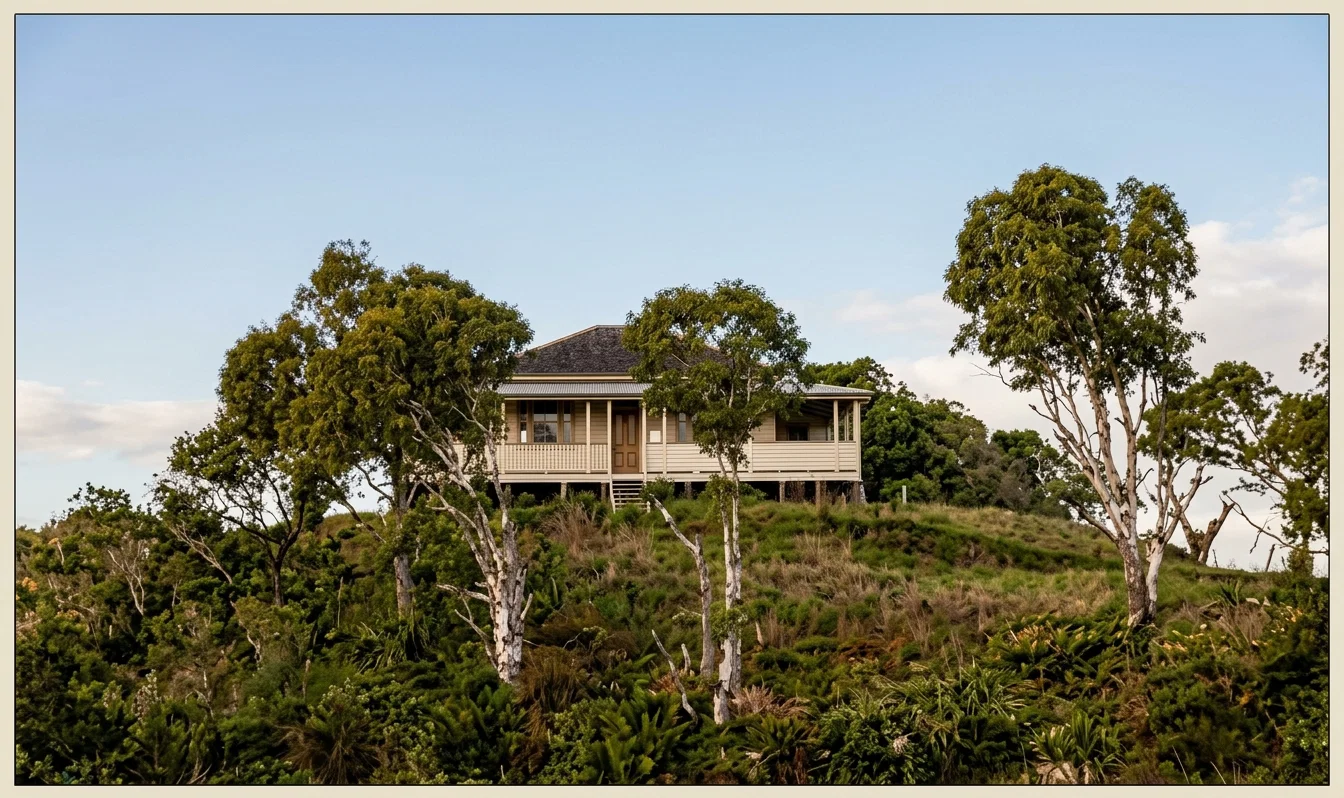
Mission Home for Our Workers for Indians in Fiji
Cannibalism Made a Fine Art
The revolting practice of cannibalism has been so fully explained since the discovery of man-eating tribes, that there scarcely seems need to give it more than a passing word. “Cannibalism, occasional on many of the island groups, or reserved for the treatment of conquered foes, was here elevated into a national cult and custom. They used to mark these pleasant little achievements by memorial stones. The great chief, Ra Undreundre, had eight hundred and seventy-two of these set up to mark his prowess.”
The Marvelous Transformation
After looking at these people as they were when discovered, it is a great relief and pleasure to turn to look at them as they are to-day. We obtained a short glimpse of them at the time of this visit. When our steamer pulled up to the wharf in Suva, our friends hurried us into a taxicab, and took us out to their mission station some five miles around the bay. Here we found all our European missionaries, native evangelists, a number of native students from our school, and nearly two hundred of our Fijian converts.
They were holding their annual convention. As we had but a few hours to be together, we lost no time in getting acquainted. At the ringing of the church bell, all gathered under the trees on the lawn in front of the church.
Pastor Stewart, the superintendent of our work in Fiji, introduced us to the native believers.
Our Fijian minister, Pastor Pauliasa Bunoa, responded in an address of welcome. He told us how they had long looked forward to this hour. He said they had come over the mountains and over the waters from a number of the islands to greet us. On the way, and every day at the conference, they had prayed the Lord to bring the ship to Suva in the daytime, to bring us in health, and to give us good weather, so that we might come out to the mission station. Their prayer had been answered, and they were all thanking the Lord for hearing them.
A Hearty Reception
In closing, he said that all present wanted to shake our hands, and, according to Fijian custom, make us some presents. He said the presents would not be great nor of much value, but they would represent something great—the fullness of love and gratitude they felt to their Lord and Saviour, and to the dear friends of our church in America and Australia, for sending our missionaries to them with the light and blessings of the gospel for this generation.
He then called them forward in companies according to their church membership. The first to come forward spread on the grass before us a mat they had made and brought as a present. The groups that followed all brought presents, consisting of mats, baskets, fans, bottles of oil, etc. One old man, probably nearing his hundredth birthday, laid a whale’s tooth at our feet. Our missionaries told us that the old man had very likely treasured that tooth for half a century. In old Fijian life, a whale’s tooth was a treasure of the first magnitude. It was about the last thing a native would part with; and when presented to a friend, it expressed the highest regard and esteem.
When hand-shaking was over and presents were made, we expressed to these people the great pleasure it gave us to meet them. We, too, had long looked forward to this hour, and were glad it had come. We assured them of the deep interest our people had in them, and that we would carry back to our people in America the presents they had given us, as tokens of their love and gratitude to them for sending missionaries to help them.
An Inspiring Service
Adjournment was then made for the evening meal, after which all gathered in the church for preaching service.
To the visitors, that service was a remarkable occasion. Two hundred dark-skinned Fijians assembled in a Christian church to worship the God of heaven, their Creator and Redeemer. To us it seemed impossible, after reading of their degradation only a short time back. But there they were, with bushy heads, and with countenances still severely stern and rigid, but hearts tender, and loving, and kind.
They had got a new vision. They had come to know the God and Father of all the living, and His Son, who died on the cross for them. They were no longer savages—no longer cannibals. Compassion for men—for suffering, sorrowing men and women—had taken the place of the savage cruelty that had formerly ruled them. Our dear Brother Pauliasa, who had given us the address of welcome earlier, and who opened their service with prayer, had known what it was to feast on the flesh of his fellow creatures. Now he was an ordained minister of Christ the Lord, preaching peace on earth and good will to men.
It was a wonderful sight,—those two hundred Fijians, suitably dressed, sitting on the mat-covered floor, with Bibles in their hands, and with faces radiant with the joy that filled their hearts. As Scripture texts were read during the address, the majority in the audience followed closely, turning to the texts and reading for themselves in order more fully to get the meaning of the sermon.
But how did they get the Bible in their own language? and how came they to know how to read? How had this marvelous, yes, this miraculous change come about?
The Heroism of Two Methodist Missionaries
In 1835, two God-fearing Methodist missionaries, with their families, came to Fiji to save these people. The record of the dangers, privations, hardships, sufferings, deaths, and the glorious triumphs, fills volumes with the most thrilling experiences. The gospel they bore to these benighted heathen—the most desperate to whom it was ever preached—changed the face of Fiji. A written language was constructed by the missionaries, into which they translated the word of God. That living Word laid hold of the hearts of the people. They turned to God, and He regenerated them.
Some of the missionaries who first went among them, lived to see cannibalism entirely banished from Fiji. Their tribal wars have ceased, and with them infanticide, the strangling of widows, the dispatch of the old, the sick, and the helpless. The result is a new Fiji.
Thus again are fulfilled the words of Jesus, “Other men labored, and ye are entered into their labors.”
The Reforms Are Substantial
Our missionaries assured me that our Fijian Christians were as conscientious and faithful in Christian life as the Christians in any community. We have some 400 believers in Fiji. None of them use intoxicating liquors. None are supposed to use tobacco, though occasionally one falls under temptation. Though poor, they are faithful in the payment of tithes and offerings for the support of gospel work.
They are active in missionary work. A number of excellent evangelists have been developed among them. In our missionary training school at Buresala, on the island of Ovalau, we have a company of forty or fifty students in training, a number of whom give promise of making good gospel workers. The Fijian paper we publish, is strongly circulated by our people among their neighbors.
Gospel work for these people is most interesting; and the returns are the richest and most satisfying to the soul, of any labor performed by man.