TWO VIOLATED PROMISES

3%

Pacific Press Publishing Association · Mountain View, California · Jun 8, 1915

FromSigns of the Times, Vol. 42, No. 23.

Read the full edition

TWO VIOLATED PROMISES

One Resulted in Disaster—The Other Brought Reformation and Great Reward
By Mrs. E. G. White
WORDS are of no value unless they are accompanied with appropriate deeds. This is the lesson taught in the parable of the two sons. When the father went to the first son, saying, “Go work to-day in my vineyard,” the son promptly answered, “I will not.” Matt. 21:28, 29. He refused to obey, and gave himself up to wicked ways and associations. But afterward he repented, and obeyed the call.

I GO, SIR

The father went to the second son with the same command, “Go work to-day in my vineyard.” This son made reply, “I go, sir,” but he went not. Verse 30.
In this parable, the father represents God; the vineyard, the church. By the two sons are represented two classes of people. The son who refused to obey the command, saying, “I will not,” represented those who were living in open transgression, who made no profession of piety, who openly refused to come under the yoke of restraint and obedience which the law of God imposes.
In the son who said, “I go, sir,” and went not, the character of the Pharisees was revealed. Like this son, the Jewish leaders were impenitent and self-sufficient. The religious life of the Jewish nation had become a pretense. When the law was proclaimed on Mount Sinai by the voice of God, all the people pledged themselves to obey. They said, “I go, sir,” but they went not. When Christ came in person to set before them the principles of the law, they rejected Him.

ANNOUNCED THEMSELVES UNWITTINGLY

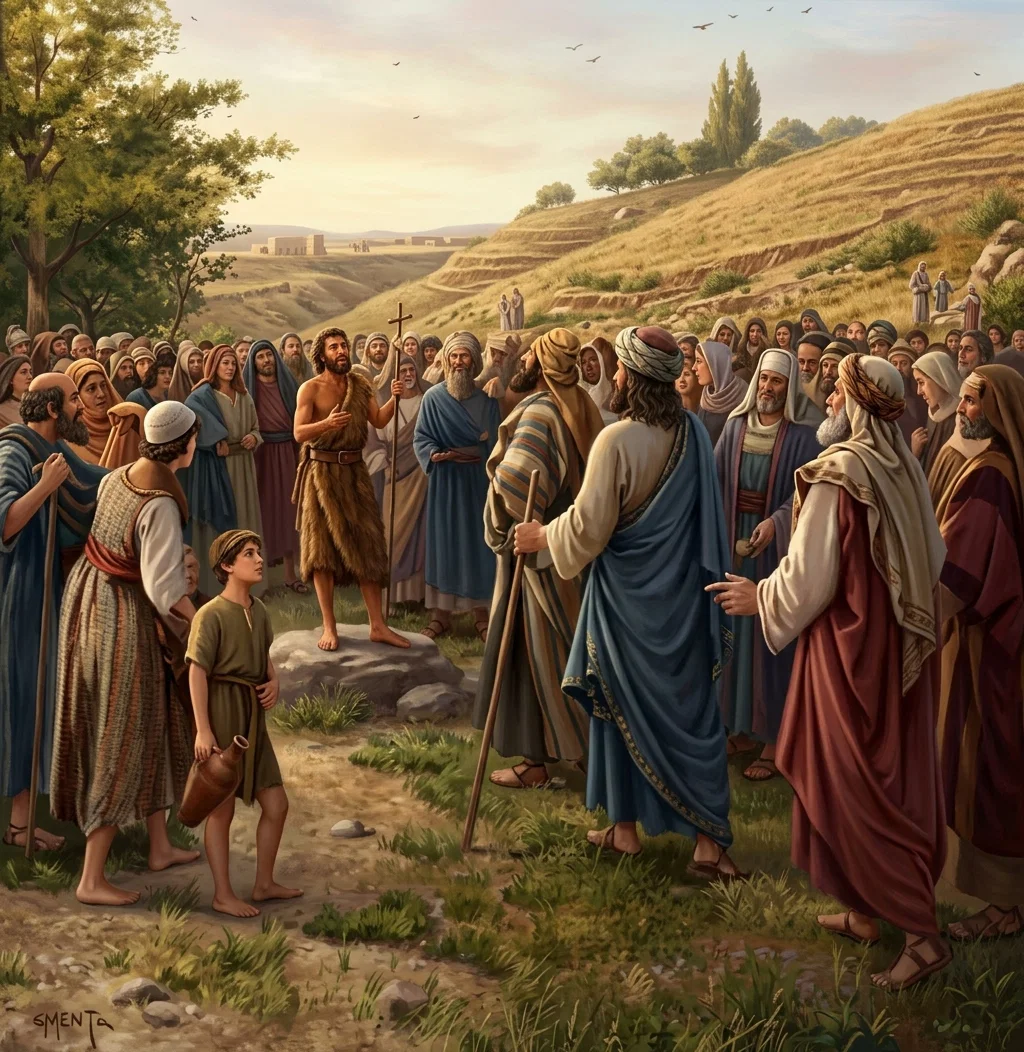
“John the Baptist came preaching truth, and by his preaching sinners were convicted and converted. These would go into the kingdom of heaven before the ones who in self-righteousness resisted the solemn warning.”
In the company before them there were scribes and Pharisees, priests and rulers; and after giving the parable of the two sons, Christ addressed to His hearers the question, “Which of them twain did the will of his father?” Repeating themselves, the Pharisees answered, “The first.” Verse 31. This they said without realizing that they were pronouncing sentence against themselves. Then there fell from Christ’s lips the denunciation: “Verily I say unto you, that the publicans and the harlots go into the kingdom of God before you. For John came unto you in the way of righteousness, and ye believed him not: but the publicans and the harlots believed him: and ye, when ye had seen it, repented not afterward, that ye might believe him.” Verses 31, 32.
John the Baptist came preaching truth, and by his preaching sinners were convicted and converted. These would go into the kingdom of heaven before the ones who in self-righteousness resisted the solemn warning. The publicans and the harlots were ignorant, but these learned men knew the way of truth. Yet they refused to walk in the path which leads to the Paradise of God. The truth that should have been to them a savor of life unto life became a savor of death unto death. Open sinners who loathed themselves had received baptism at the hands of John; but these teachers were hypocrites. Their own stubborn hearts were the obstacle to their receiving the truth. They resisted the conviction of the Spirit of God. They refused obedience to God’s commandments.

CREATED THEIR OWN OBSTACLES

Christ did not say to them, Ye cannot enter the kingdom of heaven; but He showed that the obstacle which prevented them from entering was of their own creating. The door was still open to these Jewish leaders; the invitation was still held out. Christ longed to see them convicted and converted.
The priests and elders of Israel spent their lives in religious ceremonies, which they regarded as too sacred to be connected with secular business. Therefore their lives were supposed to be wholly religious. But they performed their ceremonies to be seen by men, that they might be thought by the world to be pious and devoted. While professing to obey, they refused to render obedience to God. They were not doers of the truth which they professed to teach.
The son who said, “I go, sir,” represented himself as faithful and obedient; but time proved that his profession was not real. He had no true love for his father. So the Pharisees prided themselves on their holiness; but when tested, it was found wanting, “forthey say, and do not.” Matt. 23:3. They had no true love for God or man. God called them to be coworkers with Him in blessing the world; but while in profession they accepted the call, in action they refused obedience.

FALSE PROMISES TO GOD

Self-righteousness is not true righteousness, and those who cling to it will be left to take the consequences of holding a fatal deception . Many to-day claim to obey the commandments of God, but they have not the love of God in their hearts to flow forth to others. Christ calls them to unite with Him in His work for the saving of the world; but they content themselves with saying, “I go, sir.” They do not go. They do not cooperate with those who are doing God’s service. They are idlers. Like the unfaithful son, they make false promises to God.
In profession they claim to be sons of God, but in life and character they deny the relationship. They do not surrender the will to God. They are living a lie.
There is more hope for publicans and sinners than for those who know the word of God but refuse to obey it. He who sees himself a sinner, with no cloak for his sin, who knows that he is corrupting soul, body, and spirit before God, becomes alarmed lest he be eternally separated from the kingdom of heaven. He realizes his diseased condition, and seeks healing from the great Physician, who has said, “Him that cometh to Me I will in no wise cast out.” John 6:37. These souls the Lord can use as workers in His vineyard.

IT WAS NO VIRTUE

The son who for a time refused obedience to his father’s command was not condemned by Christ; and neither was he commended. The class who act the part of the first son in refusing obedience deserve no credit for holding this position. Their frankness is not to be regarded as a virtue. Sanctified by truth and holiness, it would make men bold witnesses for Christ; but used as it is by the sinner, it is insulting and defiant, and approaches to blasphemy.

NO HYPOCRITE, YET A SINNER

The fact that a man is not a hypocrite does not make him any the less really a sinner. When the appeals of the Holy Spirit come to the heart, our only safety lies in responding to them without delay. When the call comes, “Go work to-day in My vineyard,” do not refuse the invitation. “To-day if ye will hear His voice, harden not your hearts.” Heb. 3:7, 8. It is unsafe to delay obedience. You may never hear the invitation again.
And let none flatter themselves that sins cherished for a time can easily be given up by and by. This is not so. Every sin cherished weakens the character and strengthens habit; and physical, mental, and moral depravity is the result. You may repent of the wrong you have done, and set your feet in right paths; but the mold of your mind, and your familiarity with evil, will make it difficult for you to distinguish between right and wrong. Through the wrong habits formed, Satan will assail you again and again.
In the command, “Go work to-day in My vineyard,” the test of sincerity is brought to every soul. Will there be deeds as well as words? Will the one called put to use all the knowledge he has, working faithfully, disinterestedly, for the Owner of the vineyard?

WHAT WE MAY BE

God stands toward His people in the relation of a father, and He has a father’s claim to our faithful service. Consider the life of Christ. Standing at the head of humanity, serving His Father, He is an example of what every son should and may be. The obedience that Christ rendered, God requires from human beings to-day. He served His Father with love, in willingness and freedom. “I delight to do Thy will, O My God,” He declared; “yea, Thy law is within My heart.” Ps. 40:8. Christ counted no sacrifice too great, no toil too hard, in order to accomplish the work which He came to do. At the age of twelve He said, “Wist ye not that I must be about My Father’s business?” Luke 2:49. He had heard the call, and had taken up the work. “My meat,” He said, “is to do the will of Him that sent Me, and to finish His work.” John 4:34.
Thus we are to serve God. He only serves who acts up to the highest standard of obedience. All who would be sons and daughters of God must prove themselves coworkers with God and Christ and the heavenly angels. This is the test for every soul. Of those who faithfully serve Him the Lord says: “They shall be Mine . . . in that day when I make up My jewels; and I will spare them, as a man spareth his own son that serveth him.” Mal. 3:17.