The Events of History Fulfill the Prophecy—Four World-Wide Kingdoms, Then a Division—No More World Empire Until the Close of Time
By Jean Vuilleumier
THE KING'S QUESTION
“The king answered and said to Daniel, whose name was Belteshazzar, Art thou able to make known unto me the dream which I have seen, and the interpretation thereof?”
DANIEL REPLIES WITHOUT HESITATION
“Daniel answered before the king, and said, The secret which the king hath demanded can neither wise men, enchanters, magicians, nor soothsayers, show unto the king; but there is a God in heaven that revealeth secrets, and He hath made known to the king Nebuchadnezzar what shall be in the latter days.”
TELLS THE KING HIS THOUGHTS
“Thy dream, and the visions of thy head upon thy bed, are these: as for thee, O king, thy thoughts came into thy mind upon thy bed, what should come to pass hereafter; and He that revealeth secrets hath made known to thee what shall come to pass. But as for me, this secret is not revealed to me for any wisdom that I have more than any living, but to the intent that the interpretation may be made known to the king, and that thou mayest know the thoughts of thy heart.”
THE PROPHETIC IMAGE OF THE KING'S DREAM
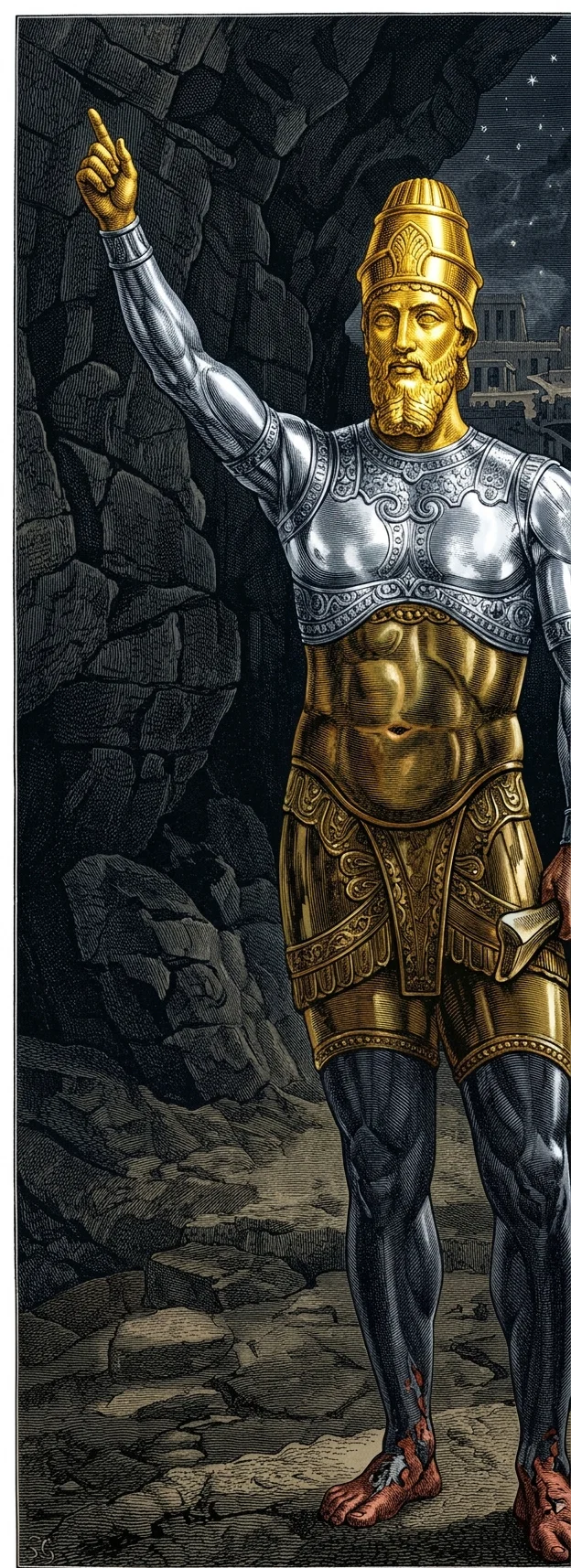
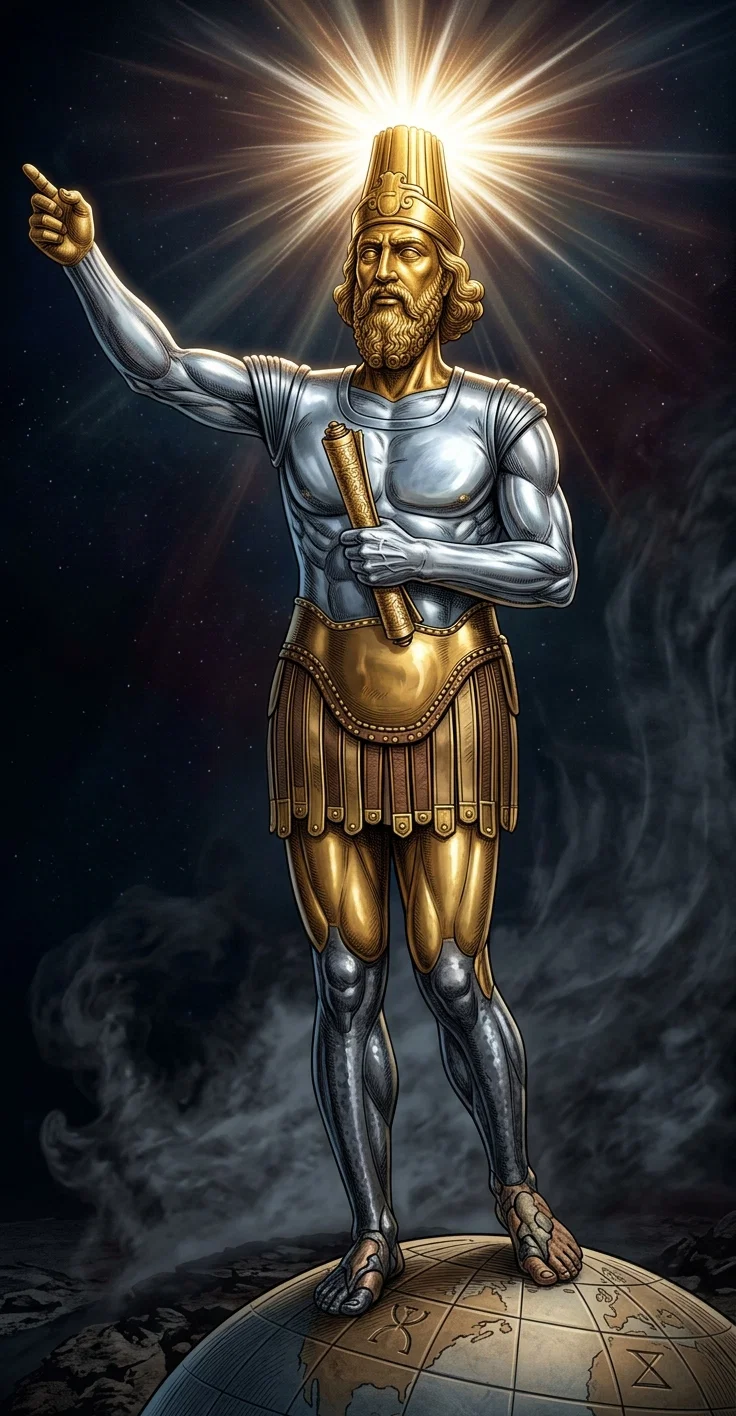
“Thou, O king, sawest, and, behold, a great image. This image, which was mighty, and whose brightness was excellent, stood before thee; and the aspect thereof was terrible. As for this image, its head was of fine gold, its breast and its arms of silver, its belly and its thighs of brass, its legs of iron, its feet part of iron, and part of clay. Thou sawest till that a stone was cut out without hands, which smote the image upon its feet that were of iron and clay, and brake them in pieces. Then was the iron, the clay, the brass, the silver, and the gold, broken in pieces together, and became like the chaff of the summer threshing floors; and the wind carried them away, so that no place was found for them; and the stone that smote the image became a great mountain, and filled the whole earth.”
INTERPRETATION: A SUCCESSION OF KINGDOMS
“This is the dream; and we will tell the interpretation thereof before the king. Thou, O king, art king of kings, unto whom the God of heaven hath given the kingdom, the power, and the strength, and the glory; and wheresoever the children of men dwell, the beasts of the field and the birds of the heavens hath He given into thy hand, and hath made thee to rule over them all: thou art the head of gold. And after thee shall arise another kingdom inferior to thee; and another third kingdom of brass, which shall bear rule over all the earth.”
FOURTH KINGDOM PERMANENTLY BROKEN
“And the fourth kingdom shall be strong as iron, forasmuch as iron breaketh in pieces and subdueth all things; and as iron that crusheth all these, shall it break in pieces and crush. And whereas thou sawest the feet and toes, part of potters' clay, and part of iron, it shall be a divided kingdom; but there shall be in it of the strength of the iron, forasmuch as thou sawest the iron mixed with miry clay. And as the toes of the feet were part of iron, and part of clay, so the kingdom shall be partly strong and partly broken. And whereas thou sawest the iron mixed with miry clay, they shall mingle themselves with the seed of men; but they shall not cleave one to another, even as iron doth not mingle with clay.”
THE ETERNAL KINGDOM SUCCEEDS ALL
“And in the days of those kings shall the God of heaven set up a kingdom which shall never be destroyed, nor shall the sovereignty thereof be left to another people; but it shall break in pieces and consume all these kingdoms, and it shall stand forever. Forasmuch as thou sawest that a stone was cut out of the mountain without hands, and that it brake in pieces the iron, the brass, the clay, the silver, and the gold; the great God hath made known to the king what shall come to pass hereafter; and the dream is certain, and the interpretation thereof sure.” Dan. 2:36-45.
Last week Mr. Vuilleumier gave an introduction to a study of the prophecy of Daniel, chapter two. In order that the reader may have the words of the prophet in mind, the text is reproduced in the center of this page. His article this week shows how kingdom has succeeded kingdom. It speaks also of the divisions of the Roman Empire, and of the unfruitful efforts to reunite the fragments—and all in direct fulfillment of the prophetic Word.
Next week his article will show the superhuman efforts that some great men like Napoleon have made to unite Europe in one vast empire. They have seemed at times on the point of achieving success. But failure following failure has shown the futility of their ambitions, and left the prophecy standing, a monument to divine foreknowledge. Other articles on the prophecies will immediately follow these that are given on the second of Daniel.
EDITOR.
History in hand, we find that the vision has been fulfilled with absolute accuracy from the days of Daniel down to our own.
BABYLONIAN HEAD OF GOLD
The Babylonians, 625-538 B. C., were well symbolized by the head of gold. Their capital—as described by Rollin, Lenormant, and Sayce, following Herodotus, and the cuneiform inscriptions discovered within the last fifty years—was a city of marvelous size and wealth. Its wall, three hundred fifty feet high, eighty-seven feet wide, and sixty miles in circumference, made it impregnable. Its hanging gardens; its palaces, several miles around; its fifty streets, fifteen miles long, crossing one another at right angles; the temple of Bel, containing sacred vessels and statues in gold to the amount of over one hundred million dollars,—all this justified the words of prophecy, “Thou art this head of gold.” The empire of Babylon lasted eighty-seven years.
THE PERSIAN BUST OF SILVER
In 538 B. C., after a long and memorable siege, Babylon was conquered by Cyrus, general-in-chief of the Medo-Persian armies, and the world passed into the hands of the kingdom of silver. The splendor of the Medo-Persian empire, compared with the Babylonian, was to be what silver is to gold. Next to the power of Nebuchadnezzar comes the glory of Darius, Xerxes, and Artaxerxes, the Medo-Persian kings. Next to the glory of the city of Babylon comes that of Shushan and Persepolis, Persian palaces that were marvels of wealth, as may be read in the first chapter of the book of Esther. The royal vestures of Xerxes and his son, according to Plutarch, were worth respectively twelve thousand and ten thousand talents, which represent thirty and twenty-five million dollars. This Persian power lasted two hundred seven years.
THE BRASS OF THE IMAGE AND THE EMPIRE OF GREECE
In 331 B. C. the world again changed masters, and passed under the scepter of a Greek conqueror, Alexander the Great. The brass empire had come. Less ductile and malleable than gold or silver, but with a quick passing brilliancy, this metal fittingly represents the third great monarchy. It was reared in eight years of the swiftest triumphant march ever recorded in history, and at the end of it the founder suddenly disappeared. But it continued 183 years without glory, until 148 B. C., passing through continuous wars between the Seleucidae, or Syrian kings, and the Ptolemies, or Egyptian kings, the two remaining divisions of the empire.
LEGS OF THE IMAGE—THE IRON MONARCHY OF ROME
One century and a half before Christ, still again the world changed masters, and passed under the iron rule of Rome. This symbol indicated that the fourth empire was to outdo the first three in political despotism, brutal force, and devastating instincts. “The fourth kingdom,” says the prophecy, “shall be strong as iron, forasmuch as iron breaketh in pieces and subdueth all things. . . . shall it break in pieces and crush.” Verse 40.
Such was the power established by Marius, Sulla, and Caesar. The terror of the Roman name has become proverbial. Listen to this prayer: “O God, I thank Thee that I was not born a Roman, so as to be still human.” Not only did the Romans conquer and plunder the world, but their heavy, crushing iron yoke rested for six long centuries upon the nations of the world.
THE IRON KINGDOM BROKEN
Then, weakened by corruption bred of wealth and leisure, the empire tottered and fell. Several barbarian nations which had for some time been incorporated into the armies of the empire, conquered it, and have since formed the large and the small powers of Europe.
Here is the list of the ten nations that divided the Western Roman Empire among themselves between the years 400 and 476 A. D.: 1. the Alemanni, who settled in South Germany; 2. the Franks, in northern and central Gaul; 3. the Burgundians, on both sides of the Jura; 4. the Suevi, in Galicia and Portugal; 5. the Vandals, in Andalusia (Vandalicia); 6. the Visigoths, in Spain; 7. the Saxons, in Great Britain; 8. the Ostrogoths, between the Danube, the Po, and the Adriatic; 9. the Lombards, in Lombardy; and 10. the Heruli, in southern and central Italy.
This new phase of universal history is introduced by the prophecy as follows: “And whereas thou sawest the feet and toes, part of potters' clay, and part of iron, it shall be a divided kingdom.” Verse 41. The parts composing this division were to be marked by two characteristics.
“PARTLY STRONG AND PARTLY BROKEN”
First characteristic: “There shall be in it of the strength of the iron, forasmuch as thou sawest the iron mixed with miry clay. And as the toes of the feet were part of iron, and part of clay, so the kingdom shall be partly strong, and partly broken.” Verses 41, 42.
Indeed, the nations that took the place of the Roman Empire have always been divided into two classes, the large and the small powers. Among the large powers must be ranked France under Charlemagne, Francis I, Louis XIV, and Napoleon; Germany under Frederick Barbarossa in the twelfth century, and the Hohenzollern in the nineteenth and the twentieth; Austria under the Hapsburgs; Spain under Charles V; England under the Tudors; Italy since King Victor Emmanuel I. Among the small powers can be mentioned the Swiss cantons, the kingdom of Bavaria, Portugal, Holland, Wurttemberg, Saxony, and Belgium.375
THEY SHALL NEVER BE UNITED AGAIN
Second characteristic: “And whereas thou sawest the iron mixed with miry clay, they shall mingle themselves with the seed of men; but they shall not cleave one to another, even as iron doth not mingle with clay.” Verse 43.
“Thou, O king, sawest, and, behold, a great image.”
It is an undeniable fact that all the political history of the Middle Ages and of modern times is overshadowed by one persistent idea on the part of the leading rulers; that is, the reconstitution of the Roman Empire or of some kind of universal empire.
Charlemagne was crowned “emperor of the Romans” at Rome in the year 800. The German emperors still call their power “the Holy Roman Empire of Germany.” The title of “Roman emperor” was taken by Napoleon from the Austrian court, and he called his son “king of Rome.” The custom of intermarriage among the various reigning families is one leading feature in this policy.
INTERMARRIED AND COMMINGLED
It can be safely said that all the courts of Europe have been for centuries intermarried with each other, and thus “mixed with the seed of men”; but notwithstanding that, they have been hopelessly divided by rivalries, jealousies, and bitter enmities, which, in spite of Christianity and civilization, have resulted in the recent period of exhausting armaments and in the present war, the greatest yet witnessed on the face of the globe.