A Religion That Presents Annihilation as the Only Relief from Misery—Feeding the Priests to Gain the Boon of Extinction—What Christian Men and Women Are Doing to Dispel That Darkness
By ARTHUR G. DANIELS
THAT which impressed me most deeply in Burma was the manifestation of religious sentiment. Here, as in other parts of India, “the people are deeply and absorbingly religious.” This appears in their literature and science, and in all their business and social relationships. They are all religious, and they are religious all the time. As one writer says: “From the womb to the burning ground, mortal man is held to be the plaything of the Divine, and is bound to the legion toils of religious observances. There is not a single event which transpires in the social, domestic, or individual life which is not definitely regarded as the expression of the attitude of the infinite, Brahm, towards the soul.”
PROFESSOR AND MRS. LUDDINGTON IN THE RANGOON GARDENS
One observer described the people as being “God-intoxicated.” In the census reports of 1911 for India, out of 315,000,000, only seventeen persons claimed to be atheists. Fifty called themselves agnostics. Forty-five of these were from Burma, and it is supposed they were Chinese. It is said that “one third of the population of the world worship at the shrines of the faiths begotten” in India.
THE RELIGION OF BURMA
The religion of Burma is Buddhism. Of the 12,000,000 inhabitants given in the census of 1911, 10,000,000 were reported to be Buddhists. Thus it is plain that Buddhism is the one great non-Christian religion with which the Christian missionary has to deal in Burma. It is remarkable in the history of Buddhism that it has no place as a separate, distinct religion in the land of its birth.
A GROUP OF OUR MISSION WORKERS IN BURMA
The founder, Gautama, is supposed to have been born near Benares, the great center of Hinduism, about 600 B.C. It was here that the tenets of Buddhism were first set forth by Gautama, and where he gained his first disciples. The faith spread rapidly, and for nearly a thousand years it was the principal religion of India. But as it spread to other countries—Ceylon, Burma, Tibet, China, and Japan—it ceased to exist in India as a separate, dominant religion. Not more than a third of a million profess to be Buddhists. However, its most important features are said to have been absorbed by Hinduism.
WHAT IS BUDDHISM?
The answer is not easy to give. Volumes have been written explaining it. Perhaps the following statement of its most important tenets will make it as clear as any brief statement that can be made:
“(1) Misery is the inevitable consequence of existence. (2) Misery has its source in desire. (3) Misery can be escaped only by the extinction of desire. (4) Desire can be extinguished only by becoming fully unconscious of the world and self. (5) He who attains to such unconsciousness attains to Neikban. (6) Evil actions constitute demerit. Good actions constitute merit.”
This brief outline practically covers the range of Buddhistic teaching as it is elaborated in their sacred books. From this it will be seen that Buddhism has no God, and no Saviour to redeem man from sin and misery. It holds out no future triumphant life in God for even the most faithful. While it recognizes the existence of sin, and the suffering and misery it entails on the human race, the only way of escape it offers is by the utter extinction of all desire; and the only way to secure this extinction is by the annihilation of one’s own existence. This self extinction is called Neikban, or Nirvana, which means annihilation. Thus it is seen that the one supreme and final end to which every Buddhist looks and for which he longs all through life is total extinction as a living, conscious being.
THE HOPE OF EXTINCTION
No Buddhist expects this extinction to take place402at the close of his present life. His doctrine of reincarnation, or millions of rebirths, places the time of extinction far away in the distant future. And here comes in the doctrine of merit and demerit. The Buddhist is always keeping a merit and demerit or credit and debit account in his life. Every act he performs has either merit or demerit. All the acts of merit performed during life will stand to his credit at death. But from these meritorious deeds must be subtracted the deeds of demerit. Should there be a surplus of meritorious deeds, these will lift him a little higher in the scale of life when this life closes. Should his demerits exceed his merits, his next existence will be in a lower scale than his present life. Thus he must toil and strive through countless ages to rise in the scale of merit until he has earned Nirvana, or nonexistence, when his sufferings and sorrows will be over.
FEEDING THE PRIESTS FOR MERIT
The Buddhist ideas regarding what acts will count for merit, and what for demerit, are shaped almost wholly by the priests, who are the leaders of the people. The list of meritorious deeds seems well calculated to maintain and propagate the faith, care for the priests, and give display and show to the worship.
One of the deeds of merit that counts most is to provide priests with their daily food. In all the towns of Burma, the priests may be seen every morning going through the residence streets with their large food bowls, to receive the food the people wish to give them. The people are looking for them, and have the food ready to drop into their bowls.
This is not regarded by either the priests or the people as begging. It is so good and meritorious on the part of the priests to give the people an opportunity to give them food, and thus lay up merit that the priests never express a word of thanks or appreciation for what is given them. The people are supposed to be grateful to the priests for coming their way through the hot sun or the rain to give them a chance to increase the credit side of life’s ledger.
This doctrine of merit is a tremendous factor in tightening the grip of Buddhism on its followers, and also in giving it prominence, and keeping it alive and aggressive in the world. Believing that acts of merit are the only possible way of escape from countless rebirths and lives of toil, oppression, pain, and misery, they are goaded on to do what they never would were it not for this conviction. But the deeds of merit are not all beneficial and helpful to either the ones who perform them or their fellow men around them.
THE MERIT OF PAGODA BUILDING
One of the greatest deeds that counts on the merit side of a Buddhist’s life is the building of a pagoda. A pagoda is to Buddhists what a church is to Christians, and a temple to Hindus. Wherever you see a pagoda, you are reminded of the great and good Buddha, you are assured of the triumphs of Buddhism in that place, you behold a witness of its onward march.
A man may do a great many deeds of demerit to gain certain selfish ends, and having gained what he wanted, may offset these demerits by building a pagoda. The larger and more costly the pagoda, the greater will be the merit. For this reason, tens of thousands of pagodas are to be seen occupying the most prominent places in cities and country in Burma. Thousands of them are so small and cheap that they are not worth mentioning, but they represent all the builders could do, and counted a little for merit. But some of these pagodas are immense, and represent years of labor and millions of dollars of expense.
The first sight one gets of the city of Rangoon, as his steamer approaches Burma, is a pagoda—the world-famous Shwe Dagon. It is built on a great eminence made for the purpose. Hundreds of thousands of tons of earth were carried in small baskets on the heads of the people to this spot, until a great hill was made. On this was built a pagoda which measures 1,350 feet in circumference at the base, and 328 feet in height.
This immense structure is entirely covered with gold leaf. Its umbrella-shaped pinnacle is ornamented with gold and gems valued at $200,000. This pagoda has been re-gilded many times at fabulous cost. In fact, re-gilding is going on every day.
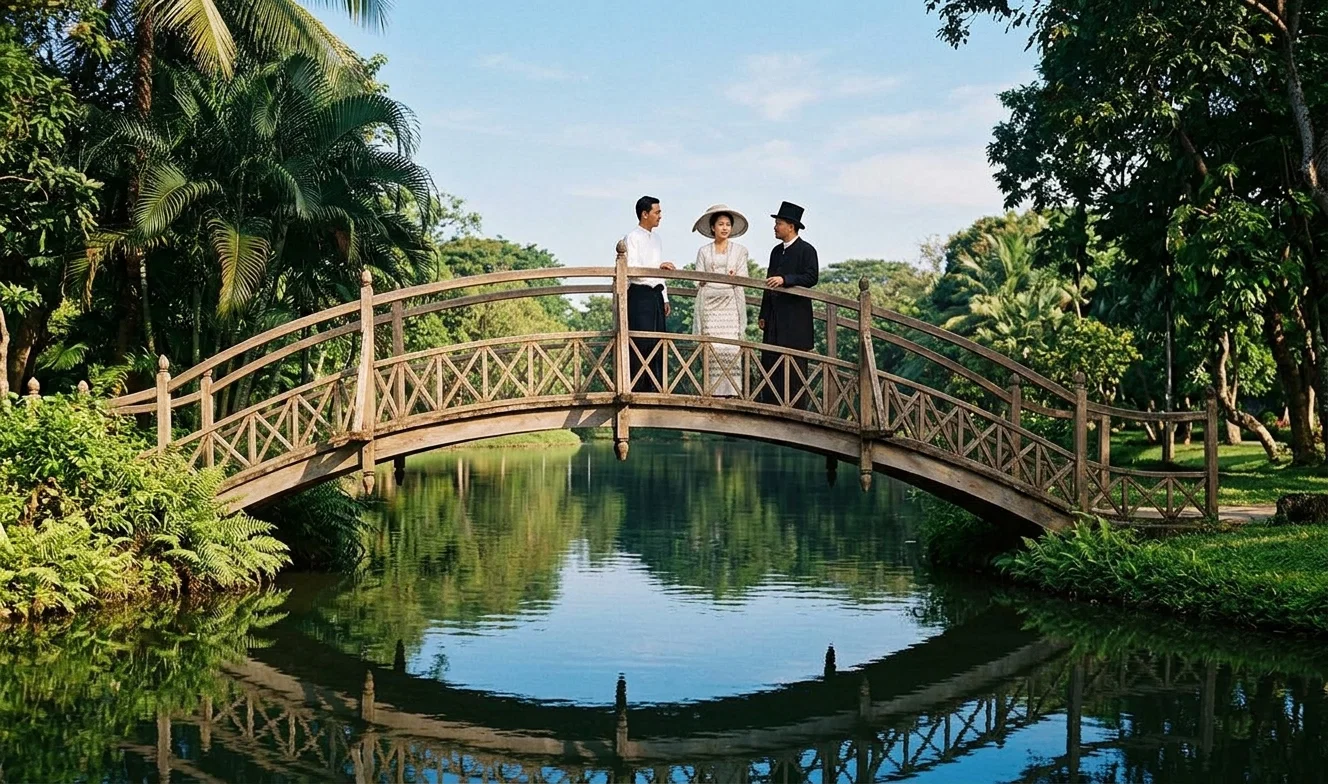
SMALL BRIDGE IN RANGOON PARK
One meritorious feature of the worship at these pagodas is to buy a package of gold leaf, and, after kneeling before the image of Buddha and presenting the package as a grateful gift, to take it to the priest, who will see that the leaves are spread on the pagoda.
In reply to inquiries regarding the sale of this gold leaf, a priest told me that the average daily sale amounted to two hundred packages. Each package contains one hundred small sheets of gold leaf, valued at about $1.30. The sales each day total $260, amounting to $95,000 a year. This gold leaf is spread over the pagoda, and also over the hundred images of Buddha. In addition to this, the candles, flowers, and food offered before the images of Buddha at the pagoda cost the worshipers $100,000 a year.
All this is to gain merit, and thus secure an existence in a higher scale of life in the next reincarnation, and at last to secure self extinction. Of this central tenet in the religion of Buddhism, one writer has said: “The gift of Gautama is eternal death. How different from the central truth of the Christian religion, ‘The gift of God is eternal life.’”
WHAT JUDSON AND WIFE DID FOR BURMA
It was to bring God’s gift of eternal life to the knowledge of these millions of devotees of Buddhism that Adoniram Judson and his saintly wife came to Burma a century ago. There they lived, toiled, suffered, and died for these Buddhists. They sowed the gospel seed in faith, believing that in time it would spring up and bear fruit. They did not labor nor believe in vain. A marvelous change has taken place in Burma since these consecrated missionaries landed there. To-day Burma is enjoying the benefits of modern civilization—steamship, railway, cable, telegraph, and telephone service, the advantages of the printing press, and of educational and medical institutions, and the commercial prosperity derived from the intelligent development of its agricultural, mineral, and other natural resources.
But above all, the people of Burma are blessed with the light and power of the gospel of Christ. The words of the prophet Isaiah have had a wonderful fulfillment: “The people that walked in darkness have seen a great light: they that dwell in the land of the shadow of death, upon them hath the light shined.”
Judson landed in Burma in 1812. Six years later, he baptized his first Burman convert from Buddhism to Christianity. To-day there are 50,000 baptized Christians in the Baptist missions in Burma. The census returns for 1911 report 90,000 Protestant Christians. It is understood that as many more attend religious services under the teaching and preparation necessary for full membership in the church. Of course, statistics of this kind cannot convey the tremendous influence for good these Christian people exert over the lives of their fellow men, but this influence is seen and felt by all who come in contact with the people.
PRESENT EFFORTS IN RANGOON
On the occasion of my recent visit to Burma, I accompanied Prof. H. R. Salisbury, president of our Indian Union Mission. We were glad to find our mission in Rangoon, the capital, in a prosperous condition. This is the headquarters of our work in Burma. In this mission field, we are carrying on four lines of work—evangelical, printing, educational, and medical. The evangelistic features enter into all the branches of work. The literature printed and circulated is all religious, setting forth the blessings of the gospel and the conditions of salvation.
Our hydropathic treatment rooms in Rangoon are in a good location, and are splendidly equipped. The nurses in charge, Brother F. A. Wyman and wife, are doing most efficient work. The institution is patronized by some of the best people in the city. It is our desire and endeavor to make this institution a radiating center of gospel light and truth.
At Meiktila, three hundred miles north of Rangoon, we are conducting an industrial school. I was pleased with our location, the buildings, and the practical work of the school. Besides giving full literary work, several industries are taught, such as carpentry, basket making, wickerwork, and shoemaking. This school is under the leadership of Professor Luddington. The Bible holds a prominent place in the school; and the aim of those in charge is, to lead all the students to accept Christ and devote their lives to His service.
EVANGELISTS IN MEIKTILA
A hundred miles north of Meiktila, in the old city of Mandalay, the last capital of the Burmese kings, we found Brother Robert Beckner and his wife engaged in evangelistic work. It was a great pleasure to meet these earnest missionaries and the converts they have won to Christ. Mandalay is the center of an immense population. From the top of Mandalay hill, Brother Beckner pointed out scores of villages he had visited and in which he had people reading religious literature.
A MISSION FOR THE KARENS
The most interesting feature of our visit to Burma was the locating of a mission station among the Karens. Starting at Maulmain, at the mouth of the great Salwin River, we ascended the river nearly one hundred miles. Here we found a place that seemed eminently suited for a permanent station. Arrangements were made for Pastors Thurber and Hamilton, who had previously investigated this part of the country, to proceed with the purchase of land and the erection of buildings. Our Australasian believers have donated the funds to establish this mission.
(Continued on page 8)3
Buddhism, and the Desire for Extinction
(Continued from page 2)
We found our missionaries in Burma in as good health as could be expected in such a hot corner of the earth. It is a common saying in Burma that it is “hot and hotter.” But although the climate is very trying, our workers are of good courage. It is most inspiring to find young people glad to leave their native land and everything they hold dear in this life, to toil and sweat in mission fields of this kind. They should have the prayers and the hearty, liberal support of the Christian people in the home land.