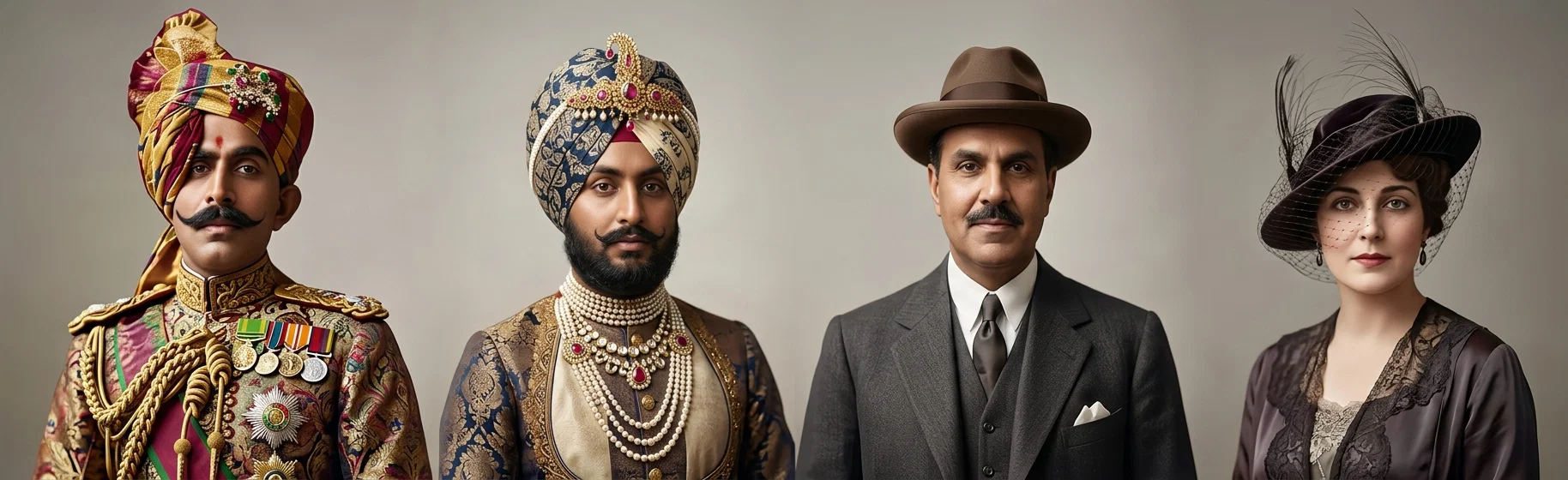
From left to right: the maharaja of Bikaner, the maharaja of Patiala, the maharaja of Kapurthala, with his Spanish wife.
Native States of India, and the War
By George F. Enoch
Forces of Sedition and Revolution Held in Check — The Many States of the Empire — Native Princes Supporting the War — The Ominous Cloud Arising
By GEORGE F. ENOCH
Elder Enoch has spent quite a number of years in India as a missionary. At present, he is on a furlough in the United States. His opportunity to know the truth of what he writes is the best.
EDITOR.
It is remarkable to note the way in which divine Providence has been shaping the affairs of even the remote nations so that the finishing of the gospel work might not be hindered, but hastened. No more interesting problem faces the Christian church to-day than that of how these opened doors are to be entered and the message given without delay.
INDIA AND THE PRESENT WAR
Many are inquiring concerning the attitude of the people of India during the present war. Seditionists driven from India for political reasons during the past few years are causing misleading statements to appear in the papers, representing India on the eve of revolt. On the contrary, word comes from our missionaries who are on the ground out among the people, that they feel as little influence of the great war there as any place in the world. Things were never more settled, and the people never more willing to hear the gospel message.
I do not believe that there will be very serious trouble at this time. Doubtless there will be sporadic outbreaks occasioned by political agitators; but this will mean no more than the political outrages of the past few years, beginning with the attempt on the life of Sir Andrew Fraser in 1907, and including such as the murder of Mrs. and Miss Kennedy in 1908, and Mr. A. M. Jackson, a government official, in 1909, and Mr. Ashe, another official, in 1911, culminating in the throwing of the bomb which wounded the viceroy, Lord Hardinge, in 1912, at the time of his royal entry into the new capital, Delhi. However, these outrages do not represent the feelings of the great masses of the Indian peoples, but are perpetrated by irresponsible youths, stirred to fanaticism by a few irreconcilables who manage to keep in the background.
INFLUENCE OF THE NATIVE STATES
In the present war, one of the great factors in holding India loyal to the British “raj,” and thus prolonging the time of peace during which the gospel message can be proclaimed vigorously, is that of the native states.
British dominion in India did not develop according to any plan, but, like Topsy, it just grew. Traders landed in several strategic places, and gradually their influence extended, until the British East India Company became a great political organization as well as a commercial one. It had friendly relations with some of the native princes of India, and made war upon others, until it had developed quite a territory ruled by military power.
CRASH OF THE MUTINY
Then in 1857 came the great crash of the mutiny, when its house almost fell about it like a pack of cards. But the British army saved the day, and India passed under the British crown in name as well as in form. But the purely British territory crystallized just as the mutiny found it. To all native rulers that had not been actively disloyal was granted suzerainty under the paramount power. No encroachment has been made on the territory of these native states since then. The native princes rule as kings in their own right, and excepting over British subjects, are free from the control of the laws of British India. The paramount power acts for them in all external affairs, but except in the case of gross mismanagement, scrupulously respects their internal authority. They are protected by Britain from encroachment from without, and in turn can have no official connection with external governments.
THE BULWARK OF STRENGTH
Recently the paramount power and the native states have been drawing nearer together, and it is believed that closer relations will develop. It is curious to note that these native states, which were supposed by some at the time of the mutiny to be an element of danger which would eventually drive the British flag from India, are now, on the other hand, the bulwark of the stability of the British “raj.” The native rulers know that if Britain should leave, they would be lost in the ensuing chaos, and they do not desire to trade their present overlord for any other.
THE AREA AND THE NUMEROUS STATES
All India has an area of 1,773,168 square miles. An area of 675,266 square miles of this is ruled by native princes with 70,000,000 subjects. These native states are scattered in all parts of the country and are of all sizes, from the premier state, Haidarabad, as large as Italy, with a population of 13,000,000, ruled by the Nizam, to the small state of Lawa in Rajputana, having but 19 square miles. There are 675 native states, 175 being controlled by the viceroy, from Simla, and 500 by the provincial governments.
LOYALTY OF NATIVE RULERS
Some of these states, with their rulers, have been much in the public eye lately. The maharaja of Patiala, a dashing young man of twenty-four years, is reported to have headed a body of his own troops, and to be now fighting on the battle fields of Europe. The maharaja of Bikaner also has seen foreign service under the British flag, serving in the China war in 1898, also in Somaliland at the head of his own troops. The maharaja of Udaipur, one of the prominent Sikh states, promised the king, at the commencement of this war, that India would recruit, equip, and finance an army of 3,000,000 men if needed. Other states, like Mysore, have given millions of dollars to the war chest.
Some of these rajahs have American and European wives. The maharaja of Kapurbala, a native state in the Punjab, has recently attracted attention in this country by his visit with his Spanish wife to the San439Francisco exposition. It is true that she has three queens ahead of her, all living with her husband; but as she has a palatial residence in that queen of Himalayan summer stations, Mussoorie, with all the money at her command that she wants, being the fourth wife seems to her to be of minor importance.
STABILITY NOW, BUT WHAT OF THE FUTURE?
To-day these native states mean the stability of the British rule; but what of to-morrow? While no immediate danger threatens India through the war in Europe, there is a cloud on the horizon, which seems to the writer to be larger than a man’s hand.
That danger is the deep strategy which aspires to the leadership of the Orient against the Occident.
The last few years, India has been sending her best sons in ever increasing numbers to Japan for education and training. The cry, “Asia for the Asiatics,” is more than a remote possibility. Religiously, racially, politically, the combination of the Orient, including the Mohammedan countries, which contains two thirds of the human family, against the Occident, with less than one fourth, seems the logical outcome.
Those familiar with these conditions plead with every lover of the Lord Jesus to press into the Orient now with the gospel message, while peace lingers. Soon it will be too late.