G. W. BARRON, president of the company that publishes the Wall Street Journal, recently spent considerable time in Europe studying financial conditions there at first hand. He recently made an address before the Canadian Club of Montreal. Some of his most striking utterances were:
“Russia has the greatest unturned soil in the world. She has more wheat lands stretching out to the Pacific across Asia than we have on this entire continent. Formerly you would look upon Russia as the rival of the British Empire. For long we have heard of the Dardanelles being controlled against Russia; of her strife toward India, etc. But what are we hearing to-day? We are hearing about the Canadian boy and the Russian boy fighting a common enemy; about France and England battering open the Dardanelles to let Russia out. . . .
“What was my astonishment to find in London everybody saying Russia could have all of Constantinople that she wanted, and her fleets would go through the Dardanelles. Russia will not only get from this war the benefit of the Dardanelles, but she will get the benefit of an internationalization of the Kiel Canal. She will have two outlets to the ocean. And the whole British Empire rejoices over this prospect as much as Russia. . . .
“The question of England’s right to develop Egypt is already settled. Mesopotamia you have heard of. Her oil fields have been subject to controversy with the Turks for years. The Bagdad Railway you have also heard of. The Germans are in control of it now, and you know who will own it after the war.
“But you have not heard so much about the Mesopotamia irrigation scheme. Now the valleys of the Euphrates and the Tigris, when irrigated not only by water but by 35,000,000 pounds of British capital, will be like the Imperial Valley of California, where you can raise four crops a year. . . .
“From the whole empire, from India, Africa, Canada, and the islands of the sea, is rising a larger soul life. You will see in the future that while the war may be long and bloody and costly, it will be worth in the end all that it costs and far more. . . . So I say, Do not be alarmed over a long war, a costly war. It will be worth all it cost.”
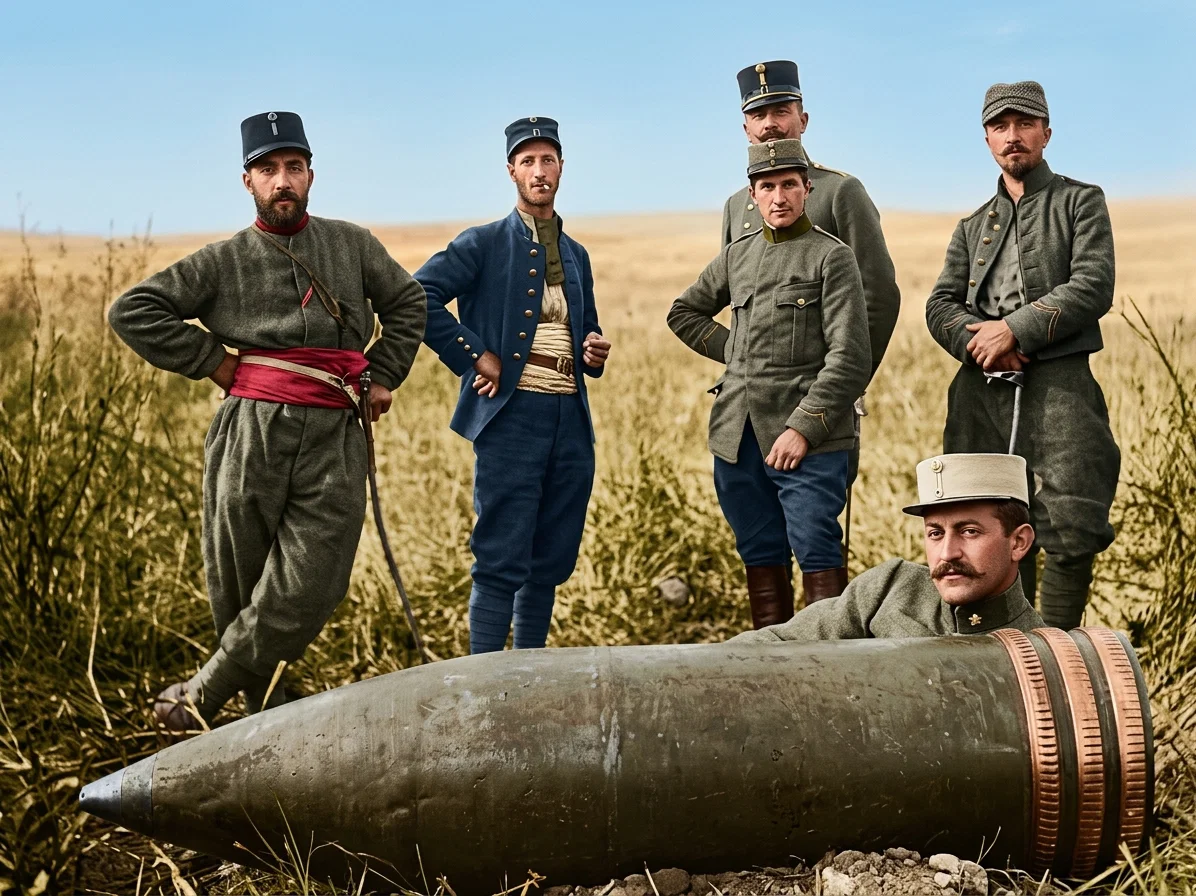
AUSTRIAN 380-MILLIMETER SHELL
History is in the making in the struggle around the Dardanelles. And we see, by the utterances of this well informed financial writer and publisher, that the eyes of those nations are not only on the Dardanelles, but on the great territory of the Euphrates. The struggle over the Euphrates Valley and the Dardanelles territory will also involve the Holy Land, which lies quite well between them. And here is where the prophets place some of the mightiest conflicts of the closing days of this world. Whatever may be the outcome of the present war, without any question it will have a bearing on the conditions that will produce the terrific conflict at Armageddon in the neighborhood of Jerusalem.
In passing, would it not be proper to observe that our civilization has not yet reached such lofty ideals as we would fondly have ourselves believe? When we can place in the scales on one side the millions of men that are killed, and the millions of women and children that are left destitute and in the throes of indescribable anguish, and on the other the advantages of irrigation schemes, commercial projects, and shipping facilities, and say that this war will be worth all it costs, our ideals are not so much above those of the medieval Huns and Vandals after all.