The Medo-Persian Ram—The Prophet Sees Him Overthrown by the Grecian Goat—The Little Horn That Symbolized Rome
By JEAN VUILLEUMIER
In previous issues, Elder Vuilleumier has presented studies on both the second and the seventh chapter of Daniel. This is the first of several articles from him on the eighth and ninth chapters of that most wonderful and interesting prophetic book. Editor.
In the year when great Babylon fell into the hands of Medo-Persia, (538 B. C.), which was the third of Belshazzar, the last successor of Nebuchadnezzar, Daniel, then eighty-six years of age, shut within the doomed city, had another vision. For the third time, the prophet was called upon to behold at one glance the whole succession of worldly empires down to the time when the last of them is “broken without hand,” to make room for the everlasting kingdom of God on earth.
These visions, covering the same ground and confirming each other, are not mere repetitions, as we shall see. New aspects of history, new and startling elements in the age-lasting battle between truth and error, spring up before us in each successive revelation.
THE MEDO-PERSIAN RAM
In this vision, Daniel saw himself in Shushan, a royal residence “by the river Ulai.” “Then I lifted up mine eyes,” he writes, “and saw, and, behold, there stood before the river a ram which had two horns: and the two horns were high; but one was higher than the other, and the higher came up last.” Dan. 8:1-3.
The angel Gabriel himself made him understand the vision, and gave him the explanation, as follows: “The ram which thou sawest, that had the two horns, they are the kings of Media and Persia.” Verse 20.
The kingdom of Babylon, then on the verge of disappearing, was not included in the vision; but the second world empire was brought in, and—a novel thing in these prophecies—mentioned by its historic name. Thus Daniel and all the believing Jews in the besieged city knew that, in spite of all the boasting and scorn of the Babylonians, their apparently impregnable city would soon fall into the hands of the besiegers.
The vision exactly describes the new masters of the world—a twofold power, the Medes and the Persians—and refers to the fact that the Persians, who were the weakest of the two to begin with, finally had the upper hand in the monarchy, when Cyrus the Persian succeeded Cyaxares, or Darius the Mede. This will appear farther on.
“I saw the ram pushing westward, and northward, and southward; and no beasts could stand before him, neither was there any that could deliver out of his hand; but he did according to his will, and magnified himself.” Verse 4.
In the west, Cyrus defeated Croesus, the wealthy king of Lydia, then Babylon; while Darius I subdued Thrace and Macedon. In the north, Cyrus made war on the Massagetae, north of the Jaxartes River; while Cambyses, Cyrus’ son, went south to conquer Egypt and Ethiopia. “The triumph of Cyrus,” says Maspero, “marked a decisive era in history. All the kings of the east, the great ones as well as the smaller ones, understood that they were now at his discretion.”
THE GRECIAN HE-GOAT
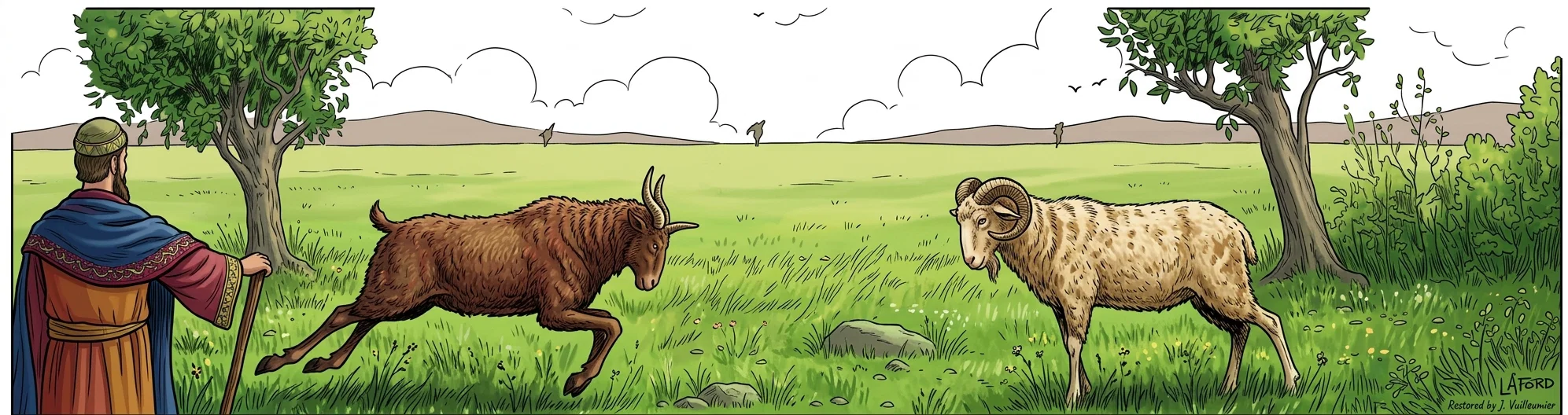
“And as I was considering, behold, a he-goat came from the west over the face of the whole earth, and touched not the ground: and the goat had a notable horn between his eyes. And he came to the ram that had the two horns, which I saw standing before the river, and ran upon him in the fury of his power. And I saw him come close unto the ram, and he was moved with anger against him, and smote the ram, and brake his two horns; and there was no power in the ram to stand before him; but he cast him down to the ground, and trampled upon him; and there was none that could deliver the ram out of his hand.” “And the rough he-goat is the king of Greece: and the great horn that is between his eyes is the first king.” Verses 5-7, 21.
No more accurate, concise, and graphic description could be made than is found in this symbolic picture of the marvelous career of Alexander the Great. Placed, in 336 B. C., at the age of twenty, on the throne of the Greeks and the Macedonians, he started out at the head of only 35,000 soldiers, to conquer the Persian monarchy. Near the Granicus River, in Asia Minor, he obtained a first victory by defeating a Persian army 140,000 strong. After crossing Phrygia and Cilicia, and subduing the country, he met the Persian king, Darius Codoman, in the narrow gorge of Issus, and inflicted a signal defeat to his 600,000 men. Syria, Damascus, and rich treasures were the reward of this victory. Aradus, Byblus, and Sidon opened their gates to Alexander, while Tyre the proud refused to recognize him. The siege was begun under the greatest difficulties; and after seven months, the city was taken and burned.
From here, Alexander turned his face toward Jerusalem, resolved to treat this city with the utmost severity for having refused him any assistance during the siege of Tyre. But the high priest, being warned of God in a dream, went out to meet him in his sacerdotal robes, and with him the whole multitude clad in white garments. As Alexander saw the high priest, he recognized in him a personage whom he had seen in a dream at Dios in Macedon, who invited him to make the conquest of the world. To the astonishment of all, Alexander fell at his feet, and then entered into the city and went to the temple.
Here he offered a sacrifice to the true God, and heard the reading of the very prophecy which we are now studying, and which told him that a Greek would overthrow the Persian empire. Gratified and overjoyed with this prospect, says Josephus, who has recorded these incidents, Alexander granted the Jews all the favors they asked of him, among them the right and liberty to follow their own worship undisturbed.
King Darius now offered his powerful antagonist the possession of Asia to the Euphrates in exchange for his wife and children, who had fallen into his hands at Issus. Alexander refused. At Gaza he was detained two months. Then he entered Egypt, where he was hailed as a liberator. From here he returned to Damascus, crossed the Euphrates and the Tigris, and finally met the last Persian army in the plains of Arbela, not far from ancient Nineveh. It numbered 1,000,000 soldiers. With his 100,000 men, Alexander won a third victory over the Persians, a victory which made him the master of the world. Babylon, Shushan, and Persepolis opened to him their gates and their treasures.
Relentless, he followed Darius in the north of Media, went up into the territory of the Scythians, north of the Oxus and the Jaxartes, and then down into India. His exhausted army refused to follow him any further. He came back into Persia through the deserts of Gedrosia and Karmania, where he lost a good share of his troops. After escaping many dangers and undergoing extraordinary hardships, he returned triumphantly to the Persian capitals.
FIVE THOUSAND MILES OF CONQUEST
According to Rollin, in eight years his army had covered 1,700 leagues, or over five thousand miles, not counting his return from India to Babylon. How true the words written by Daniel that “none could deliver the ram,” the king of Media and Persia, “out of his hand,” and that “the he-goat magnified himself exceedingly”! Verses 7, 8.
At the gates of Babylon, Alexander hesitated, his mind clouded with dark forebodings. Did he perchance remember that in this same city, 195 years before, Daniel had written this sad warning: “And when he was strong, the great horn,” the first king, “was broken?” In this magnificent city, which he planned to make his capital, ambassadors from the remotest nations were waiting to present him their homages. Rest and frugality could have saved his constitution, shattered by too great exertions. But, surrounded by vile flatterers, who called him a god, he yielded to sensual excesses, and at the zenith of his power and glory, just as foretold, he suddenly died a victim to intemperance, at the age of thirty-two years and eight months, after having reigned a little over twelve years.
“And when he was strong, the great horn was broken; and instead of it there came up four notable horns toward the four winds of heaven.” “And as for that which was broken, in the place whereof four stood up, four kingdoms shall stand up out of the nation, but not with his power.” Verses 8, 22.
On his dying bed, Alexander said of his thirty-four generals, “I foresee that they will give me bloody funerals.” He spoke the truth.456For twenty years, in their mad rivalry, they turned the empire into a field of carnage. Eleven years after Alexander’s death, no heir was left him. His wife, his two sons, his brother, and his mother had all perished of violent deaths. In 301, after a great battle fought at Ipsus, in Phrygia, in which Antigonus was defeated, Alexander’s vast dominions were divided into exactly four kingdoms, just as stated in the prophecy. Ptolemy had Egypt; Seleucus had Syria and all the east to the Indus River; Lysimachus had Thrace and Asia Minor; Cassander had Macedon and Greece.
These four kingdoms were soon reduced to two, Syria and Egypt, which were called the kingdoms of the Seleucidae and of the Ptolemies. The prophecy goes on to describe the moral decline of these kingdoms, which lasted only about one hundred years: “And in the latter time of their kingdom, when the transgressors are come to the full.” Verse 23. The history of Egypt under the last Ptolemies and the last Seleucidae is one of moral corruption, infamous cruelty, horrible debauchery, cowardice, and imbecility. Then for their own good, and for the good of the world, these two remaining twigs were absorbed by a growing power soon to come upon the stage of action.
THE ROMAN HORN IN ITS PAGAN PHASE
“A king of fierce countenance, and understanding dark sentences, shall stand up.” Verse 23. This description is almost word for word the repetition of the one made a thousand years earlier by Moses when predicting the destruction of the Jewish nation by the Romans: “Jehovah will bring a nation against thee from far, . . . whose tongue thou shalt not understand; a nation of fierce countenance, that shall not regard the person of the old, nor show favor to the young.” Deut. 28: 49, 50.
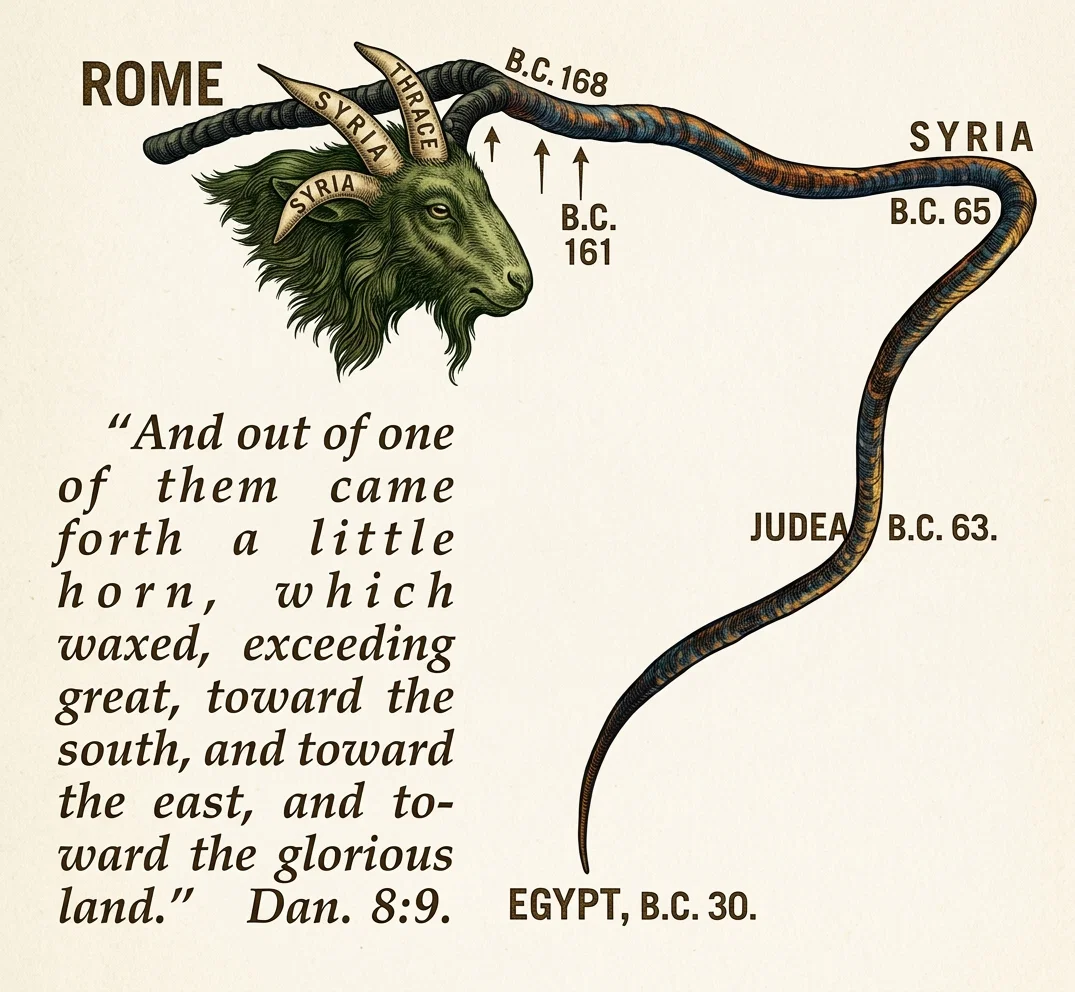
“Out of one of them came forth a little horn, which waxed exceeding great, toward the south, and toward the east, and toward the glorious land.” Dan. 8: 9. In 168 B. C., the Romans began the conquest of the Old World by conquering Macedon. Hence the Roman “horn” seems to the prophet to emerge from one of the four Grecian kingdoms. The Persian power is said by the prophecy to have “magnified itself”; the Grecian empire is said to have “magnified himself exceedingly”; and the Roman horn is now said to have “waxed exceeding great”—a gradual progression, which, with the whole description, shows this new “horn” to be a new world empire.
EXACTLY FULFILLED THE PROPHECY
The Romans exactly fulfilled the prophecy by extending their power to the south over Carthage 146 B. C. and Egypt 31 B. C.; in the east, by the conquest of Greece, Asia Minor, Syria, and Phoenicia, 65 B. C.; and over the glorious land, by the conquest of Judea 63 B. C.,—the land over which God’s protection had so long and signally rested.
“And it waxed great, even to the host of heaven; and some of the host and of the stars it cast down to the ground, and trampled upon them.” “And his power shall be mighty, but not by his own power; and he shall destroy wonderfully, and shall prosper and do his pleasure; and he shall destroy the mighty ones and the holy people. And through his policy he shall cause craft to prosper in his hand.” Verses 10, 24, 25.
NEVER IN GOOD FAITH
Craft, devastation, and persecution are here brought to view as leading characteristics of the Roman power. “The policy of the senate,” says Montesquieu, “was worth more to them than their armies even. . . . Their constant maxim was to divide. . . . They never concluded peace in good faith.” The wonderful destruction carried on by the Romans for six centuries is shown in the fact that in the nine years that Caesar spent in conquering Gaul, he took 800 cities, subdued 300 tribes, and defeated in battle 3,000,000 men, of whom 1,000,000 perished, and 1,000,000 were reduced to slavery.
When Titus came back from Jerusalem, he inaugurated the Colosseum in Rome by public fights which lasted 100 days, and in which 5,000 wild beasts and 2,000 gladiators were sacrificed. Rich Romans owned as many as 20,000 slaves, over whom they exerted the power of life and death. “Just think,” says the Belgian historian Laurent, “of the infinite number of men killed or sold as slaves in a permanent war which lasted 800 years!”
THE HOST OF HEAVEN
Verse 24 explains “the host of heaven” and “the host” and “stars” of verse 10, by calling them “the mighty ones” and “the holy people,” or “people of the saints,” margin. The nominal people of God were not altogether protected from the power of Rome. When Jerusalem was taken by Pompey, 63 B. C., 12,000 persons were slaughtered. In 70 A. D., under Titus, 1,100,000 perished. But the prophecy seems to refer more particularly to the true people of God, of whom 3,000,000 were tortured and killed by order of the Roman emperors during the second and third centuries of the Christian era. Some were burned, beheaded, strangled, racked. Others were burned above a slow fire, with the head downward. Some were roasted on iron grates, or dipped into boiling oil, or drowned in rivers. Still others had the whole body carded with iron combs. Many were devoured by wild beasts, to amuse the multitudes.