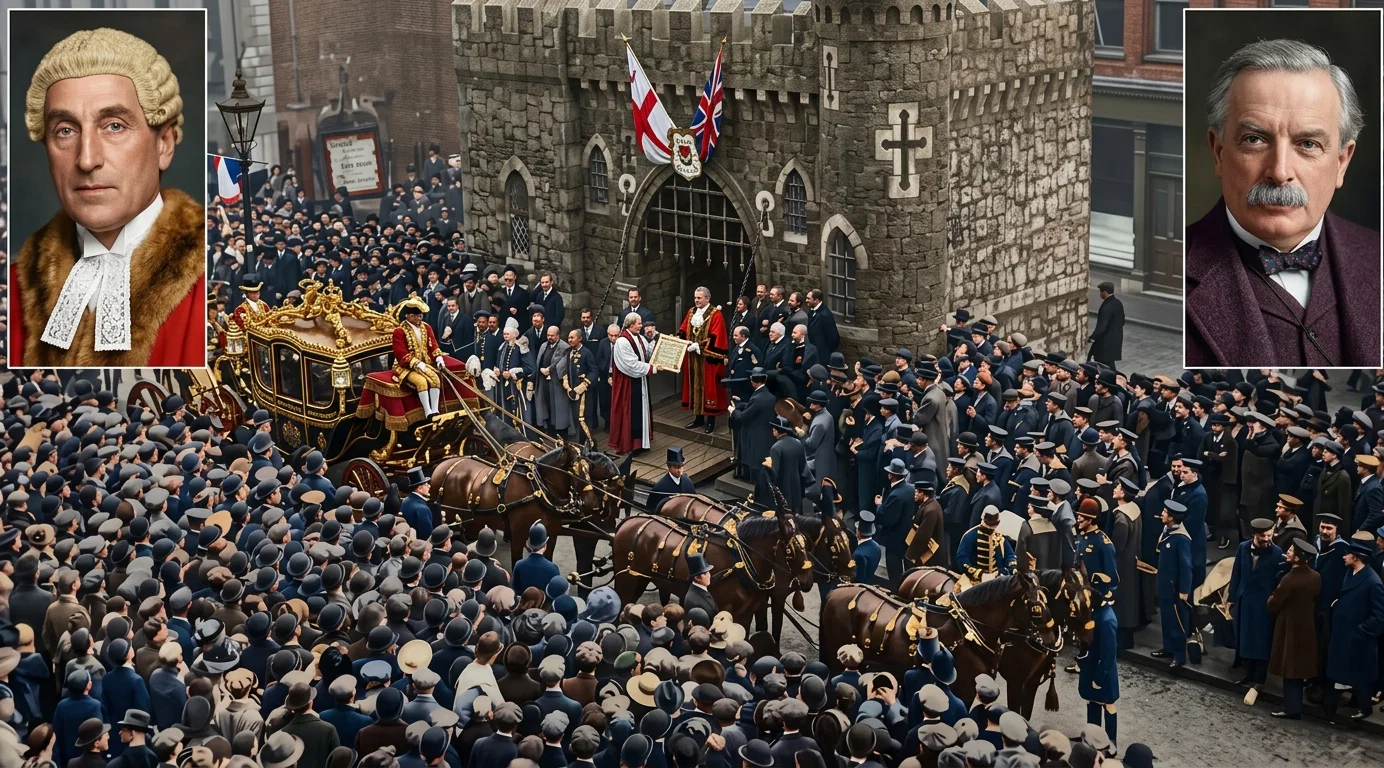
The Government as Landlord—Socialistic Ideas Gaining Rapidly—Spirit of Unrest and Rebellion—Peace Outlook in Europe
By W. T. BARTLETT
SCENE IN THE LORD MAYOR'S SHOW, LONDON, NOVEMBER 10
THIS is the regular summing up, or quarterly letter, by our London correspondent, Mr. W. T. Bartlett, editor of Present Truth.
Mr. Bartlett is in a position to take an intelligent view of conditions in England, and to study them in their relation to the larger affairs of Europe in general. His article forcibly reminds one of the experiments in paternalism that were tried in Rome during her decline and fall. Paternalism in Rome served to increase the discontent and turbulence; it appears to be working in the same manner in England to-day. History is ever repeating itself, yet few seem to be willing to learn the lesson. EDITOR.
If, as its opponents allege, the Liberal government has introduced its land reform proposals at this point with the idea of turning minds away from the Irish Home Rule imbroglio in Ulster, its tactics are certainly proving a success. Mr. Lloyd-George again fills the public eye, and easily holds the public ear. His program has been submitted in instalments in a series of striking speeches. His appeal is addressed to almost every class, in both the rural districts and the cities.
Extensive Government Landlordism
To the agricultural laborer he holds out the hope of a minimum wage, and a cottage to be rented from the state, with enough land around it to grow his own vegetables. Hitherto the laborer has almost invariably rented a cottage from his employer; when he lost his job, he had to vacate his cottage to make room for his successor. Now, if the laborer becomes unacceptable to his master, he will still be able to stay in his home and grow a part, at least, of the food he eats. He is also, if he so desires, to be supplied with a few acres of land for a small holding; and if he shows himself able to make a success of farming on a small scale, he may call upon the authorities to find for him a larger piece of land.786The government proposes to build some 120,000 suitable houses throughout the country, to be let to small holders and laborers at an economic rent.
Farmers' Right of Appeal, and Higher Wages
The land reform scheme aims to make it possible for the farmer to pay his laborers an increased wage by giving him the right to appeal, if necessary, against the rent he himself pays. He may make his appeal to a land court; and he is also to have the advantage of a more secure tenure of his farm. So long as he cultivates the land properly, he is not to be turned out of his farm against his will, merely because the landlord desires to make a change. The farmer will have the right of appeal against his landlord's dictates to government commissioners who will investigate every case of alleged injustice that is reported to them, and will have power to cancel an unjustifiable notice to quit. If the landlord still insists that his farmer tenant shall leave, the farmer must be paid a fair compensation for disturbance. The tenant is also to be permitted to kill any game that may trespass on his land and injure his crops.
In view of this plan for securing their interests, the farmers are expressing willingness to pay their laborers a higher wage. At the present time there are thousands of farm laborers who receive from three to four dollars a week. The minimum rate will probably be not lower than five dollars.
Landlords May Sell to the Government
The farmer's landlord in his turn is offered some relief. If he is unable to get his land farmed at a rent that will remunerate him for his investment in it, the government is prepared to make him a reasonable offer for his freehold, and to work the land itself, either as agricultural or as forest land.
This latter portion of the scheme has been taken up promptly by several large landowners. The Duke of Sutherland, who owns a considerable part of the north of Scotland and has turned it into deer forests, has offered the government 400,000 acres of land at five and a half to six dollars an acre. The chancellor of the exchequer will not, however, wish to test his scheme on land that the great owners are anxious to sell cheap.
Extended to Tenants in Towns
The benefits of this reform are to be extended also to tenants in towns. It has been a frequent complaint among city tradesmen, that, when they have built up a successful business and desire to enlarge their premises, the landlord charges a very much higher rent for the larger building he permits them to erect. Whenever a lease falls in on property like this, the landlord, before he will renew the lease, demands an exorbitant rent, with other burdensome conditions, and the tenant feels obliged to comply because he would lose his good-will if he went elsewhere.
In future, under reasonable conditions, business premises are to be held more securely by the tenant, or he is to be paid a fair compensation for disturbance. If the tenant makes permanent improvements to the property which increase its rental value, he is to receive compensation for these. If existing leases contain restrictive covenants of an arbitrary and unreasonable character, the tenant is to be granted some relief from these covenants.
There is rejoicing over these promised reforms among many shopkeepers in London and other large cities. These have often complained bitterly about the unreasonable and covetous spirit manifested by ground landlords when their tenants prosper and desire to extend their business premises or to renew leases. One large business house in a fashionable center of London felt itself so aggrieved by the action of a certain noble landlord, that for years it kept posted up on a prominent part of the building a protest against his injustice.
The Farmer and Transportation
One of the principal obstacles in the way of making farming remunerative in England is the high cost of transportation where railway facilities exist. On account of this, it sometimes does not pay the grower to send his vegetables and fruit to market when the price is low. Multitudes would be glad to buy the produce at a fair price, but the cost of getting it to them would leave the farmer with less than nothing for his share.
The railways ought to pay well in this country, but they are heavily handicapped. When first made, they were obliged to pay such a heavy price for the land they bought that much of their large income goes in paying interest on the investment. They have lately received permission to increase their freight rates on account of the higher wages paid to employees.
Some of those associated with railway management are beginning to feel ready to sell out the railways to the government, and to let it face the problems involved in trying to satisfy the workmen who want shorter hours with bigger wages, and the customers who want better service at lower rates. An important royal commission has just been appointed “to inquire into the relationship between the railway companies of Great Britain and the state . . . and to report what changes if any are desirable in that relationship.”
Socialistic Ideals to the Front
Socialistic ideals are being realized rapidly. The government is not only attending to the education of our children and feeding them in the schools if we are unable to do so, but it has provided us with old-age pensions in case we omit to lay up anything for our declining years. It has provided medical attendance for us if our income does not exceed fifteen dollars a week, and is also insuring some of us against unemployment. Soon it may be running the railways and relieving landlords of the difficulties of managing their property. When the process is finished, there will not be much need for individual effort.
Paternalism Does Not Cure
With all the increasing paternalism of the state, however, we are still far from a reign of contentment. For months a serious strike of transport workers has been going on in Dublin, and at the present time the trade of that port has almost entirely ceased. There is a possibility that the trouble may continue until Christmas. The suffering among the poor is acute, but the lower classes of Dublin are not accustomed to luxury, and a little additional hardship does not frighten them. Over twenty thousand families live in single rooms below the poverty line. Their distress has been alleviated in part by the contributions of British trade-unions which have been sending food ships to Dublin, laden with provisions for the strikers and their families.
The leader of the Dublin strikers, Mr. J. Larkin, was arrested and tried for inciting to violence and sedition. He was found guilty of using seditious language and sent to prison for seven months, but the government has set him free after seventeen days in prison. During the short period of his incarceration the government lost heavily in popularity, as shown in two by-elections: the working classes bitterly contrasted the leniency shown to Sir Edward Carson in Ulster, and the severity with which Mr. Larkin was punished in Dublin.
Unrest and Rebellion
The forces of labor are seething with a spirit of unrest and rebellion. Some sections are crying out continually for a big general strike, but others are saying that this is a suicidal policy, that the wiser plan is to avoid sympathetic strikes which only play into the hands of the masters. Let the friends of the strikers, say they, stay in their employment and send their money to help their comrades who are engaged in conflict.
Society in England is certainly in a state of upheaval. In the labor world the spirit of war is ever coming to the front.
Europe in General
Turning to the larger sphere of European affairs, we do not know whether we may hope for peace or not. One week Mr. Winston Churchill holds out the olive-branch to Germany and declares that we long unutterably for some cessation in the armament race; the next he declares that England must aim at supremacy on the sea and under it and in the sky, and foretells a large addition to our naval budget. Some of his Liberal supporters are getting tired of this abandonment to militarism. They can plainly see that, no matter how much the Liberal government may talk of great land reforms, if the national revenue continues to be squandered on battle-ships, there will be an entirely inadequate sum left for the promotion of social reforms.
Universal Danger — Doctor Mott's Warning
This same spirit of unrest seems to be active elsewhere. Dr. J. Mott has come here, after twenty-one conferences in India, China, and Japan, to tell us that there was never a time in human history when the demand upon the church of Christ was so wide and appealing, and when at the same time the situation was so full of imminent danger. He asserts emphatically that in the gospel is the one power that can make of this world a safe place to live in. “The rising tide of racial and national life,” he says, “is creating new positions of tremendous portent, and the corruptions of Western civilization are eating like a gangrene into the life of the East.”
So long as the four winds of strife are held, the world continues to be a safe place, and even presents some pleasing prospects of future good; but if the turbulent forces should once break loose, there are elements of mischief in international relations and in social life, plentiful and powerful enough to turn this civilized world into a raging inferno.