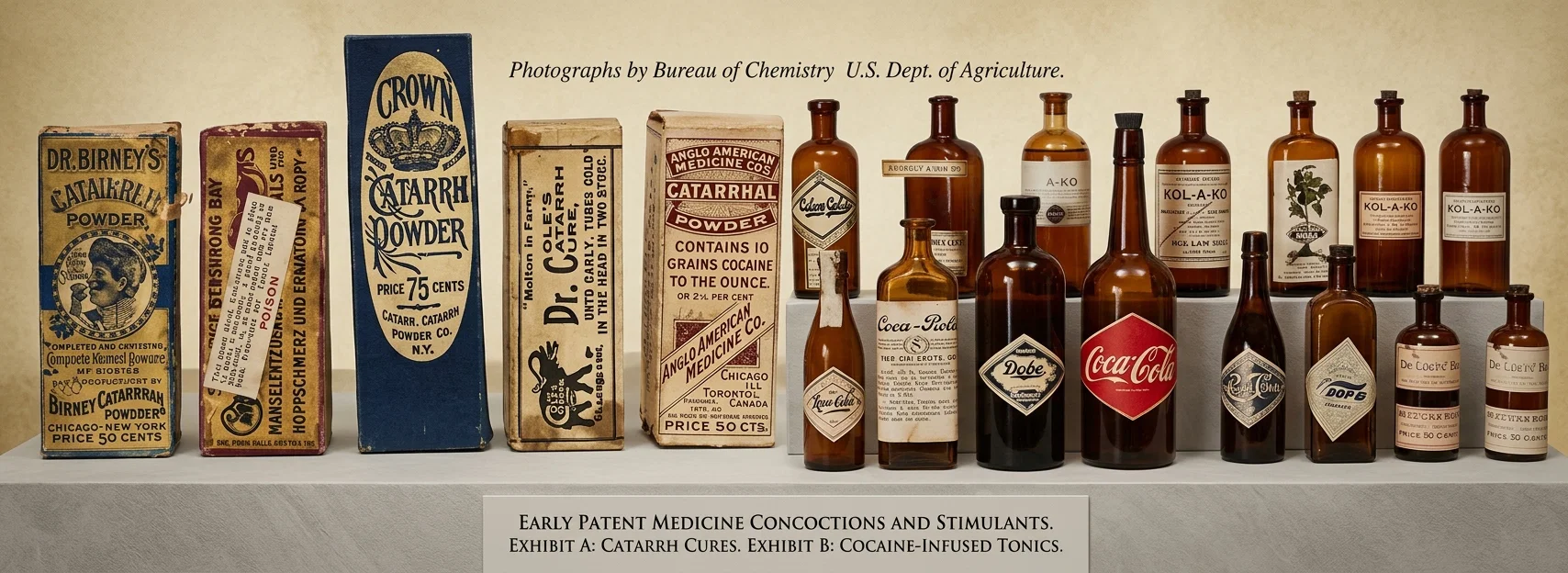
CATARRH CURES WHICH CONTAIN COCAIN — SOME ALLURING FORMS OF STIMULANTS
Persistent Use of Narcotics and Stimulants
By D. H. Kress
Why Are They So Freely Employed in All Lands?—Why Do Not Legislative Efforts of Reform Succeed Better?
By D. H. KRESS, M.D.
DOCTOR KRESS, in furnishing this article, has presented matter that will provoke interesting reflections. The doctor has the benefits of a wide practise, and his work in Chicago is attracting much favorable attention. He has been a careful student for years of the relation of diet to reform and health, and has lectured and written extensively upon the subject. EDITOR.
Alcohol has for centuries been employed in civilized communities as a medicine and beverage.
It has always been considered harmful when used in large amounts, or to the point of drunkenness. In moderate doses it was once regarded as beneficial. One hundred years ago the whisky or brandy bottle was supposed to be in every well-regulated home. It was the great emergency remedy. Ministers relied upon it to protect them from disease while conducting funeral services. Doctors depended upon it as one of the most valuable remedies in the treatment of disease. It found its way into almost every nostrum and patent medicine, the effect of these remedies being chiefly due to its presence.
Within the past few years, science has fully demonstrated that alcohol, even in minute doses, as found in wine or beer, is a mocker. It is no longer regarded as a heart stimulant or a valuable nutrient. It is now known to be a heart depressant and a narcotic drug and poison.
The past few years, desperate efforts have been made by various organizations to suppress the sale of alcohol as a beverage, with splendid results. Much of the territory in the United States has gone dry. Prohibition has made wonderful strides. Of course, prohibition does not entirely prohibit, but it must be admitted that it has minimized or at least lessened the use of alcoholic beverages in the dry communities.
More Alcohol Consumed, Nevertheless
The amount of alcohol consumed upon the whole, has in the mean time been steadily increasing. There is at present more consumed per capita than ten years ago.
Have the efforts of reformers been in vain?—By no means. They have certainly held in check this mammoth evil. Had no efforts been made to enlighten the people and to suppress its sale, America would be hopelessly degenerate by this time.
I do not anticipate that there will ever be complete and satisfactory prohibition; but should prohibition be a complete success, past history shows that some substitute would take its place, a substitute possibly more harmful than alcohol.
Cocain Substituted for Alcohol
In the South, owing to the demoralizing influence of alcohol upon the ignorant blacks and the feeling of insecurity among white women in consequence thereof, saloons have been closed up as a means of self-protection on the part of the whites. But no sooner had this been accomplished, than it was discovered that cocain, one of the most subtle and degrading drugs, had taken its place.
The Cigarette Follows Opium and Alcohol in China
Photo by Paul Thompson.
The use of alcohol was common in China in very remote times. Severe measures were employed to enforce sobriety. Vineyards were cut down by order of the government, but as drink became unpopular because of public prejudice, opium was stealthily introduced. Opium was considered a great benediction at first. Being a narcotic, it temporarily allayed pain and nervous symptoms.
China for centuries has been cursed with the opium habit. Efforts have been made in the past to regulate its sale, without much success. In recent years, in desperation and to save herself from total and irredeemable depravity and degeneracy, she sacrificed her revenue of thirty million dollars annually, and made the use of opium a criminal offense. She is succeeding beyond all expectation in freeing her people from this bondage; but lo, another evil in the form of the cigarette is taking the place of opium.
Various Narcotics in Different Countries
The history of the South and of China in this respect is merely a repetition of the history of the countries of the past in their efforts to free themselves from certain evils. They did so only to have another grafted on. The Turks, when forbidden the use of wine by the Koran, shortly began the use of “hashish,” a drug extracted from Indian hemp.
When in England the smoking of tobacco became almost universal during the Elizabethan age, so that women as well as men smoked, and even children had their pipes filled by parents before going to school, as a means of protection from disease, efforts were made to check its use.
Educational efforts were followed by legislative efforts. The time came when smoking was actually done away with to such an extent that even at the beginning of the reign of Queen Victoria it was almost impossible to find a man on the streets of London smoking the pipe. But as public prejudice was awakened against smoking, the use of snuff gradually and insidiously gained favor with those formerly addicted to smoking.
In time the use of snuff became general in England. Great pride was manifested by the ladies in the exhibition of their beautiful and artistically designed golden snuff-boxes and the scented snuff they made use of. Some had a special snuff-box for each month in the year.
The use of snuff became more common in England than even smoking had been before. Again a wave of reform swept over the country, and snuff-taking had had its day. But as the taking of snuff went out the back door of old England, the cigarette—through the example797of the soldiers who had returned from the Crimean War—came in the front door. Again tobacco smoking, and now in the form of cigarettes, became general in England.
In the United States, in spite of the effort to suppress the use of the cigarette by boys, from thirty-five per cent to fifty per cent of the boys over eleven years of age attending the public schools in the large cities smoke. While there has been a good deal said about cigarettes, some have given up their use and resorted to the inhalation of the smoke of the pipe or cigar, believing they were at least making a partial reform. But this is a snare and a delusion, for the cigar and pipe are more injurious than the cigarette, if the smoke is inhaled.
The General Craving for Narcotics
Past history and the present demand show there exists in human nature a craving for narcotics, and that this craving will be satisfied in some way. Dr. Parkhurst observed this. He said, “The desire for something more stimulating than anything found in brook or cistern is a natural one.” Is the craving for narcotics really natural? I am forced to admit that this craving is almost universal, but I can not admit it to be natural.
Stimulants and narcotics are not craved by any creature aside from man. He alone is addicted to tobacco and alcohol.
It is evident that so long as this craving exists in men and women weakened in willpower, the demand will exist for a narcotic of some kind. And so long as the demand exists, legitimately or illegitimately, some narcotic will be secured. The narcotic against which the least public prejudice exists is the one that will be most generally used.
If in some way we could lessen this craving for narcotics, we would thereby lessen their use.
Why Does the Craving Exist?
Why does this craving for narcotics exist? In order to answer this we must understand the influence of narcotics.
Narcotics are deceptive. Under their influence the man with a guilty conscience feels less guilty. They make the sick man feel well. They do this in the same way that they make the poor man feel rich.
The one who injures his neighbor feels conscience-smitten. This is right, but unpleasant. He can get mental relief in two ways. He can go to his neighbor and confess his faults and get permanent relief, or he can narcotize his brain with nicotin and get temporary relief. The majority choose the latter way. People want to feel better than they actually are.
The use of coffee and tea, the free use of meats, salt, pepper, etc., all tend to cause irritability, nervousness, and other disagreeable symptoms which may be relieved temporarily by the use of narcotics. A simpler diet composed chiefly of grains and fresh fruit, will in time neutralize or eliminate the desire for alcohol and tobacco. This is something worth knowing. Parents may do much to safeguard their children's future by withholding from them the highly seasoned foods and the stimulating beverages served at the modern table.
When table reforms are combined with legislative reforms, we may hope to make progress. So long as they are not, and the desire for narcotics is cultivated, legislation will fail to accomplish what it should. To this the history of the past and present bears witness.