How Introduced in the Country — Classes of Animals Affected — Men May Become Infected — The Rapid and Persistent Contagion — The Danger from Eating Meat — Substitutes May Be Had
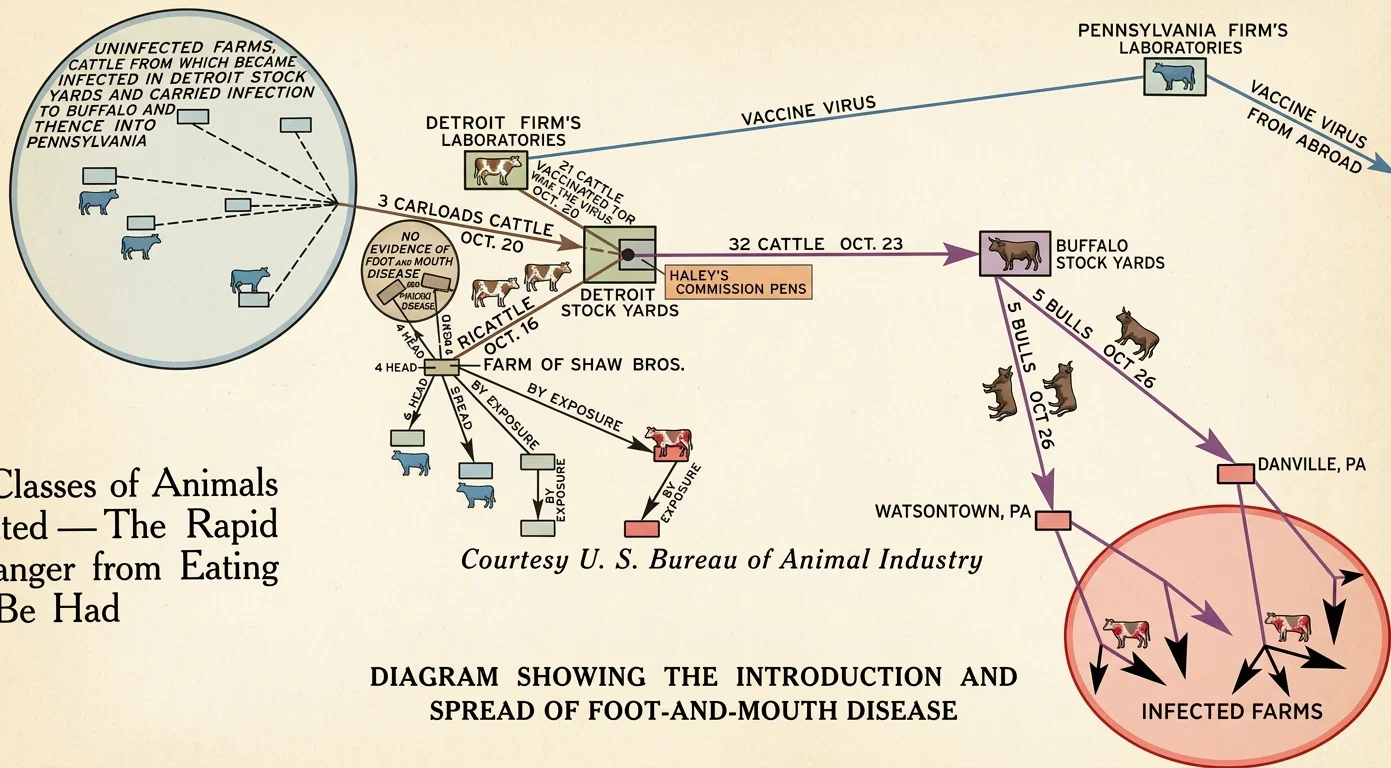
DIAGRAM SHOWING THE INTRODUCTION AND SPREAD OF FOOT-AND-MOUTH DISEASE
It is difficult to appreciate the vast magnitude of the cattle industry. There are scattered through the length and breadth of the land about one hundred seventy million head. The very day when foot-and-mouth disease was discovered in the Chicago stockyards, there were seventy thousand head of cattle and other meat animals in its yards. The business transacted in that center alone amounts to more than a million dollars daily.
Within forty-eight hours after this plague was recognized in Chicago, it was found to exist in ten other states, and a little later in four others. When we remember that foot-and-mouth disease is more contagious among cattle than smallpox is among men, the difficulties in the way of stamping out this disease can be partially comprehended.
Story of Foot-and-Mouth Disease
This cattle plague has been more or less prevalent in Europe for several generations. In Germany, in 1892, two million sheep contracted the disease, and again a million and a half in 1899. The cattle on the great ranges in Argentina from time to time suffer severely of the same disease.
The disease was imported into this country on a small scale in 1870 and 1884. In 1902 and 1908 were the two epidemics previous to the present one. According to the United States government report, both of these epidemics were introduced into this country through smallpox vaccine that was imported from abroad, and, unpleasant as the thought is, was intended for the vaccination of human beings. In this instance, cattle were first inoculated with it, so as to secure a larger quantity of cowpox; and thus the cattle, instead of human beings, took the disease.
The government inspectors took samples of the same vaccine virus and inoculated healthy calves, which promptly contracted foot-and-mouth disease. So there was absolutely no guesswork concerning the origin of that epidemic. There are well-informed people who believe it will yet be demonstrated that this present appalling epidemic had a similar origin.
What Is Foot-and-Mouth Disease?
It is supposed to be due to a germ that is too small to be recognized by a microscope. This germ, or virus, or contagion, is found in the blisters that flourish in the mouth of the infected animal, in the saliva, in the milk and various other secretions and excretions, and also in the blood.
Courtesy U. S. Bureau of Animal Industry
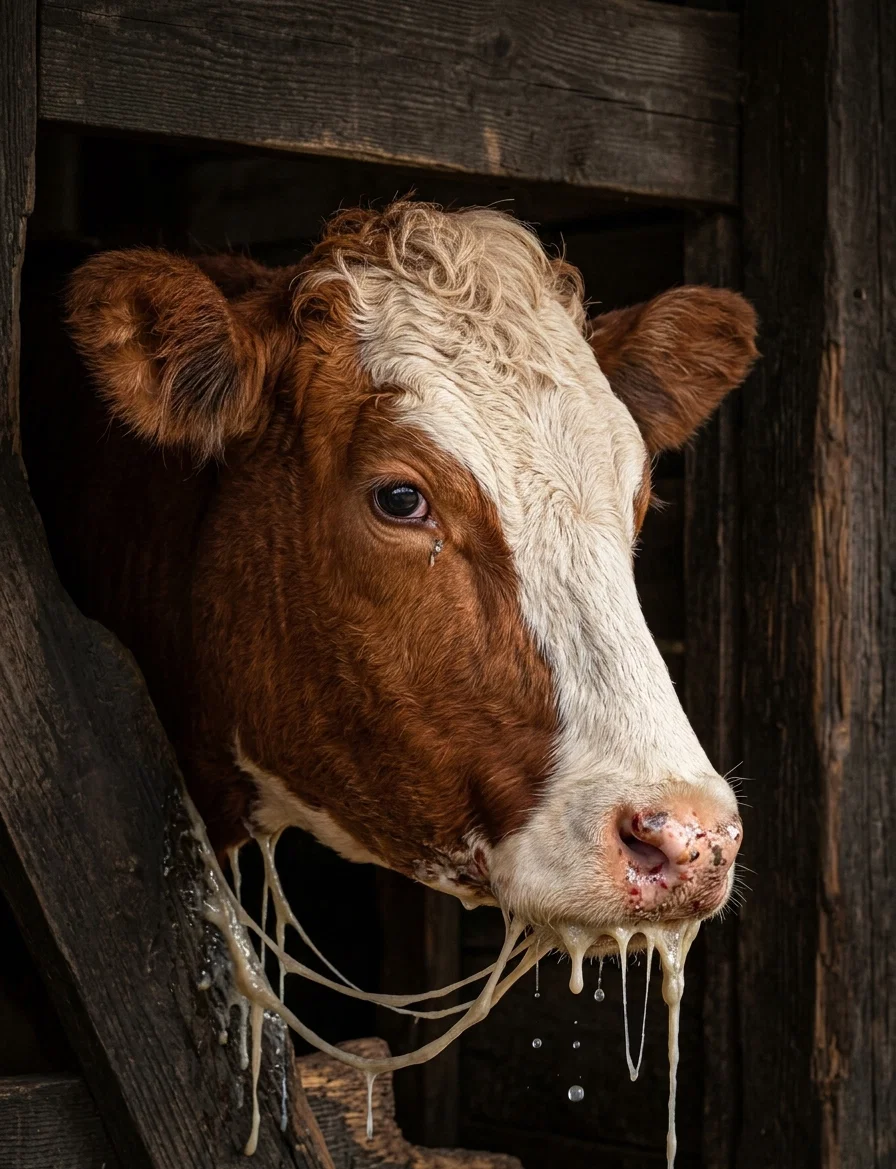
HEAD OF COW WITH FOOT-AND-MOUTH DISEASE
It is so intensely contagious that it can be carried long distances on the boots, shoes, clothing, or hands of persons who have been in contact with the infected cattle or even in the barn where they are kept. It affects not only the ordinary cattle, but especially swine, goats, and dogs and cats; and human beings are susceptible to the same disease.
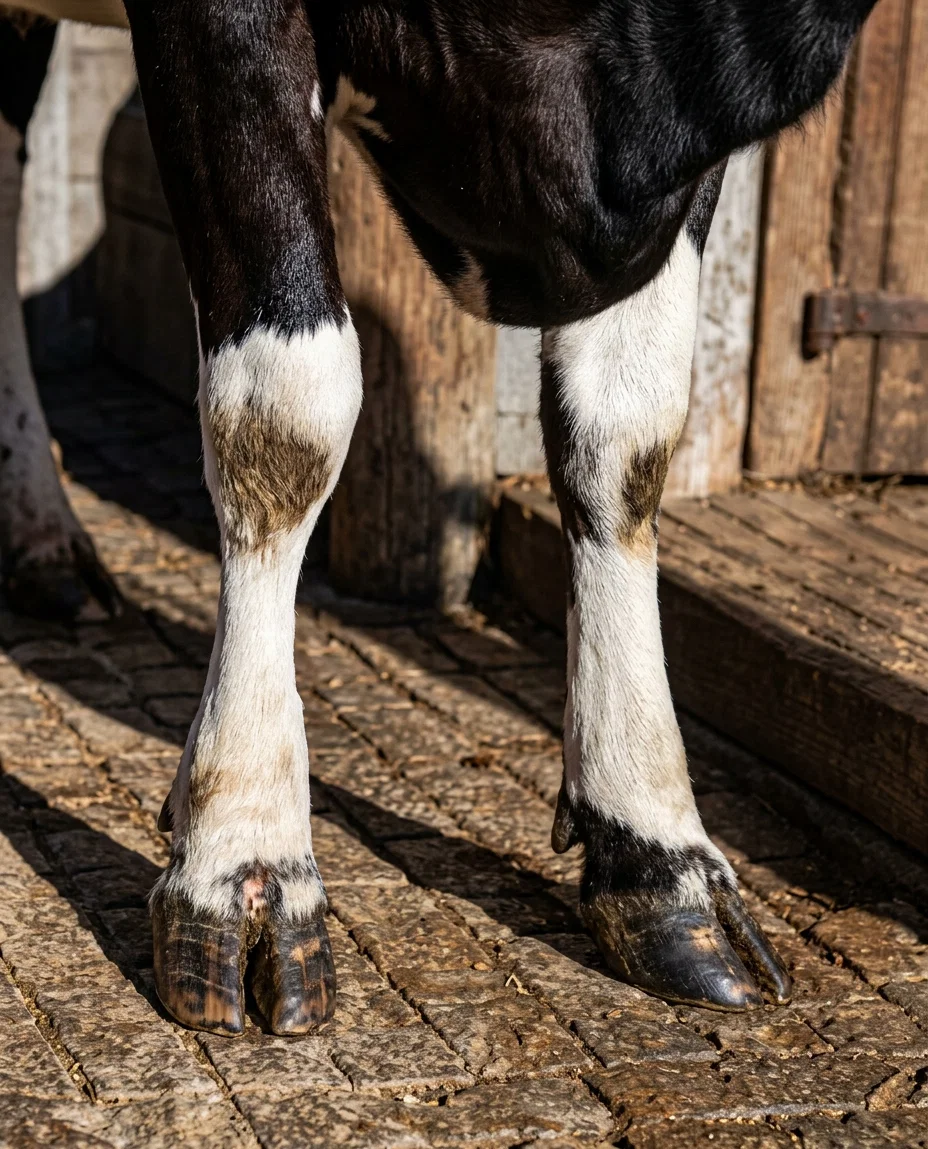
It is readily detected by the smacking sound the animal makes with its lips, and the ropy and stringy saliva that invariably hangs from its mouth. The animal suffers of fever, refuses to eat because of the sores in its mouth, and soon begins to have blisters about its hoofs. One attack does not preserve the animal from having the same disease subsequently.
Courtesy U. S. Bureau of Animal Industry
FRONT FEET OF COW WITH FOOT-AND-MOUTH DISEASE
It is so contagious that it spreads like wildfire. No matter how large the herd, if one animal is infected, all the rest will invariably contract the disease. And that is why the government insists on slaughtering the entire herd upon the first definite signs of an outbreak.
The Present Plague
All authorities agree that the two or three previous attacks are utterly insignificant compared with the widespread magnitude of this epidemic.
There are various reasons for this. The authorities at the stockyards informed me that the resistance of the animal creation is gradually becoming lowered, their blood is becoming more and more impure, and as a consequence, they are readily overwhelmed with disease. These men said the animals were kept too much indoors, breathing foul air; they were overfed and underexercised, and many of them were actually fed on filth, such as distillery slops.
Furthermore, in order to secure certain high grade features, they were overbred. In other words, high breeding often means a low grade of health. One man said: “Touch a match to a pile of sand, and nothing happens; but apply the same match to a keg of powder, and something happens.” Expose a healthy animal to disease, and it is not a serious matter; but in the case of a weakened one, the same cause will speedily prostrate it.
The present epidemic was first discovered near Niles, Michigan, about the middle of October, and was supposed to be carried to the Chicago stockyards by a shipment of infected hogs.
Unfortunately, at that very time, the great national dairy show was on in the stockyards district. Nearly a thousand prize cattle from all parts of the country, valued at about three million dollars, were on exhibition. Some of these speedily contracted the disease. Before it was discovered, some of the exposed and infected cattle had already been shipped to different parts of the country; and within a few days, the disease was spreading in more than a dozen different states.
For the first time in their history, the great Chicago stockyards were closed. The government at once began to trace every shipment of cattle that had gone out from Chicago since the disease broke out; and a corps of trained inspectors was sent to all these different points, and the cattle were placed under quarantine. Every freight car that had carried such cattle was fumigated.41
Beautiful herds were slaughtered on a most unprecedented scale. One large herd of eight hundred animals in Indiana, worth thirty thousand dollars, were killed in one day, the United States government and the state sharing the actual expense, or beef value, of all these animals. Many of them were high-bred cattle worth many times these figures, so that the total loss is enormous.
This time the disease threatens to become a permanent epidemic in the United States, as it has broken out among the cattle on the vast ranges in Montana. Dr. Bennett, the government inspector, said regarding this development: “The report from Montana is the worst blow we have struck in this fight. If the disease gets thoroughly implanted among the millions of cattle herded on the Western ranges, it is extremely probable we will never get rid of it.”
Dr. Flexner, of the Rockefeller Institute, one of the world’s greatest pathologists and bacteriologists, who discovered the germ of infantile paralysis, came to Chicago to study this disease first-hand, with the hope that a serum could be prepared with which to immunize cattle in the future.
Fumigation on a Large Scale
Every square foot of the vast stockyards in Chicago was thoroughly cleaned, fumigated, and whitewashed; and then a high board fence was built, dividing it into two sections. On one side the cattle were handled that came from uninfected districts, and on the other side those were slaughtered that came from suspicious territories.
The several thousand workmen who were engaged in dealing with these cattle and slaughtering them were not allowed to come out again until their clothes had been thoroughly fumigated.
Some Interesting Reflections
In this quarantined section, all the cattle are killed for food as soon as they arrive, provided the disease has not already broken out. For instance, six thousand cattle were being fattened for the market on the distillery slops in Peoria. Sixty of this herd contracted the disease. Immediately a hundred carloads of these cattle were rushed to the Chicago stockyards, and slaughtered the next day for human consumption. How many of these cattle already had the disease in their systems, which would have broken out in a few days more, will of course always be an unanswered question. At any rate, in order to be on the safe side, the hides were all dipped in disinfectant solutions before they were put on the market.
The authorities at the stockyards informed me that these cattle stood in stalls and were fed on these hot slops; that the flesh of such animals was considered especially tender. The real reason was, as one expressed it, because it was “rotten.” The slightest injury in such cattle will produce festering sores. Their systems are feverish.
There may be those who choose to have such flesh served on their tables, to be transformed into their own flesh and blood. Personally I object to eating such secondhand foods. I prefer to accept my food first-hand from the lap of nature in all its original delicacy and wholesomeness.
For instance, what is the sense in feeding the hog seven or eight pounds of corn in order to get in return one pound of pork than there is in any one pound of corn — especially when I know that something like three hogs out of every hundred have trichina, and a certain percentage in addition have tapeworm? Again, I greatly prefer to eat my corn before it has been dragged in the wallow.
One financial expert, in discussing the hardships that this quarantine was inflicting on the farmers in various states where quarantine is enforced, innocently suggests that “the quarantine period has developed an outbreak of hog cholera which is costing enormous loss, that might have been averted to a large measure if the stock could be shipped to Chicago.”
Could Not Market the Sick Hogs
In other words, on account of the quarantine, the farmers were compelled to keep their hogs on the farm for the time, and let them die, instead of doing as they otherwise would have done — rushed them off to market and had them slaughtered before they all had a chance to die.
It is safer to eat oats and wheat and corn and cabbage and tomatoes. Corn does not get hog cholera until after it is in the hog. If the tomato is a little decayed, we throw it away, and it produces no serious disorders; but when flesh has begun to decompose, it develops ptomaine poisoning.
A well-informed writer says that this plague has undoubtedly affected beef consumption adversely; and unquestionably he is right. Even if the government succeeds in stamping out this disease, there will be many who will have discovered that their health was improved, that their strength was increased, by discontinuing the use of meat, and hence will not care to resume consuming it when this evident danger is past.
There was a time when most people did not think they could live and preserve their strength unless they drank liquor. I have heard old people say they could remember a time when a minister would take brandy with him into the pulpit, and during the sermon would “take some spirit down in order to bring the spirit up.”
We are beyond that time. We now know that liquor, instead of being a stimulant, is a depressant; and the meat-strengthening delusion also is passing away. The editor of the Journal of the American Medical Association, in a recent editorial, voices the new sentiment of the enlightened and intelligent medical profession when he says that it is the duty of physicians to instruct their patients that there is nothing especially strengthening about a meat diet; that bread, with its natural accompaniment of butter, comes much nearer being a substantial dietary.
Some Self-Evident Conclusions
It is useless to close our eyes to the fact that this terrible and widespread epizootic means something. The prevention of disease among animals is becoming increasingly difficult. Human beings and cattle are both living under such unnatural conditions, and in a certain sense in such close proximity, that they infect each other.
Furthermore, disease germs for both man and beast are becoming increasingly virulent; and the time may not be far distant when absolute safety will demand not only that we abstain from the flesh of animals — as sensible and well-informed people are now doing — but that even dairy products be tabooed. In that case, God will no doubt stir up human wits and ingenuity to provide satisfactory substitutes. In fact, the first steps in that direction have already been taken.
Meanwhile, all those living in the infected areas, and all others, for that matter, who can not be sure that their milk is absolutely above suspicion, should sterilize it. Dr. Evans, formerly health commissioner of the city of Chicago, says that the virus of foot-and-mouth disease is easily killed by heat. According to him, milk pasteurized at 140 degrees for twenty minutes is safe. Such a temperature, and in fact any temperature below 160 degrees, does not change the character of the milk, but does discourage the activity of all ordinary disease germs that may happen to be present.