YES, there are failures in missionary effort—hundreds of them. That is, they are failures to human eyes. But as that is not a fall which is a fall forward, so failure is not failure when it is a part of success. And in a work, where not even an expired breath returns void, nothing really fails.
Missionaries have been censured for “not reporting conditions as they are.” This touches a great question, but just a word about it here. God alone sees things as they are, for things as they have been and will be have so close a connection with present conditions. Wise and honest men say that the world is growing better all the time, and other wise and honest men see it growing worse. Who can give a perfectly true impression of a people or a work?
The missionary often hesitates to tell of matters even as he views them, for fear that before the eyes of those who can not possibly get the true perspective, he may project a vision which is not of things as they are at all. The following short chapter of a Burmese boy’s life is a recital of facts as the writer sees them. Therefore it is called a failure.
Maung Bo, Aung Thein’s foster-father, is the owner of a small cotton-mill at Mahlaing, and withal a man of wealth and influence in the Oriental way. Without a child of his own, he adopted Aung Thein, gave him everything a Burmese child desires, and reached the height of his idea of parental providence by insuring the boy’s life for a good sum.
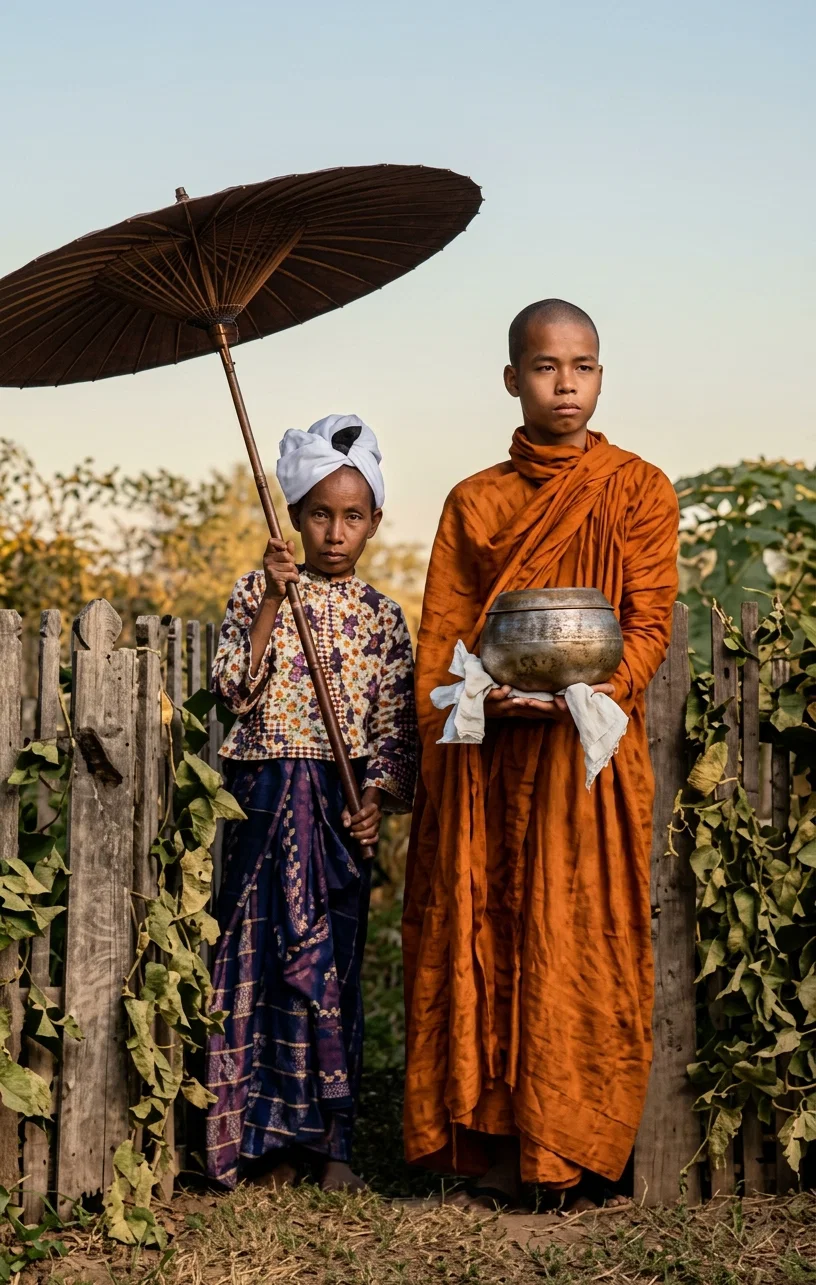
A bhogya, or Buddhist priest, begging for food — his only means of livelihood
Casting about for a good school to which to send his son, he was recommended to our institution at Meiktila. A trial would do no harm, so this little boy, with his long, black hair tied with a cord at the back, started to school. The length of his hair indicated that he was not yet old enough to be consecrated to the priesthood.
His heart was tender and very susceptible to religious influences, and soon he plunged heartily into the best the school taught by precept and example. He worked with a will at anything that was given him to do,—a very unusual procedure for a Burman nurtured in ease. He entered into Bible study with remarkable aptitude for one of his age, and in fact, was soon made over new. He went home for a short vacation, and his people were surprised at the change in him. He was obedient and respectful, eschewed bad companions, and was in general a good boy, yet not a “goody-goody” boy.
Two Burmese girls
But at the first meal, the mother asked, “Why do you put your head down before you eat?” and later, “What book is this that you like so well to read?” Then the truth was revealed to them. So Aung Thein was getting evil as well as good at that school. They knew it was a Christian school, but hundreds of Buddhist boys had passed through other Christian schools uncontaminated. The general result of the work at this school was the best they had ever seen, but the hated faith would never do. So they attempted the impossible—to separate cause from effect, Christianity from goodness. Aung Thein was sent back with the solemn command to remain a good boy and a Buddhist.
Childhood is simple, and naturally chooses good means for good ends. The boy became more steeped in the anathematized truth than before. The news of his farther straying soon reached home; and there came a command for him to stop all manual labor, for perhaps it was the work which charmed him. Didn’t his father have money? He didn’t need to work. But still he progressed in the love of God and the Word. Maybe it was because he had not been made a priest yet. Thereupon he was called home, and that elaborate function of fasting, head shaving, and yellow robing was followed out according to approved custom. While every boy is consecrated to the priesthood, very few wear the robe more than a few days. An active boy dislikes to mumble, be idle, and beg.
In a short time Aung Thein was back, and rose, in the first praise meeting, with a strong testimony expressive of his love for God and his gladness to get back. Well do I remember the day he ran after me down the sandy lane and shyly put a two anna piece into my hand with the words, “Of ten parts, one part”—the Burmese expression for tithe.
The battle waged hotter. The boys of a family living near the school were set as spies to watch what Aung Thein did and said, and to report to his parents. The father made a hurried visit to the school, and at first greeting was met by this request from his son: “I want to be baptized and to be a Christian.” Maung Bo was furious, and threatened to remove the boy immediately. But sober judgment and the advice of friends prevailed, and he was still led to hope that his son could remain in the fire and not get burned.
Aung Thein was so young that it seemed best for us to do nothing more than to teach the Word and pray. We had not urged him, from the first, nor did we mention baptism to him individually; but like the Ethiopian eunuch, he said, “What doth hinder?”
Balaam of old, that broken mouthpiece for God, tried more subtle means when direct opposition to Israel failed. The inspirer of Balaam now put it into the father’s heart to take his boy out of the school home and have him board with an adjacent family. Perhaps he absorbed Christianity by contact, and partial separation would help. This was striking at a vital point, and, sad to relate, the scheme succeeded. Live with a boy or lose him, is a truth we have found to be practical.
Ridicule and scoffing, intentionally and systematically followed up day by day, soon played havoc with Aung Thein’s slender faith. He stopped attending the meetings, and the new influence soon told in his personal appearance and behavior. His dress became unclean and disorderly, and he took on the slouch and slink of the street boys. A few days before school closed for the year, he and a companion stole a neighbor’s duck and killed and ate it—a very disgraceful15action for even a Buddhist. He escaped prosecution by making amends.
Eight of Aung Thein’s schoolmates whom he had led in espousing Christianity, were baptized before they went home for the holidays. He stood on the bank of the lake and witnessed their start in a newness of life. We do not know what thoughts coursed through his mind then, nor what feelings tugged at his heart; but we hope and pray, and work and wait.
Do you wonder that this year we have made a rule that no boy whose parents do not live near the school shall board outside the school home? For we are fishers of boys, and try to be “wise as serpents and harmless as doves.” This year Aung Thein has come back to the school home, his faith shattered. Are your prayers for him?