Its Setting—How Portions of It Have Been Fulfilled—Other Portions Sure of Fulfillment
By Calvin P. Bollman
This is the first of some five or six articles by Elder Bollman, on the prophecy of Christ recorded in Matthew, chapter twenty-four. This article, after giving the setting when the prophecy was made, shows how completely prediction met fulfilment in the overthrow of Jerusalem by the Romans. Our readers should not fail to watch for these articles from week to week, and also to pass them on to their friends and neighbors.
Editor.
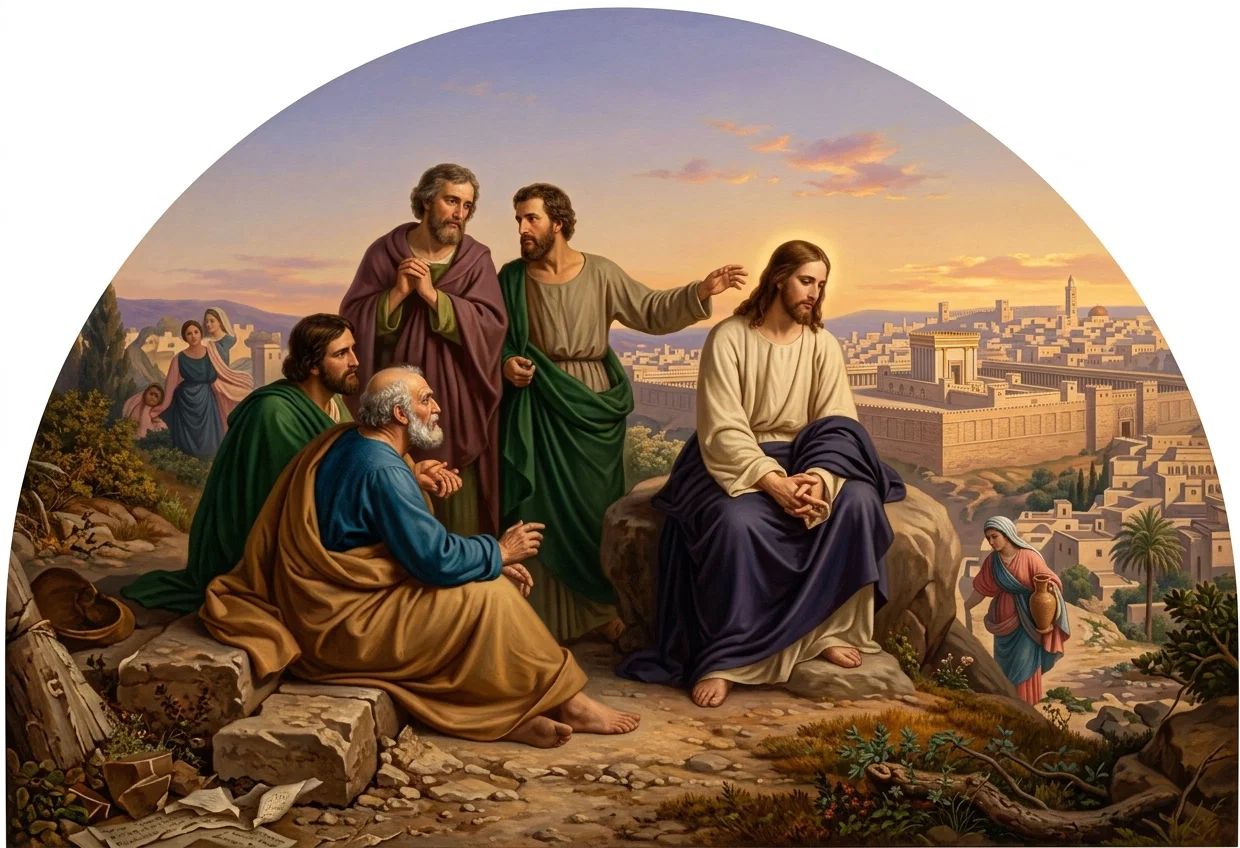
The place is the Mount of Olives, overlooking Jerusalem to the west. From this elevation, a most magnificent view could be obtained not only of the temple and its courts, but of a large part of the city.
The time was probably late in the afternoon of the third day of the crucifixion week—the week that was to see, and that did see, the completion of Christ's work on earth for the redemption of fallen humanity.
The occasion was the perplexity of the disciples over certain statements the Lord had made concerning their beloved city and temple—the city and temple which they fondly hoped might stand forever; the city to be the capital of the restored kingdom of Israel; the temple, the gathering place of the nations as they should come to do homage to the Son of David.
To Be Completely Demolished
Just a little while before our Lord's prophecy was uttered, the disciples, their hearts swelling with national pride, had come to Him “to show Him the buildings of the temple.” Jesus said to them: “See ye not all these things? verily I say unto you, There shall not be left here one stone upon another, that shall not be thrown down.” Matt. 24: 2.
Astonished and awed by the Master's words and manner, the disciples were silent; but by and by, “as He sat upon the Mount of Olives,” they “came unto Him privately, saying, Tell us, when shall these things be? and what shall be the sign of Thy coming, and of the end of the world?” Verse 3.
The Question Analyzed
The disciples' question was in reality two questions. Or shall we say three? (1) “When shall these things be?” (2) “What shall be the sign of Thy coming?” (3) “and of the end of the world?”
Evidently the disciples associated the three events; namely, the destruction of the city and the temple, the second coming of Christ, and the final destruction of all earthly things. To them it seemed impossible that the foretold destruction of their city, and especially of the temple, with its massive foundations, could take place apart from the end of the world.
But in this they were mistaken. About forty years later—well within the generation then living—the temple was burned by the infuriated Roman soldiers under Titus, and its seemingly indestructible foundations were removed, so that not one stone was left upon another.
The Destruction of Jerusalem
Deeply had Jerusalem sinned in rejecting the Messiah, and terrible was to be its punishment; and this punishment was to come not directly, as a retributive judgment, but as the result of their own hardness of heart and blindness of mind.
Throughout their history, the Jews had been a typical people; and this was to be no less true of the final judgments that would come upon them as a nation. The horrors of the siege, and of the destruction of the city, were a type of the world-wide time of trouble foretold in these words of the angel, spoken more than six hundred years before to the prophet Daniel: “There shall be a time of trouble, such as never was since there was a nation even to that same time: and at that time thy people shall be delivered, every one that shall be found written in the book.” Dan. 12: 1.
This is the time of trouble that comes upon the wicked just before the Lord appears the second time, much as the time of trouble came upon Jerusalem and its people, bringing the end of the Jewish age and nation.
Signs of Impending Judgment
There being so many points of resemblance between the destruction of Jerusalem and the final destruction of the wicked powers of earth, the Saviour, in answer to the disciples' question, intermingled the two events and the signs that should precede them severally.
From this elevation, a most magnificent view could be obtained not only of the temple and its courts, but of a large part of the city.
However, we have time and space in this study to mention only one sign of the destruction of Jerusalem; namely, that given in Matt. 24: 15.
In the first part of this same chapter, the Saviour gave His disciples a solemn caution against being deceived by any thought or suggestion that His second coming was then near at hand. In doing this, He sketched briefly—very briefly—the leading events from the time then present until His return should be due to the world, ending with the statement in verse 14, “This gospel of the kingdom shall be preached in all the world for a witness unto all nations; and then shall the end come.”
Then going back to the first question, “When shall these things be?”—meaning the destruction of the city and the temple—our Lord said: “When ye therefore shall see the abomination of desolation, spoken of by Daniel the prophet, stand in the holy place, (whoso readeth, let him understand:) then let them which be in Judea flee into the mountains: let him which is on the house-top not come down to take anything out of his house; neither let him which is in the field return back to take his clothes.” Verses 15-18.
“Abomination of Desolation”
But it may be asked, How could any one flee after the city was compassed with armies? In its details, the story is a long one; but the more essential facts may be stated in few words. Beginning at Jerusalem about A. D. 65, the fires of dissatisfaction, and a little later a revolt against the Romans, began to burn, and speedily spread over nearly all Judea and Samaria. The fortress of Masada, a stronghold to the west of the Dead Sea and near its southern end, was first seized, and its garrison of Roman soldiers put to the sword.
Soon the standard of revolt was raised also at Cæsarea and at Jerusalem. Agrippa, mentioned in Acts 25 and 26, endeavored to restore peace, but without avail. Then Cestius Gallus, the governor of Syria, and for that reason commander-in-chief of the Roman soldiers in that part of the empire, after subduing the incipient rebellion at Cæsarea, marched against Jerusalem and at once besieged it. His point of attack was the wall immediately in front of the temple. Soon a breach was made, and the Romans were about to set fire to the temple itself—thus it may be said “the abomination of desolation”8stood in the holy place—when a most surprising thing happened: Cestius suddenly suspended his operations, renounced his advantages, and withdrew from the temple wall.
It was an act so difficult to account for, naturally it was ascribed to a higher power than man. Josephus regarded it as proving the divine anger; for he believed that if the city had been captured then, all the subsequent horrors of war would have been avoided. Others supposed that this was the opportunity pointed out to the disciples by the Saviour, when they might escape to a place of safety and avoid all the coming woes of the siege. Now, it is supposed, the Christians made good their escape to Pella, a village east of the Jordan, fifteen miles south of the Lake of Tiberias; and certainly none perished, since not one was deceived by the false promises and expectations on which the multitude depended to their ruin. (“From Exile to Overthrow,” pages 304, 305.)
Preliminary Movements
Almost all Palestine was in revolt against the Romans, and some time was necessarily spent in subduing the rebellious Jews in other and less important cities than Jerusalem. When the extent of Rome's humiliation through the weak and vacillating course of Cestius Gallus was known at Rome, Vespasian, the strongest military leader in the empire at that time, was sent out to direct operations and reestablish the imperial authority in the East. He first besieged and took Jotapata. This exceedingly difficult undertaking consumed nearly fifty days, leaving Vespasian's army tired and in need of rest. Six weeks was spent in preparing for further offensive operations, and then nearly two years was devoted to subduing the rebellion outside of Jerusalem. While this was going on, the emperor, Nero, died, or rather committed suicide, and Vespasian was personally called to Rome to become emperor. His son Titus had been closely associated with him in the reconquest of Palestine, and him Vespasian commissioned to complete the conquest by the capture of Jerusalem.
Horrors of the Siege
It is needless to dwell upon the horrors of the siege of the devoted city. Two years had passed since the fall of Jotapata, and the Romans had become highly exasperated at what they regarded as sheer madness upon the part of the Jews. Judged by the standard of the times, Titus was not a cruel man, and he would gladly have avoided further bloodshed, but the Jews would not consider surrender. The city was rent by factions, and was dominated by the worst element. Many fell victims to civil strife, while nearly a million lost their lives in the siege, and more than a hundred thousand were taken captive and sold into slavery.
The people not only suffered the usual stress of a siege; but after a few weeks, famine and disease were added to the destruction of battle. Many died of starvation and of sickness, while some were driven to cannibalism. Thus not only were our Saviour's words fulfilled to the letter, but the elder prophecy by Moses, uttered nearly two millenniums before, and recorded in Deut. 28: 40-57, was also fulfilled in every detail.
And as these prophecies were fulfilled then, and as others have since been fulfilled, as we shall learn in a further study of our Lord's great prophecy, so also shall those things surely come to pass which have not yet been fulfilled, but which unfolding events unerringly show us to be even at the door. “Heaven and earth shall pass away,” says the Saviour, “but My words shall not pass away.” Matt. 24: 35.
There is yet in this twenty-fourth chapter of Matthew much of deepest interest and of greatest moment to the people of this generation.