This article on the Waldenses is one of six or eight that are to appear in our columns. Mr. Hall has given much study to the subject, and to many it will be new to learn that the history of this intensely interesting people is traced back to the days of the apostles. They held closely to the pure doctrine taught by Christ, and were in continuous conflict with the apostasy that sought to compel men, by cruel persecutions, to conform to bigoted religious decrees. The articles are a timely warning in this age when great religious majorities are seeking to combine for the control of the world.
EDITOR.
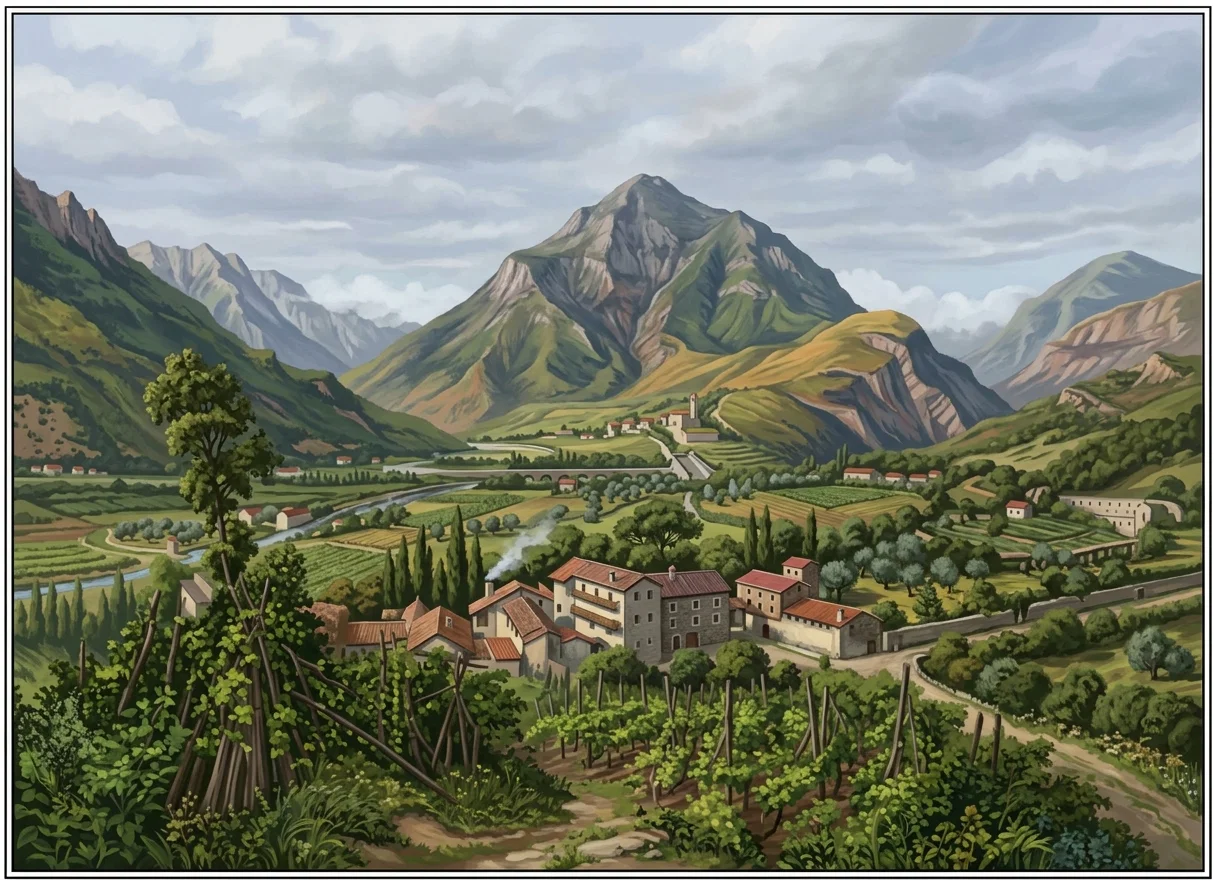
In the valleys of the high Alps which form the boundary between northwestern Italy and southeastern France, have lived from “time out of mind” the “men of the valleys”—for such is the meaning of the name “Vaudois,” or “Waldenses.” Their little territory, some eighteen miles long and fourteen wide, is deeply furrowed by seven valleys, each having its own gate of ingress and egress, and so opening into each other as to justify Leger, a veteran Waldensian pastor and historian, in saying, “The Eternal, our God, having destined this land to be the theater of His marvels and the bulwark of His ark, has by natural means most marvelously fortified it.” (Wylie’s “History of the Waldenses,” page 7.)
These valleys, which are watered by mountain torrents formed by the melting of the mountain snows, rapidly narrow as one ascends them, and are soon lost in a series of deep and densely wooded ravines, accessible only to the practised foot of the mountaineer. Above are towering peaks, frightful precipices, and caverns of unknown depth, which so often were ways of escape to the “hunted men of the valleys.”
In this little district of less than three hundred square miles, with its limited crop-raising area, its long, severe winters, and their accompanying heavy snows and frequent avalanches, lived a people numbering at times 23,000 souls. Why should such a company as this live in these cramped quarters? Why did they not occupy the beautiful Piedmont Valley at the foot of their mountain? Let us see.
Descendants of the Apostles
First let us hear what they have to say through one of their leading pastors and military men, Henry Arnaud:
LA TORRE — THE WALDENSIAN CAPITAL
“Neither has their church been ever reformed, whence arises its title of evangelic. The Vaudois are, in fact, descended from those refugees from Italy, who, after St. Paul had there preached the gospel, abandoned their beautiful country, and fled, like the woman mentioned in the Apocalypse, to these wild mountains, where they have to this day handed down the gospel from father to son, in the same purity and simplicity as it was preached by St. Paul.”—“The Glorious Recovery by the Vaudois,” page 14 of preface, translated by Acland.
That this belief was common among them is shown by their petition to Philbert Emmanuel, duke of Savoy and prince of Piedmont, in 1659:
“We likewise beseech your royal highness to consider, that this religion we profess, is not only ours, nor hath it been invented by men of late years, as it is falsely reported, but it is the religion of our fathers, grandfathers, and great-grandfathers, and other yet more ancient predecessors of ours, and of the blessed martyrs, confessors, prophets, and apostles; and if any can prove the contrary, we are ready to subscribe and yield thereunto.”—Gilly’s “Waldensian Researches,” page 42.
This opinion is upheld by the following facts and citations.
Early Christians Driven to the Mountains by Persecution
We know that Paul’s ministry in Rome, some three hundred miles south of the Piedmont valleys, was very successful, enabling him to say, “All the saints salute you, chiefly they that are of Caesar’s household.” Phil. 4:22. We know also of the terrible persecution of the Christians under Nero, to which Paul fell a victim; and of those which followed in the second and third centuries, “which drove many of the Christian fugitives from Milan on one side and from Lyons on the other, to the Alpine retreat.”
Admissions of Their Enemies
Bernard of Clairvaux, whose death occurred in 1153, says:
“They are rustics, and laymen, and thoroughly contemptible. I am aware they boast that they and they alone are the body of Christ. They boast that they are the successors of the apostles, and call themselves Apostolicals.”—Bernard, sermon 66, Gilly’s “Waldensian Researches,” pages 43, 44.
Less than one hundred years later, about 1230, Reinerus the inquisitor takes the Waldensians to task as follows:
“The heresy of the Vaudois, or poor people of Lyons, is of great antiquity. Among all sects that either are or have been, there is none more dangerous to the church than that of the Leonists, and that for three reasons. The first is, because it is the sect of the longest standing of any; for some say that it hath been continued down ever since the time of Pope Sylvester; and others, ever since that of the apostles. The second is, because it is the most general of all sects; for scarcely is there any country to be found where this sect hath not spread itself. And the third, because it has the greatest appearance of piety; because, in the sight of all, these men are just and honest in their transactions, believe of God what ought to be believed, receive all the articles of the Apostles’ Creed, and only profess to hate the Church of Rome.”—Bib. Patr., tome 13, page 299, quoted on page 22, Gilly’s “Excursion.”
Thus we see their deadly enemy—and one who had been a Waldensian himself, by the way—admitting, in the thirteenth century, that the Waldensians—“Leonist” and “Waldensian” were used interchangeably—were said to have flourished from the time of Pope Sylvester, who is supposed to have baptized Constantine the Great, and who occupied the papal chair from 314 to 335 A.D.
Other Evidences of Their Antiquity
In the beginning of the fourth century, under Constantine, the apostasy foretold by the apostle Paul in 2 Thess. 2:3, 467
“We well know that this sentence of the gospel is ill understood, ‘Thou art Peter, and on this rock will I build My church; and I will give unto thee the keys of the kingdom of heaven.’ Under pretext of which words, a coarse and ignorant people, destitute of all spiritual knowledge, put their trust in Rome for the attainment of everlasting life. Whereas the ministry belongs to all the true superintendents and pastors of the church, who perform it as long as they are in this world; and when they have paid the debt of nature, are succeeded by others of equal authority and power.
“Return, O ye blind, to your light; return to Him who enlightens every man that cometh into the world. For all you, who keep not to this light only, walk in darkness, and know not whither you go. For if God shall be believed when He promiseth, by how much the more when He sweareth! ‘Though Noah, Daniel, and Job were in it, as I live, saith the Lord, they shall deliver neither son nor daughter.’ And it is to this end that He makes this declaration, namely, that none should put their trust in the merits or intercession of saints.”—“The Glorious Recovery,” pages 24, 30, by Acland.
This brief sketch of Claude’s life will suffice to explain why the Waldenses point to his example as an authority for making the Bible their rule of faith and practise. Some of them even go further, and point to him as the one under whom they separated from the Church of Rome. This is indicated by the following dialogue between a Waldensian president or moderator, M. Peyrani, and Napoleon Bonaparte:
“N. How long have you formed an independent church?
“P. Since the time of Claude, bishop of Turin, about the year 820.”—Gilly’s “Excursion,” pages 81, 82.
To this agrees the report of Rorenco published in 1632 at Turin:
“Marcus Aurelius Rorenco, the grand prior of St. Roch, when he was commissioned to make inquiries concerning them, under the title of ‘A Narrative of the Introduction of Heresy in the Valleys of Piedmont,’ delivered in a return which stated that ‘those Apostolicals, as they called themselves, were of an origin of which nothing certain could be said, furthermore than that Claude might have detached them from the church in the eighth century, and that they were not a new sect in the ninth and tenth centuries.’”—Gilly’s “Researches,” page 40.
As Rorenco lived in the valley, and was considered by the Roman Church to be one of their most able instruments in suppressing the doctrines of the Vaudois, and therefore had access to all the available documents, his conclusion is a significant one.
Conclusion
But time would fail us to tell of Peter de Bruys, Henri, Arnauld, and Waldo, who followed on in the path that had already been blazed. Passing over, for the time being, their work and persecution during the time intervening between the days of Claude and those of Luther, it will be intensely interesting to know that in 1526 Gonin, a Waldensian pastor, brought Luther’s writings from Germany. In 1530 they sent representatives to Switzerland and Germany with a Latin document containing an account of their discipline, worship, and doctrine. They were joyfully received by the Reformers, and in 1532 the famous synod or convention was held in the valleys, which was attended not only by the Waldensian representatives, but by Reformers from French Switzerland and even Bohemia. What a meeting of the old church and the new! The Vaudois decided to translate into French and print both the Old and the New Testament as their gift to the Reformation. Says Wylie:
“That book which the Waldenses had received from the primitive church—which their fathers had preserved with their blood—which their barbes had laboriously transcribed and circulated—they now put into the hands of the Reformers, constituting them along with themselves the custodians of this, the ark of the world’s hopes.”—Wylie’s “History of the Waldenses,” page 61.
From the foregoing, we may confidently conclude that while the Waldensians may not have had a separate organization until the ninth, tenth, or even the twelfth centuries,
(a) They were descendants from the original apostolic church.
(b) They resisted the corruptions that were successively introduced into the Roman Church.
(c) Men of God were their bishops and leaders.
(d) They held to the Bible as their rule of faith; and as the difference between them and their former associates became more and more marked, they withdrew into the mountains and valleys.
(e) They retained their identity and their faith until the time of the Reformation, when, by way of showing their appreciation of that Word which had made their history possible, this little and poor people collected fifteen hundred gold crowns for an edition of the Bible in French, which was published in the year 1535.