Civil War in China

2%

Pacific Press Publishing Association · Mountain View, California · Oct 14, 1913

FromSigns of the Times, Vol. 40, No. 40.

Read the full edition

Civil War in China

Causes — Effects — Future Outlook
By Our Own Correspondent
THE war-clouds that have been threatening the new republic of China ever since it was established, suddenly broke with tremendous fury on July 15. The troops stationed at Kiukiang, an important city on the Yang-tse River, not far from Hankow, revolted, and opened an attack on a company of northern soldiers who had been sent down by Yuan Shih Kai, in anticipation of an outbreak.
The southern troops then declared martial law, took control of the city, and immediately the Kiangsi province declared its independence from the Peking government.
The next day found Nanking, the historical old southern capital and the scene of many a previous conflict, in the hands of the rebels. Three of the commanding officers stationed in the city, who avowed their allegiance to Yuan Shih Kai, and refused to join the rebels, were seized and beheaded. The rank and file of the soldiers were easily brought over, by the promise of a few extra dollars.
Having secured enough of the soldiery to make a formidable attack, the office of the governor-general was stormed, and the governor of the Kiangsu province, Mr. Chen, was forced, at the point of the bayonet, to turn over the seals of his office to the rebels. A proclamation was issued in his name, declaring Kiangsu province independent, appointing Huang Hsing as generalissimo of the southern army, with orders to proceed north at once on a punitive expedition to kill Yuan Shih Kai, who was declared to be a tyrannical monarch, and restore the republic to the control of the people. What troops could be spared from the northern expedition were despatched to Shanghai to capture the arsenal and take command of the Woosung forts.
Thus far the rebels seemed to have everything their way; and when seven of the southern provinces joined hands with them, and offered support of soldiers and money, it appeared that this rebellion was assuming large proportions, and threatened to bring about the long-dreaded division of China into the north and south, with the Yang-tse River as the dividing line.
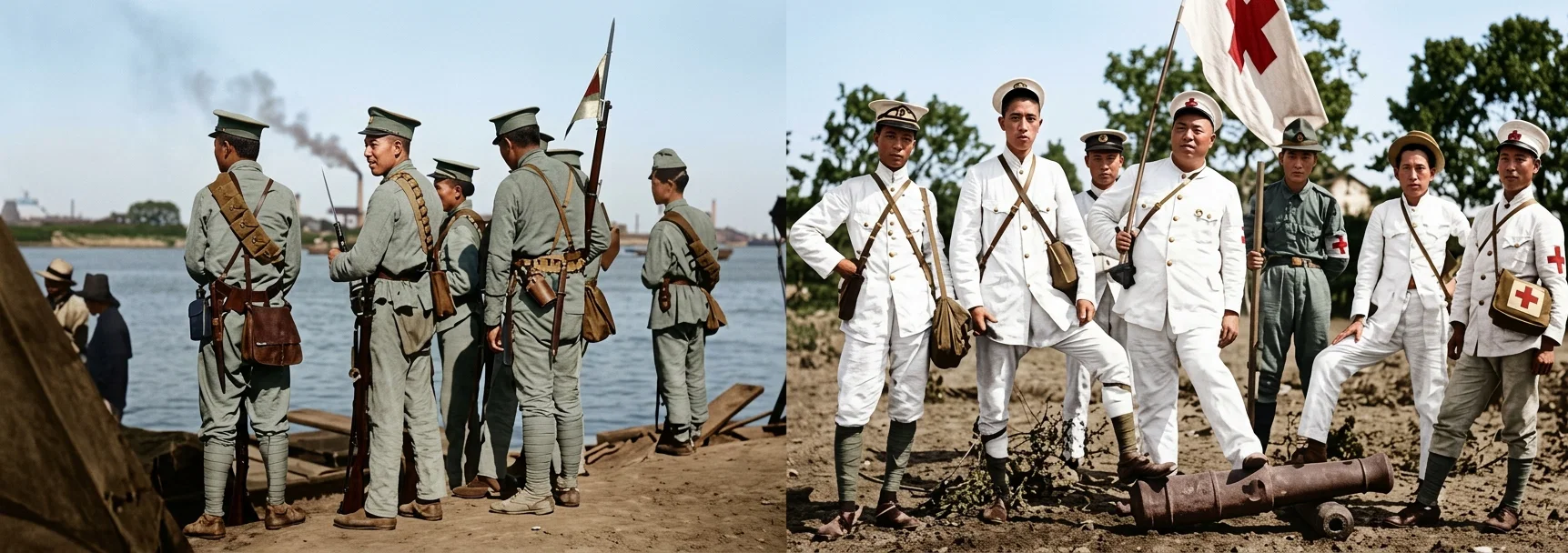
Peking soldiers guarding the Whangpoo River at Shanghai Representatives of the Chinese Red Cross Society in Shanghai
In order to be successful, however, there were two important points of vantage for them to gain. One was the control of the navy, which up to this time had remained neutral; and the other was the Shanghai arsenal, from which to draw their ammunition, it being impossible to carry on a war for any great length of time depending on ammunition that had to be smuggled in from foreign countries.
Right here the rebels lost, and here again was manifested another instance of the ability and foresight of President Yuan Shih Kai in making the needed preparation to prevent just such a calamity. About two weeks before the rebellion broke out, one thousand picked soldiers from Peking were sent to Shanghai, who took over the control of the arsenal, displacing the southern soldiers, whose loyalty was in doubt. The loyalty and good training of these soldiers proved to be the turning-point of the war and the downfall of the rebel army. For eight days they held out against an almost continual rain of shot and shell that was poured in upon them, both night and day, by something like ten thousand of the best of the southern soldiers, who surrounded the arsenal, and attacked from three sides at once. The fourth side is the Whangpoo River; and when the war-ships of the Chinese navy declared themselves for the Peking government, they poured out a scorching fire of big shells before which the rebels were forced to retreat.
Gathering reenforcements, they returned, more determined than ever to capture the arsenal, knowing full well that this was the decisive battle of the war. The arsenal is by no means an easy place to defend, as it is stretched out over several miles of territory, and only partly protected by walls. But the handful of loyal soldiers returned every attack with a hot fire from their rapid-firing guns, until, exhausted and disorganized, the rebels beat a hasty retreat, many of them throwing away their arms and uniforms, and escaping to the settlement in the hope of saving their lives.
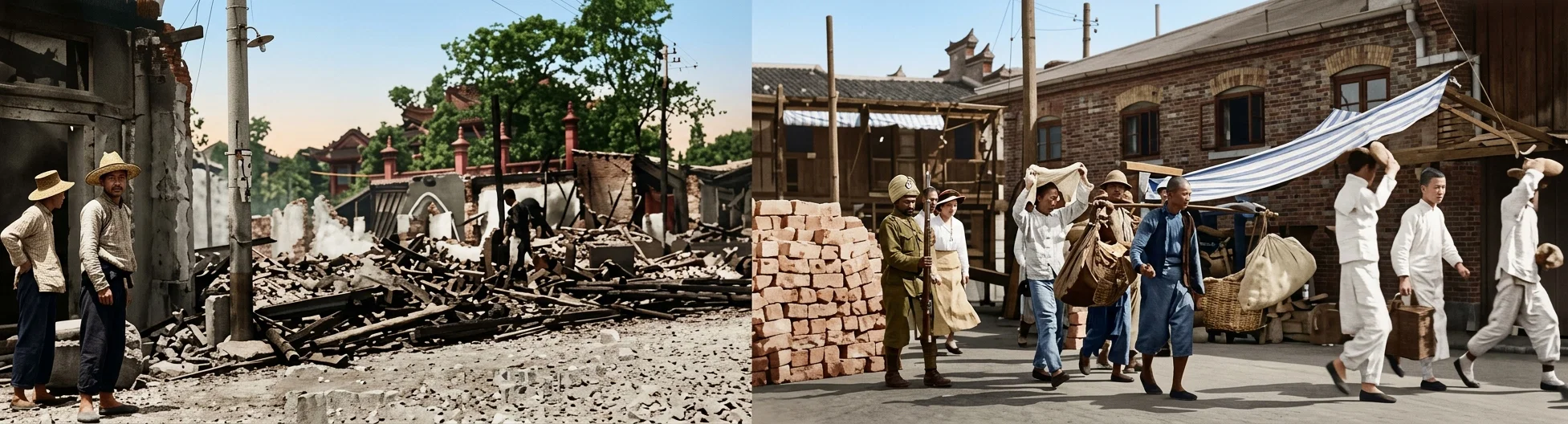
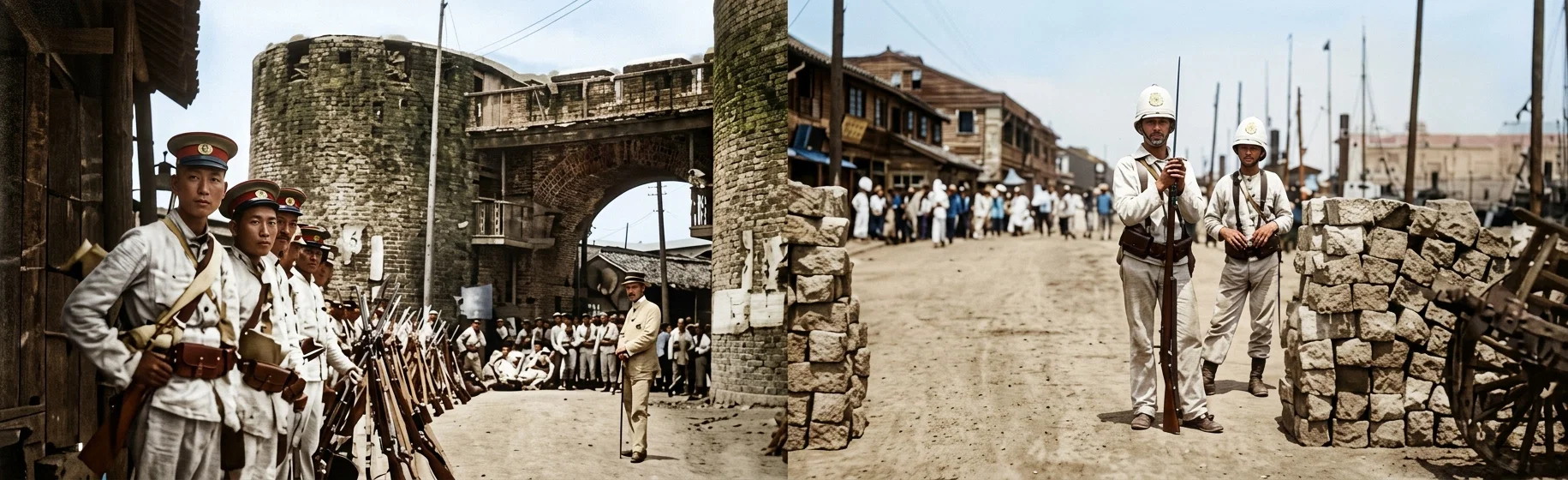
This week of severe bombardment was a time of great danger to both the native and the foreign population of Shanghai. Barricades were hastily thrown up at the entrances to the foreign concessions, and soldiers and marines were landed from the war-ships of the various nations stationed at Shanghai. The local volunteers were called out, and patrolled all the important streets, and every precaution was taken to protect life and property. Still no place was safe, as the settlements were in direct line of the shelling from the war-ships, and hundreds of shells fell and exploded in the concessions, damaging property and injuring a number of persons. That there was not greater loss of life seems really remarkable.
The French concession, being nearest the arsenal, got the worst of it; but some shots came clear over the race-track into the Bubbling Well district, where Shanghai's fashionable foreigners live. Several of the consulate buildings were struck. Persons were forced to flee from their homes in the middle of the night, and seek a place of safety. Many had thrilling and narrow escapes from death.
Almost the whole population of the native city fled to the concessions for refuge, and a terrible congestion ensued. At places the streets were impassable, and at night the natives were simply piled up on the sidewalks and the steps of stores and office buildings.
Homeless, hungry, and restless, this mob became a menace to the safety of the residents of the settlement, and steps were immediately taken to care for them as well as possible. The Y. M. C. A., the Chamber of Commerce, and other prominent societies united in this effort. A representative committee of Chinese and foreigners was appointed to solicit funds and distribute relief. Nearly $50,000 was raised, and both food and lodging were provided for as many as 2,500 to 3,000 refugees each day until they were able to return to their homes in safety.
With the government in control of both ends of the Yang-tse, and hastening reenforcements to aid the Nanking attack, it is only a question of time now until this last stronghold of the rebels falls and the rebellion is crushed.
The leaders who plotted and made plans for the carrying out of this revolution have already fled for their lives, as there is a price of $100,000 offered for their arrest. It is rumored that they are in hiding in Japan, but no one knows positively just where they are.
House destroyed in Shanghai by explosion of shell Refugees fleeing to the foreign concession, Shanghai

Contributory Causes

In its conception, it was simply a political war, started by prominent men who were identified with the revolution against the old Manchu government, and upon the division of the spoils these men did not get the share which they claimed was their due.
Gen. Li Yuan Hung, the loyal vice-president, who has faithfully supported the Peking government, tho repeated attempts have been made by the rebels to buy him over, says:
“The present rebellion is founded on nothing but the personal ambitions of certain men. . . . The principal persons responsible are Huang Hsing and Sun Yat Sen. . . . Hardly was the republic formed when they began to scheme to get Yuan Shih Kai out of office.”
Their scheming took the form of a political party called the people's party, through which they sought to control parliament so as to get a man of their own choosing elected as president, or if that was not possible, to make the president a mere figurehead subject to the control of a parliament controlled by their party.
The assassination of Sung Chao Jen, one of their leaders, formed an opportunity of which they took quick advantage; and accusing Yuan Shih Kai with this crime, and circulating inflammatory literature, they soon had a large following.
It only remained then to get the necessary money to buy ammunition, and the rebellion was fairly launched. One thing is certain,—the money and arms for this rebellion did not come from China, and what country furnished them will prove one of the interesting points which will be investigated as a result of this war.
Right here is plainly seen to be China's real danger to-day. In order to establish firmly her government, China is compelled, by her weak condition, to depend upon the powers for their financial and moral support. In fact she is pledged, mortgaged as it were, to five of the great powers now; and if these powers, while outwardly professing to be friendly, continue to work against the up-building of the nation, and lend their support to efforts to divide the country for gain, then China has very small hope of surviving at all.
It is a significant fact that none of these five powers have recognized the Chinese republic yet, and the opinion is fast gaining ground here that “they do not really want the republic to succeed.” (Quoted from Gen. Li Yuan Hung.)
Peking soldiers guarding entrance to the arsenal, Shanghai French soldiers guarding entrance to the foreign settlement
Russia's impudent attitude in regard to Mongolia, and Japan's interest in this rebellion, have stamped these two countries as enemies of China. Great Britain's tacit refusal to help out with the struggle against opium, and the action of the municipal council of the British concession at Shanghai in trying to take forcible possession of the Chinese Chapel district during the rebellion, under cover of protecting foreign interests, have not been lost upon the Chinese; and that there is a marked feeling growing against the British is clearly manifested by the following incident of the late war:
The largest summer colony for missionaries in China is situated on Kuling Mountain, about ten miles from Kiukiang; and when the fighting commenced at that place, the missionaries assembled there for the summer, to the number of 1,200—quite a city in itself—were cut off from all supplies for several days, and a serious food famine threatened. A young Englishman named John Duff volunteered to try to break through the lines of fighting and get supplies from Kiukiang. In order to identify himself, he secured a note from the British consul, written on one of his cards. He also obtained a letter of introduction from the commanding officer of the U. S. S. Helena, who happened to be there at the time.
Young Duff made his way cautiously toward the camps of soldiers, and was soon intercepted by pickets, who escorted him to the general's tent. Producing the British consul's card, he stated the object of his visit, and was amazed to see the card snatched from him, torn up, and thrown on the ground, with the information that British would receive scant favors in their lines.
The young man, concealing the fact that he himself was a Briton, presented his American credentials, which were received with a cordial, “O, yes, we will be glad to extend favors to Americans;” whereupon the officer wrote a pass in Chinese, which said: “Pass the American, John Duff, with supplies from Kiukiang to Kuling. For this man only, and for no other purpose.”

Results of the War

The immediate results of the war will be confusion, stagnation of business, and robbery and looting by the disbanded soldiers; but given time, good crops, and no famine or plague, China can weather these conditions again, as she has done many times before.
The putting down of this rebellion means a united country, and an end to the north and south idea which has been so prominent ever since the setting up of the republic.
It should also form a striking object-lesson to anarchists and jealous politicians who, to further personal ambition, would plunge the country into strife and ruin.
It undoubtedly places the president, Yuan Shih Kai, in a stronger position than he has occupied in the past.
One result should be to teach the powers to keep their hands off and let China work out her own salvation unhampered; but whether this will be the case, we are not prepared to state.
This war should decide once for all that China is to be subjected to a strong central government, and not allow every province to be a law unto itself. It should decide that definite, strong methods are to be used in the regeneration of China, in place of the wild and impractical dreams of the Young China party.
Finally, it is to be hoped that some one man will possess strength and resolution enough to pull the republic together, instead of a dozen eager aspirants' fighting among themselves for power.
Yuan Shih Kai may have been rough in his handling of the provinces, he may have been indiscreet in his treatment of the Cantonese, he may have treated the south with too much disdain; but to unprejudiced onlookers here on the field, he still appears, for the present at least, to be the only man whocan prevent the Chinese republic from falling to pieces.
We have faith in the future of China. We believe in God's word, which declares that the gospel of the kingdom will be preached to every nation, kindred, tongue, and people before the end comes; so we know that an opportunity will be granted to present the gospel to all the Chinese people. Under just what conditions this work will be accomplished, no one can say; but we do know that now is an opportune time. Who will come and help us thrust in the sickle? The harvest is ripe. Let us work while it is day, for “the night cometh, when no man can work.”
F. E. STAFFORD.
Chefoo, China.