The Rabbis Expected a Conquering General — They Looked for One Who with Fire and Sword Would Give Them a Kingdom — The Master Came as the Great Seed Sower to Spread the Principles of Peace and Good Will
By MRS. E. G. WHITE
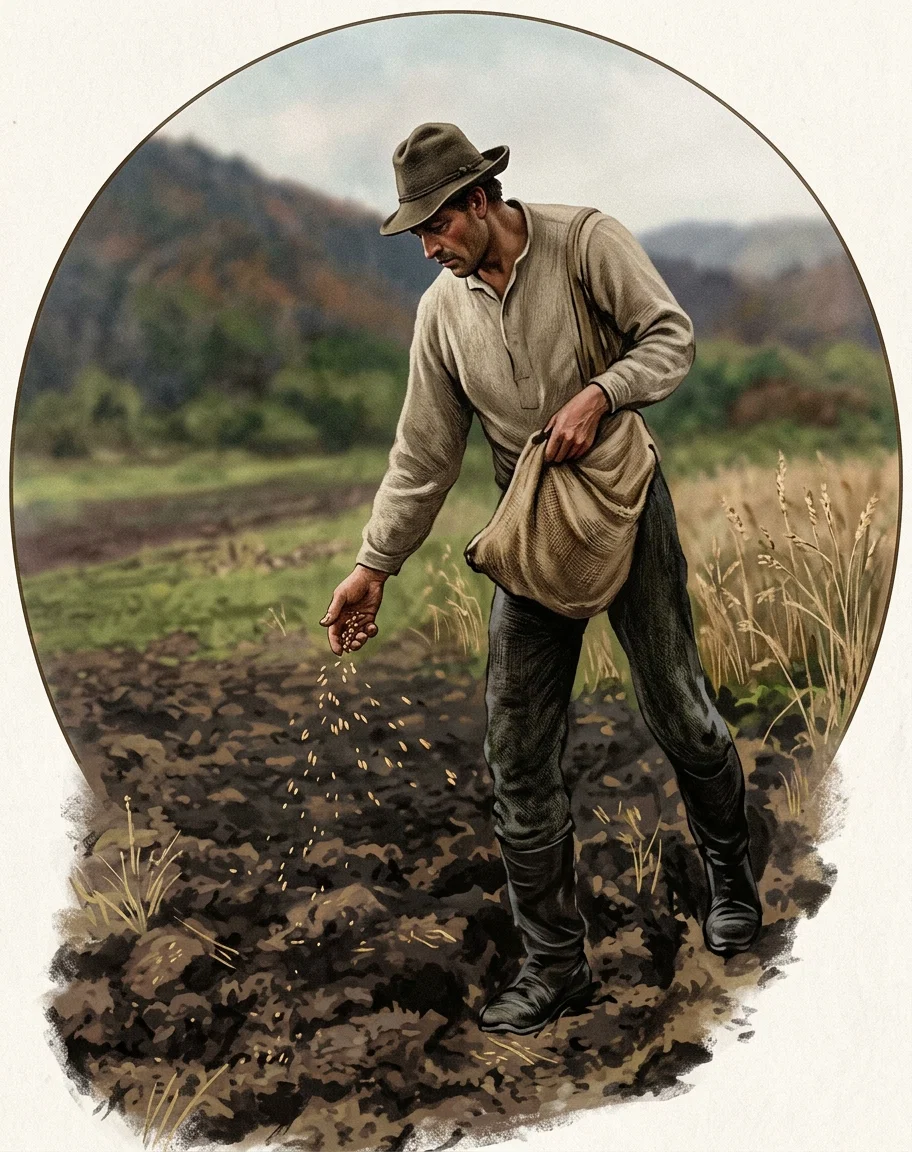
In the parable of the sower, Christ illustrates the things of the kingdom of heaven, and the work of the great Husbandman for His people. Like a sower in the field, He came to scatter the heavenly grain of truth. And His parable teaching itself was the seed with which the most precious truths of His grace were sown.
By the Sea of Galilee a company had gathered to see and hear Jesus,—an eager, expectant throng.
The Sower and the Lesson
Beside the sea lay the beautiful plain of Gennesaret, beyond rose the hills, and upon hillside and plain both sowers and reapers were busy, the one casting seed, and the other harvesting the early grain. Looking upon the scene, Christ said:
“Behold, the sower went forth to sow; and as he sowed, some seeds fell by the wayside, and the birds came and devoured them.” “Some fell upon stony places, where they had not much earth; and forthwith they sprung up, because they had no deepness of earth; and when the sun was up, they were scorched; and because they had no root, they withered away. And some fell among thorns; and the thorns sprung up, and choked them; but other fell into good ground, and brought forth fruit, some an hundredfold, some sixty-fold, some thirtyfold.”
Not by the Force of Arms
Christ’s mission was not understood by the people of His time. The manner of His coming was not in accordance with their expectations. They expected the Messiah to prove His claims by mighty deeds of conquest, to establish His empire on the ruins of earthly kingdoms. This expectation Christ answered in the parable of the sower. Not by force of arms, not by violent interpositions, was the kingdom of God to prevail, but by the implanting of a new principle in the hearts of men.
“He that soweth the good seed is the Son of man.” Christ had come, not as a king, but as a sower; not for the overthrow of kingdoms, but for the scattering of seed; not to point His followers to earthly triumphs and national greatness, but to a harvest to be gathered after patient toil, and through losses and disappointments.
The Pharisees perceived the meaning of Christ’s parable, but to them its lesson was unwelcome. They affected not to understand it. To the multitude, it involved in still greater mystery the purpose of the new Teacher, whose words had so strangely moved their hearts, and so bitterly disappointed their ambitions. The disciples themselves had not understood the parable, but their interest was awakened. They came to Jesus privately, and asked for an explanation.
Would Give More Definite Instruction
This was the desire which Christ wished to arouse, that He might give them more definite instruction. He explained the parable to them, as He will make plain His word to all who seek Him in sincerity of heart. All who come to Christ for a clearer knowledge of the truth, will receive it. He will unfold to them the mysteries of the kingdom of heaven, and these mysteries will be understood by the heart that longs to know the truth.
“The sower went forth to sow.” In the East, the state of affairs was so unsettled, and there was so great danger from violence, that the people dwelt chiefly in walled towns, and the husbandmen went forth daily to their labor outside the walls. So Christ, the heavenly Sower, went forth to sow. He left His home of security and peace, left the glory that He had with the Father before the world was, left His position upon the throne of the universe. He went forth, a suffering, tempted man; went forth in solitude, to sow in tears, to water with His blood, the seed of life for a world lost.
How His Servants Must Go
His servants in like manner must go forth to sow. When called to become a sower of the seed of truth, Abraham was bidden, “Get thee out of thy country, and from thy kindred, and from thy father’s house, unto a land that I will show thee.” “And he went out, not knowing whither he went.” So to the apostle Paul, praying in the temple at Jerusalem, came the message from God, “Depart: for I will send thee far hence unto the Gentiles.” So those who are called to unite with Christ must leave all, in order to follow Him. Old associations must be broken up, plans of life relinquished, earthly hopes surrendered. In toil and tears, in solitude, and through sacrifice, must the seed be sown.
That with which the parable of the sower chiefly deals is the effect produced on the growth of the seed by the soil into which it is cast. Explaining the seed that fell by the wayside, Christ said: “When any one heareth the word of the kingdom, and understandeth it not, then cometh the wicked one, and catcheth away that which was sown in his heart. This is he which received seed by the wayside.”
The Inattentive Hearer
The seed sowed by the wayside represents the word of God as it falls upon the heart of an inattentive hearer. Like the hard-beaten path, trodden down by the feet of men and beasts, is the heart that becomes a highway for the world’s traffic, its pleasures and sins. Absorbed in selfish aims and sinful indulgences, the soul is “hardened through the deceitfulness of sin.” The spiritual faculties are paralyzed. Men hear the word, but understand it not. They do not discern that it applies to themselves. They do not realize their need or their danger. They do not perceive the love of Christ, and they pass by the message of His grace as something that does not concern them.
As the birds are ready to catch up the seed from the wayside, so Satan is ready to catch away the seeds of divine truth from the soul. He fears that the word of God may awaken the careless, and take effect upon the hardened heart. Satan and his angels are in the assemblies where the gospel is preached. While angels of heaven endeavor to impress hearts with the word of God, the enemy is on the alert to make the Word of no effect.
Satan has many helpers. Many who profess to be Christians are aiding the tempter to catch away the seeds of truth from other hearts. Many who listen to the preaching of the word of God make it the subject of criticism at home. They sit in judgment on the sermon as they would on the words of a lecturer or a political speaker. The message that should be regarded as the word of the Lord to them is dwelt upon with trifling or sarcastic comment. The minister’s character, motives, and actions, and the conduct of fellow members of the church, are freely discussed. Severe judgment is pronounced, gossip or slander repeated, and this in the hearing of the unconverted. Often these things are spoken by parents in the hearing of their own children.
Thus are destroyed respect for God’s messengers, and reverence for their message. And many are taught to regard lightly God’s word itself.
Thus in the homes of professed Christians many youth are educated to be infidels. And the parents question why their children are so little interested in the gospel, and so ready to doubt the truth of the Bible. They wonder that it is so difficult to reach them with moral and religious influences. They do not see that their own example has hardened the hearts of their children. Thus the good seed finds no place to take root, and Satan catches it away.
The seed sown upon stony ground finds little depth of soil. The plant springs up quickly, but the root can not penetrate the rock to find nutriment to sustain its growth, and it soon perishes. It is not because men receive the word immediately, nor because they rejoice in it, that they fall away. As soon as Matthew heard the Saviour’s call, immediately he rose up, left all, and followed Him. As soon as the divine Word comes to our hearts, God desires us to receive it; and it is right to accept it with joy. “Joy shall be in heaven over one sinner that repenteth.” And there is joy in the soul that believes on Christ. But those who in the parable are said to receive the word immediately, do not count the cost. They do not consider what52the word of God requires of them. They do not bring it face to face with all their habits of life, and yield themselves fully to its control.
Strengthens One, Destroys the Other
The hot summer sun, that strengthens and ripens the hardy grain, destroys that which has no depth of root. So he who “hath not root in himself,” “dureth for a while”; but “when tribulation or persecution ariseth because of the Word, by and by he is offended.” Many receive the gospel as a way of escape from suffering, rather than as a deliverance from sin. They rejoice for a season, for they think that religion will free them from difficulty and trial. While life moves smoothly with them, they may appear to be consistent Christians. But they faint beneath the fiery test of temptation. They can not bear reproach for Christ’s sake. When the word of God points out some cherished sin, or requires self-denial or sacrifice, they are offended. It would cost them too much effort to make a radical change in their life. They look at the present inconvenience and trial, and forget the eternal realities. Like the disciples who left Jesus, they are ready to say, “This is an hard saying; who can hear it?”
Would Follow Mere Inclination
There are very many who claim to serve God, but who have no experimental knowledge of Him. Their desire to do His will is based upon their own inclination, not upon the deep conviction of the Holy Spirit. Their conduct is not brought into harmony with the law of God. They profess to accept Christ as their Saviour, but they do not believe that He will give them power to overcome their sins. They have not a personal relation with a living Saviour; and their characters reveal defects both hereditary and cultivated.
True holiness is wholeness in the service of God. This is the condition of true Christian living. Christ asks for an unreserved consecration, for undivided service. He demands the heart, the mind, the soul, the strength. Self is not to be cherished. He who lives to himself is not a Christian.
The True Principle of Action
Love must be the principle of action. Love is the underlying principle of God’s government in heaven and earth, and it must be the foundation of the Christian’s character. This alone can make and keep him steadfast. This alone can enable him to withstand trial and temptation.
If we love Jesus, we shall love to live for Him, to present our thank offerings to Him, to labor for Him. For His sake we shall covet pain and toil and sacrifice. We shall sympathize with His longing for the salvation of men. We shall feel the same tender craving for souls that He has felt.
This is the religion of Christ. Anything short of it is a deception. No mere theory of truth or profession of discipleship will save any soul. We do not belong to Christ unless we are His wholly. It is by half-heartedness in the Christian life that men become feeble in purpose and changeable in desire. The effort to serve both self and Christ makes one a stony-ground hearer, and he will not endure when the test comes upon him.