Compulsory Military Act—The Fijian Chief and the Warring Christians—Will This European War Be the Last?
By J. E. Fulton
Now that this great war has broken out so soon after Australia had launched her national defense scheme, Australians are complimenting themselves on their prudence in being in a measure ready to have an honorable part in the fray. And the destruction of the elusive German cruiser Emden by one of Australia’s warships, the Sydney, has of course increased Australia’s pride. There is no doubting the fact now that this country is strongly committed to militarism.
COMPULSORY DEFENSE ACT
Australasia led the young countries of the world in a compulsory military scheme for boys and young men; and while there was some violent criticism from a very respectable and considerable portion of the population, now that the great European conflict is on, nothing is heard by way of protest, and it is likely that any opposition to the “Defense Act” would be decidedly unpalatable at this juncture.
The Society of Friends of this country have, until the outbreak of the war, been very active in opposing the compulsory clause in the Military Defense Act, but now they have thought best not to press their opposition at such an inopportune time.
Throughout Australasia and New Zealand, great interest has been taken in the war, and the unity of these “over the sea” possessions with the motherland is very apparent. Loyalty to the empire, and a willingness to sacrifice men and means to uphold the integrity of Great Britain in this awful crisis, is all that a government could expect.
From “Hamburger Fremdenblatt”
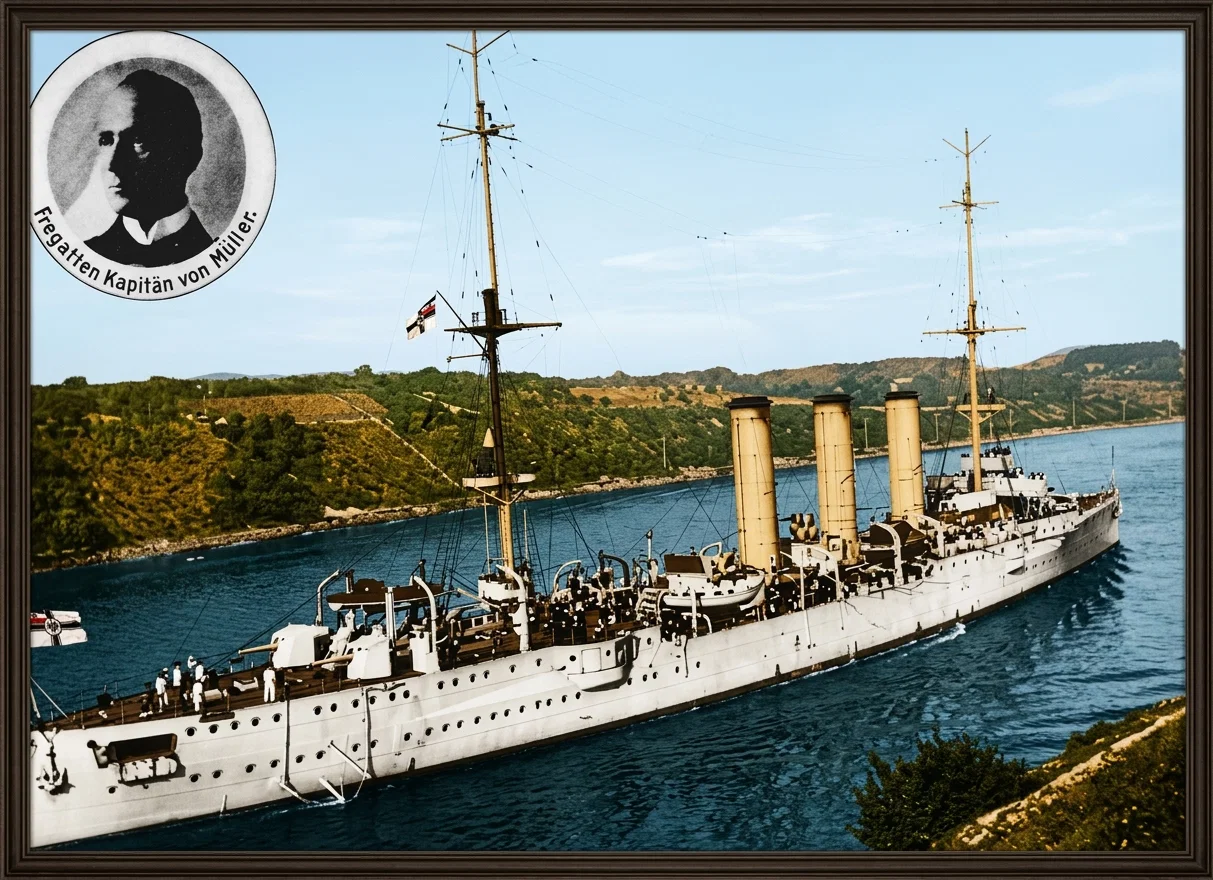
THE GERMAN CRUISER EMDEN, AND HER COMMANDER, CAPTAIN VON MUELLER
MANY TROOPS SENT
Many thousands of troops have gone on their long journey across the Indian Ocean to the battle front, and as many more are getting ready, and the numbers will probably be more than doubled soon. Word has come that our soldiers have been landed in Egypt, and soon, most likely, they will be in the conflict against the Turks.
A very remarkable idea obtains in the minds of many, and that is that this is the last great war, and that it is a war for peace. “All that is now necessary is to break Prussian militarism, and then the millennium is assured.” So while the war is raging, men are proclaiming for the future “peace and safety.”
How few know that the prophetic Word is being fulfilled in this awful conflict! Our great boasted civilization has broken down; for while man has undoubtedly been refined and educated and “cultured,” it is scarcely more than veneer, for in battle he oftentimes seems as barbarous as in the days of Attila or Alaric.
In a cartoon that appeared in one of the late magazines, the savage’s view of this war was well and truly presented. In his native wild sits the savage, reading a “war special,” under a tree, against which leans his great spear. And as he reads the terrible records of destruction and barbarity, he exclaims in disgust: “Och! The heathen!”
FIJI CHIEF AND WARRING CHRISTIANS
It is undoubtedly true that this war between so-called “Christian nations” must strike the non-Christian onlooker very strangely. Years ago, when the writer was a missionary in the Fiji Islands, the war broke out between Great Britain and the Boers. He was editing a little paper at the time, in the Fijian language, and some articles concerning that war were presented to our Fijian readers.
One day a Fijian Christian sought and obtained an interview. He was exercised over the war. His statement of the case from a native standpoint was pointed and convincing. It was much as follows: “The English and the Boers are both Christian people. They both employ chaplains to accompany and encourage their soldiers. These chaplains on both sides pray to the same God for the success of their respective armies. How can God answer both?”
Further the Fijian went on to remark: “We Fijians were a warlike people when English missionaries came to us with the gospel and told us it was wrong to fight. We listened to the gospel of peace, and after years of faithful teaching, yielded to the good advice. Our King Thakambau gave his war club to Queen Victoria, and war ceased in these islands. How is it that the English people, who taught us peace, now go forth to kill? Would it not be good, he asked seriously of the writer, “for some Fijian missionaries to go to England and preach the gospel of peace?”
What could be said in answer to such a searching argument? How could I explain that there is a good reason for war? What a severe stricture on our advanced civilization and reputed Christian teaching!
INDIVIDUALS, BUT NOT NATIONS
The nations are not Christian. Many individuals in all of them are; but the “narrow way” to life is not, and can never be, broad. The Bible teaches us that in the last days men will prepare for war and not for peace. They are doing what God said we might expect. See Joel 3:9-12.
Beneath the modern veneer of civilization and hypocritical refinement, man is, generally speaking, selfish, lustful, and easily stirred to wrath,—a prey to the great foe, who now, with his many agents, goes forth to the nations of the whole world to gather them to battle. Rev. 16:12-16.
There may come a lull in the storm, but peace cannot be assured. “There is no peace . . . to the wicked,” God has said. The end is near. The nations are angry; and the coming of Christ, which ends the reign of sin, is the only hope for peace. His coming is the “blessed hope,” and He is the “Prince of peace.”