EASTER AT JERUSALEM

4%

Pacific Press Publishing Association · Mountain View, California · Mar 16, 1915

FromSigns of the Times, Vol. 42, No. 11.

Read the full edition

EASTER AT JERUSALEM

Thousands of Pilgrims Assemble There from All Parts of the World—The Russians Predominate—Holding to Formalities—No Spiritual Help
By Ludwig Krug
It is a well-known proverb that Jerusalem is a city where people from all parts of the world meet. This was true even in the time of Christ; and it is true to-day, although the picture it presents is essentially different.
Easter is at present, as it was then, the climax of activity at Jerusalem. During the months shortly before Easter, large groups of pilgrims come streaming up to the ancient stronghold of Israel. The beginning of this pilgrim movement is a cause of rejoicing to the tradesmen and priests in Jerusalem, as they depend on these throngs of transients to replenish their money chests, which become empty during the slack times in the summer. It may be said with perfect propriety that the people of Jerusalem live upon that which they derive from the pilgrim strangers, and the money that is begged from all parts of the world.
The Russian pilgrims are the first to arrive. Small companies of them begin to come as early as the first part of November. From that time, every Russian steamer lands large numbers of pilgrims, some ships bringing as many as five hundred at one time.
About fifty per cent of all the visiting pilgrims are Russians. The remainder are made up of Greeks, Armenians, Coptics, Syrians, and Abyssinians. Besides these, there are many who come from America, Australia, South Africa, England, and the rest of Europe.
This last year, the authorities estimated that 22,000 pilgrims came in caravans, and 10,000 came singly. The different churches maintain large pilgrim houses for the accommodation of the great influx of strangers at this season. Before the last of the pilgrims reach Jerusalem, these are filled to the limit.
The better class of these travelers find entertainment at the numerous hotels, for which they pay handsomely. Guides, coachmen, and all other persons engaged actively in the traffic life of the city, advance their prices sharply. Everything in business life goes according to established custom.
To facilitate the handling of the pilgrim traffic, travelers’ bureaus have been established at various places.
The majority of these visitors bring their own bedding, and certain kinds of food. For example, the Armenians bring with them dried meat and grape honey, which is a sort of sirup made from grapes. The Russians bring little bags of ground grain, potatoes, and a quantity of old dry bread, which will be used at daily meals during the fast period.
On these occasions, the place that holds the greatest interest for the pilgrims is the “Church of the Holy Sepulcher,” which was built in the third century. It contains numerous chapels, and so many dark, partly subterranean passages, that unless one is familiar with them, he can hardly find his way through the structure.
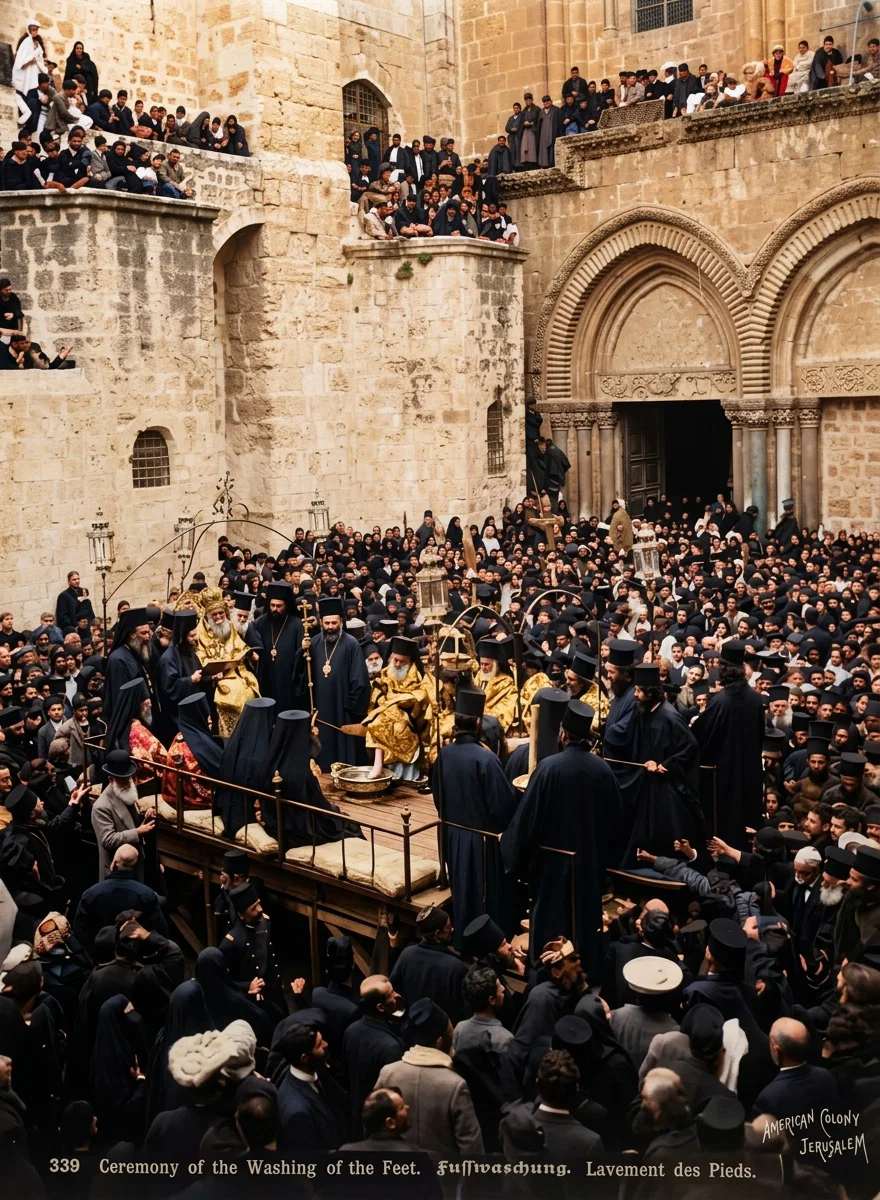
On a raised platform the Greek patriarch washes the feet of twelve priests.
The objects of greatest honor shown in this building are Golgotha, “the stone of the anointing,” and “the grave of Christ.” This great building, inclosing so many places of honor in the interior, is without ornamentation; but within it is richly appointed, having numerous fine paintings of saints. The lamps and other vessels used in the services are made of pure gold and silver.
A large company of well-kept priests are in the employ of this institution. Several confessionals are found in the church. The “Lowenanteil,” “the grave of Christ,” “Golgotha,” and “the stone of anointing” belong to the Greek Catholics. The Roman Catholics also have a part. The Armenians, the Syrians, the Coptics, and even the Abyssinians, have fixed themselves shrines outside the building.
With such a variety of races, holding different beliefs and traditions, it is impossible that these celebrations of Easter week should be conducted without strife or wrangling, unless extra police measures are taken. Accordingly, besides the regular police force, the Turkish government on these occasions keeps two companies of infantry to maintain order and peace in this assembly of worshipers.
Eastertide for the Roman Catholics and the Jews is a very peaceful occasion; but among the Greek Catholics there is excitement enough, and in part it is interesting to the observer.
There seems to be almost no end to “divine services.” On the so-called Palm Sunday, the Greek Catholics march with palm and olive branches in their hands to the Church of the Holy Sepulcher. On Thursday the ceremony of feet washing takes place. On a raised platform the Greek patriarch washes the feet of twelve priests. Thousands of people press around this platform, eager to witness the performance of the ceremony. Even the neighboring roofs are covered with spectators.
Everything is quiet on Good Friday; but on Easter Sabbath occurs the wonder of the holy fire, the origin of which dates back to apostolic times, according to church tradition. At noon the priest passes out the holy fire through a little window of the chapel to the waiting crowd outside. Hastily lighting their candles from this fire, they hurry away through the streets to their church, where another “divine service” begins.
During the night from Sabbath to Sunday, the celebration of the resurrection takesplace in the church. As soon as the clock announces the midnight hour, the tumult begins. The Russians kiss each other, and cry “Cristos Uashres”—Christ is risen.
Eastertide is at an end; but how many thousands have been deceived! And in their blindness many do not realize it.
Among these crowds of spectators is always a skeptic element. These are present for a purpose that is anything but to worship.
Heartfelt sympathy is called forth in every true man when he sees Russian women from sixty to seventy years old, laden with bags and the ever present teapot, starting out on foot for the various holy places, such as the Jordan River, Nazareth, Hebron, and others. Poor people, deceived by their priests!
It should be mentioned that the Mohammedans have instituted an opposition feature to these Easter services of the Christian churches, which occurs at the same time, and lasts eight days.
The Mohammedans from the villages far and near around Jerusalem assemble there, and march, led by dervishes, from the Mosque of Omar to “the grave of Moses,” which, according to their belief, is situated about half way between Jerusalem and Jericho. Here they remain for eight days, and on the last day the return march to Jerusalem is made. Both of these marches are attended with considerable excitement.
These services are all a series of formalities, and he who seeks for the inner spiritual life will be disappointed. But whoever would gain impressions he will never forget, let him ascend Mount Olivet either at sunrise or sunset, and there in deep contemplation call to mind the scenes of the life of our Lord and Master, Jesus Christ, and the story of His sufferings.