Economic Autocracy versus Political and Intellectual Democracy — Wanton Extravagance in Expenditure Flaunted in the Face of Destitution — The Growing Bitterness and Inevitable Clash
By PROF. G. W. RINE
Trans-Atlantic News Service Company
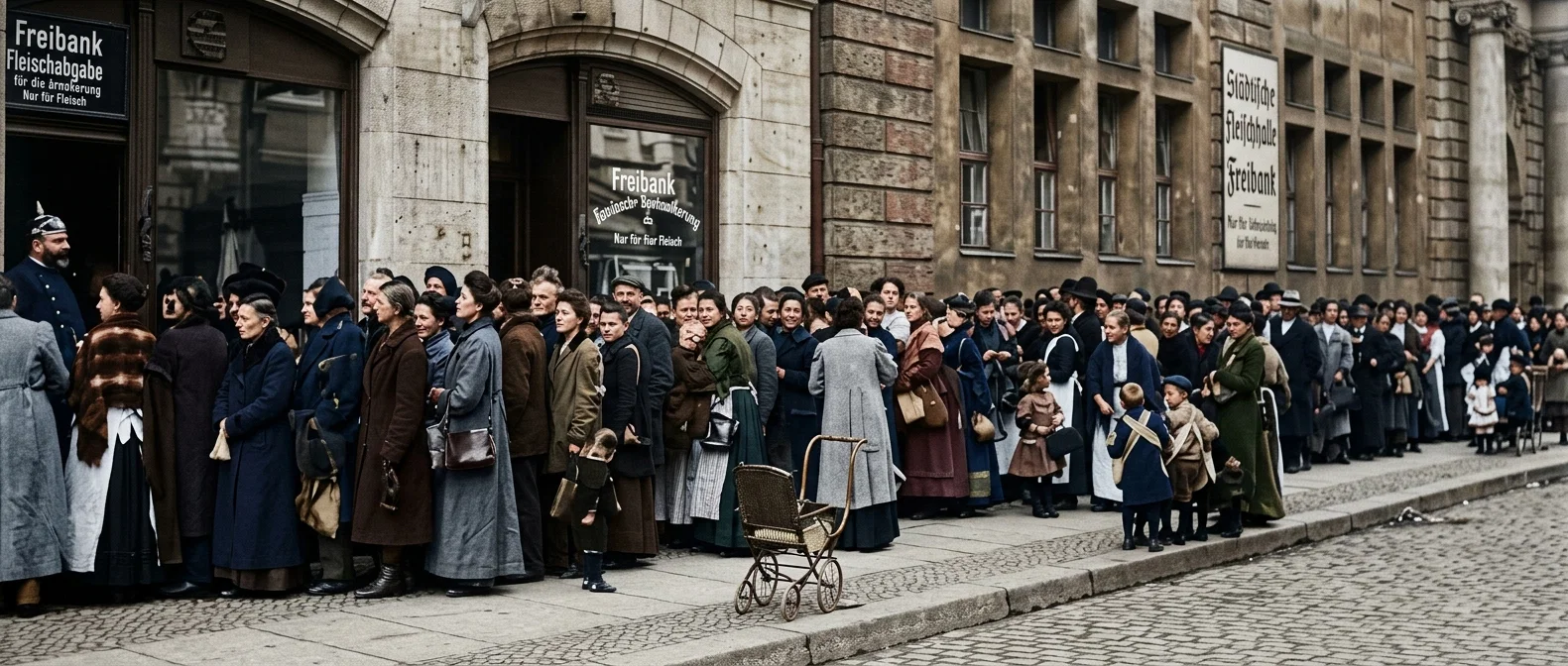
POOR PEOPLE IN GERMANY IN LINE TO GET CHEAP MEAT THAT HAS BEEN CONDEMNED IN THE REGULAR MARKETS FOR THE WELL-TO-DO
“Men Whose Pockets Are Chronically Empty”
This is Professor Rine’s third article on the industrial situation. Previous articles have told of the influence that modern means of travel and communication have had on the industrial world, of the enormous concentration of wealth in the hands of a few men, and some of the alarming problems that have sprung up in consequence. Each of these articles is complete in itself, in that it presents some distinct phase of the question. In the near future the professor will have an article viewing the subject from the prophetic standpoint.
EDITOR.
PRESENT-DAY industry is dominated by a relatively small coterie of men—the master spirits of finance. Industry is therefore in form and spirit essentially aristocratic, almost autocratic. In sharp antithesis to this economic feudalism stand our democratic political and educational institutions. This maladjustment is as ominous as it is obvious.
As long ago as 1888 a writer in the ninth edition of the Encyclopædia Britannica said, “The great American republic seems to be entering upon a new era, in which it must meet and solve a new problem—the reconciliation of democracy with the modern conditions of production.” But, as Dr. Strong reminds us, what seemed to be a peculiarly American problem a quarter of a century ago is in rapid process of becoming a world problem. The most characteristic and most nearly universal movement of recent times is the political and intellectual rise of the common people. The industrial revolution has become coextensive with the civilized world, intensifying the democratic movement by accentuating the spirit of popular discontent; and at the same time, under the influence of competition, massing capital and centralizing control, thus causing the organization of industry to grow increasingly autocratic—an abnormal condition, and as unstable and portentous as it is abnormal. In the language of Dr. Strong:
“The new industrial civilization stimulates the democratic spirit. Asia has been agricultural and despotic; it is to become industrial, like Europe and America, with a consequent impetus to the democratic movement.”
In illustration of this point, the same writer refers to the fact that on the eastern bank of the Nile at Karnak are stupendous ruins of ancient temples. The traveler is struck by the spectacle of massive pillars only lately fallen. He is informed, by the guide, that a recent overflow of the river, rising to an unwonted height, has reached and undermined their ancient foundations; and columns which had resisted the vicissitudes of time for thirty centuries, toppled to destruction. In like manner, a mighty tide of democracy is rising the world over, undermining ancient pillars of despotism; and democratic institutions in both church and state are being built on the ruins of autocracy.
Conversely, in modern industry increasing organization means increasing combination, with ever-increasing centralization of capital and of domination. A striking example of this latter movement is afforded by the recent combination of railways into ever greater systems, culminating in the Harriman railway empire. During the last several years of his life, Mr. Harriman virtually dominated about 75,000 miles of railroad, enough to cross the continent twenty-five times. In McClure’s Magazine for October, 1909, Burton J. Hendrick stated that Mr. Harriman exercised a taxing power almost as great as that possessed by any parliament—a glaring instance of taxation without representation.
Apropos of the maladjustment of our industrial system to our political system, Dr. Washington Gladden says:
“Our industries are still on an autocratic or feudal basis. We have been trying to correlate a political democracy with an industrial feudalism. They do not work well together. I do not think that they will endure together. They are antagonistic principles. . . . The working men will lose their political liberty or they will gain their industrial liberty.”
Several generations ago the difference in their possessions was but one of many differences between the rich and the poor. The former class enjoyed a monopoly of political power and of education as well as of property. “The ignorant poor, therefore, no more envied the rich their riches than they envied the birds their wings, or kings their scepters.” They felt that the monopoly of wealth by the few was the natural order of things, perhaps an expression of the divine will.
“Now,” says Dr. Strong, “all this is changed by the spirit of democracy, which spirit is asserting itself not only in western Europe but in the very seats of historic absolutism—Russia, Turkey, China, and Persia.”
Not only have the masses of the people the benefit of our public722school instruction, but multitudes are gaining a higher or liberal education. Approximately 400,000 students are receiving training in the colleges, universities, and professional schools of the United States, according to the latest census. Every few years these are replaced by augmented numbers.
The majority of these liberally educated men and women do not belong to the wealthy class. Having studied political economy and kindred subjects, they know much respecting the sources, the meaning, and the responsibility of wealth. By reason of their training they are capable not only of a profound discontent, but of an enlightened discontent. Again quoting Dr. Strong:
“Evidently the ancient monopoly of knowledge by the few and the rich has been destroyed, and its indestructible power has passed forever to the people. . . . Until modern times, political power, the power of wealth, and the power of knowledge have all belonged to one small class; and this threefold cord enabled the few to bind the many in an almost unbroken servitude. Such concentration of power created a condition of stable equilibrium. To-day the power of wealth is in the hands of the few, while political power and that which comes from education are both popularized. . . . There can not possibly be an increasing concentration of staggering wealth, increasing popular wants, increasing popular discontent, and increasing popular consciousness of power, without reaching a crisis.”
The evolution and diffusion of political democracy, the equality of all men before the law, the universality of educational facilities,—all these have begotten in the popular mind the unshakable conviction that our industrial oligarchy has become an unutterable anachronism. Political and educational equality breeds an irrepressible aspiration for economic equality.
An eminent publicist recently said:
“Add to man’s knowledge and you enlarge the world in which he lives; he sees a wider horizon; his future contains greater possibilities; he becomes conscious of new wants and higher aspirations, which, if they can not be satisfied, naturally breed discontent. . . . Popular intelligence makes the multiplication of popular wants inevitable; and the multiplication of popular wants, if more rapid than the improvement of the popular condition, necessarily produces popular discontent. . . . The masses will never be satisfied until their wants are supplied with the fulness of modern civilization.”
In other words, since the people are free politically and intellectually, they are determined to make themselves free economically. In the very nature of things, political freemen can not long remain industrial serfs. It is this glaring maladjustment that constitutes one of the most potent causes of the tense, world-wide social discontent. It is destined to be a prime cause in bringing about the universal social irruption, commonly referred to as the inevitable class war. That such a war is impending is attested not only by the leaders and makers of current history but also by the divinely inspired prophets of old. This ominous but inevitable issue will be discussed in a subsequent article.
We have seen that the modern revolution in industry accelerated the creation of wealth approximately a hundredfold, and that it is swiftly spreading over the world. No argument is needed to show that this enormous tide of wealth pouring into the lap of civilization is tremendously increasing the peril of luxury. It is a peril that always follows, like a blighting shadow, the influx of riches. Was it not the vast and sudden inflow of the precious metals from Peru and Mexico that stimulated the voluptuousness and decay that undermined the otherwise invincible strength and prowess of Spain, in the sixteenth century?
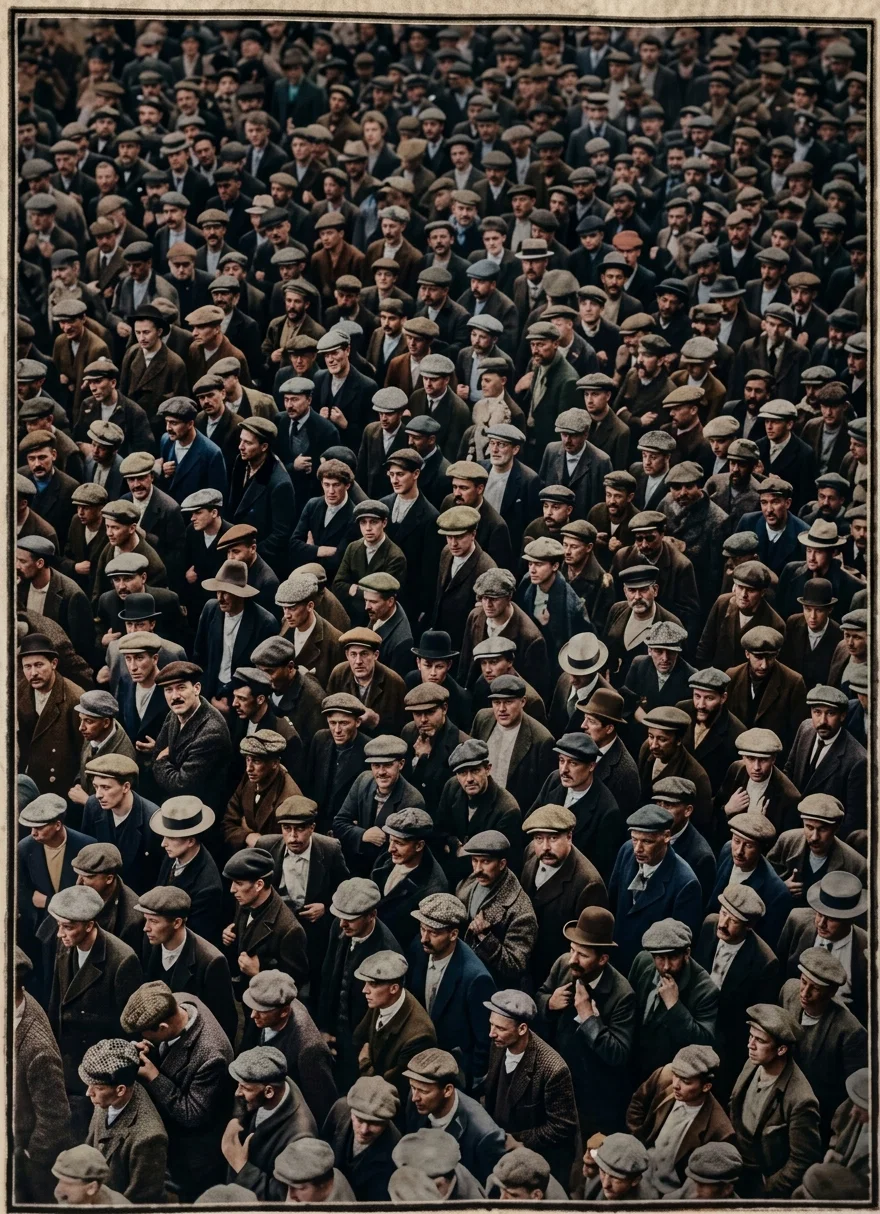
SMALL SECTION OF STRIKERS' MASS-MEETING IN ENGLAND (FROM LONDON "GRAPHIC")
“YE HAVE LIVED IN PLEASURE”
“Luxury renders effeminate, then sensuous, then sensual, and national sensuality means national decay.” Who ever heard of men being pampered into greatness? Herodotus said, “It is a law of nature that faint-hearted men should be the fruit of luxurious countries, for we never find that the same soil produces delicacies and heroes.”
The most serious and dangerous effect, however, of prodigal expenditure in self-indulgence on the part of the rich, is its unfailing tendency to excite envy and discontent in the breast of the masses. Think how men whose pockets are chronically empty must feel when they read of a dinner costing $250 a plate, of paying $1,000 for a hat pin, $10,000 for a child’s cradle, $20,000 for a man’s hat, $50,000 for a piano, $38,000 for a wash-stand, $65,000 for a dressing-table, $75,000 for opera-glasses, $280,000 for a string of pearls, $50,000 for a French poodle (with a private nurse, a private maid, and a private footman), and $600,000 for a diamond necklace!
What do the poor think when they read that a London woman of fashion spends more on her pet dog annually than a mechanic earns in the same period on which to support a family; when they read of a pink Persian kitten’s wearing a gold crown on its head and a gold order around its neck, and that its owner boasts of being the first to give a cat a pair of fine diamond earrings, because “bangles and necklaces had become so very hackneyed”? Does it lessen the discontent of the poor to read of a dog that has a complete gold service on which his daintily prepared meals are served to him, and that this dog usually rises at eight A.M., is combed and dressed, given some cream, and breakfasts at ten?
A year or two ago the papers minutely described the $7,000,000 mansion which had just been built, in New York, for a former United States senator. The edifice contained 121 rooms for one small family; it was fitted with a $300,000 pipe-organ, embellished with $2,000,000 worth of paintings, and beautified with $500,000 worth of Persian rugs.
At an elaborate banquet given in New York, each cigarette was rolled, not in white paper, but in a one hundred dollar bill. When the guests discovered this romantic method of destroying money, they greeted it with tumultuous applause.
At another sumptuous dinner given in honor of a dog, the host, in the midst of the dinner, formally decorated the dog with a diamond collar that had cost $15,000. Does it encourage indigent masses to feel satisfied with their lot when they read the much quoted remark of a young multimillionaire of New York, namely, “A man with $100,000 a year is in the unhappy position where he can see what a good time he could have if only he had the money?” The young nabob added that “easy circumstances” meant “a thousand dollars a day—and expenses.”
It is this wicked prodigality of selfish expenditure, this beastly wallowing in the luxury that unstinted wealth can command, which, as much as anything else, is intensifying popular unrest, and steeling the determination already cherished by millions of workers to overthrow the existing social and industrial system and build upon its ruins a radically democratic and collectivistic industrial regime. There are 30,000,000 Socialists in Christendom, besides several million Syndicalists, all of whose faces are set like flint toward world-wide social revolution.
Trans-Atlantic News Service Company
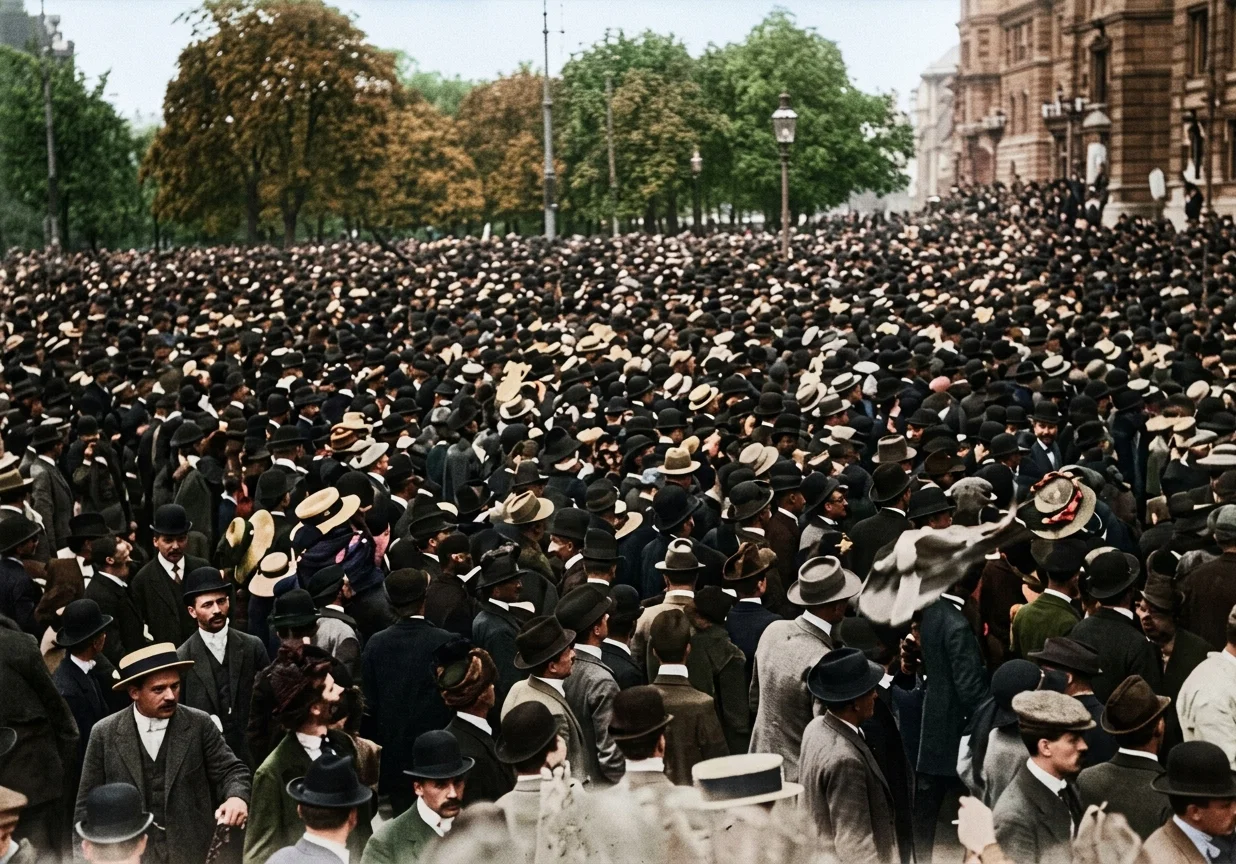
BREAD RIOTS IN VIENNA