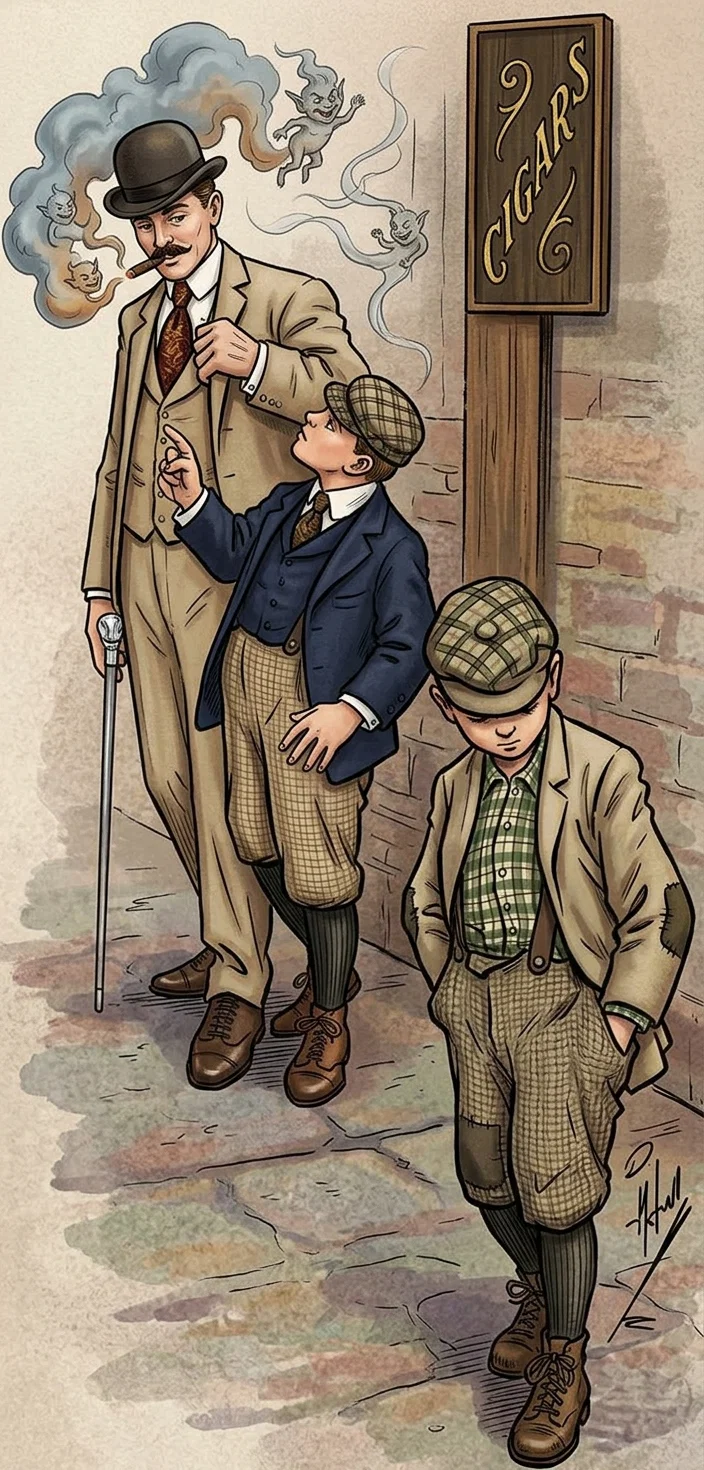
The Worst Menace to Our Boys—An Evil to Be Classed with Opium and Alcohol—Fathers and Mothers Should Be Aroused
By DANIEL H. KRESS, M. D.
This is the first of two articles by Dr. Kress on the degenerating effects of the cigarette. Concerning the doctor's investigations of the cigarette menace, the editor of “The Boy” magazine says: “There are probably few men who can speak more authoritatively upon the cigarette evil than can Dr. Kress. For many years, in his extensive travels and experience as a physician, he has made a careful study of the influence of the cigarette upon growing life.”
Every mother and father should carefully read these articles, and get their children to read them. They should form the basis for animated teaching and conversation in the home life. The conditions are so alarming as to cause parents to be earnestly and intelligently aroused.
Either of the two articles may be profitably read alone, for they are independent of each other. But each will be filled with interesting matter that furnishes material for profitable reflection.
EDITOR.
THE fight against the cigarette in America will, in the near future, resolve itself into a fight for national existence, just as, in China, the fight against opium has during the past few years.
When the opium plant was first cultivated in China, it was termed “the divine herb,” because of its soothing effect as a drug; and so long as the opium habit was confined to the few, it gave no concern, and little was said about it as an evil. But when its use became universal, and the evils resulting therefrom became apparent, China, in order to save herself from total demoralization and annihilation as a nation, was willing to sacrifice the annual revenue of over thirty million dollars that she received from the traffic. With her the fight against opium had resolved itself into a fight for national existence.
When Introduced in Japan
Three hundred years ago, tobacco was introduced into Japan. It was then considered a valuable drug, one of the most precious herbs the earth tendered to man; and so long as it was dispensed merely for medicinal purposes, nothing was said against its use. The time came when the people of Japan became enslaved to the tobacco habit to such an extent that her national existence was threatened. Boys not yet in their teens were addicts to its use in the worst form—that of the cigarette—and Japan found it necessary, in her own interest, to suppress the evil among her youths. In the year 1900 a bill was introduced into her national parliament forbidding the use of tobacco in any form by boys and young men under twenty years of age. This bill became a law on the first of April in the same year, and has been rigorously enforced.
Feared the Effect
The aim of Japan in this wise legislation may be seen from the following: The Hon. Mr. Nemote, in introducing the bill, said: “I would briefly give you reasons why we have introduced this bill. Recently even children in our public schools have come to use cheap imported cigarettes, the consequence of which we fear will bring our country down to the miserable condition of countries like China and India, because tobacco, like opium, contains narcotic poisons, which benumb the nervous system, weaken the mental power of children addicted to smoking; and thus to give point to our national policy, we must strictly prohibit the smoking of tobacco by children and young people. If we expect to make this nation superior to the nations of Europe and America, we must not allow our youths in common schools, who are to become fathers and mothers of our country, to smoke.”
It will be observed that their purpose in framing such a law was to make their country “superior to the nations of Europe and America.” They may never succeed in this effort; but they certainly recognize a principle which if strictly enforced, will go a long way toward its accomplishment. They class the tobacco habit with other forms of drug addiction, where it rightfully belongs, for it is purely a drug addiction, and cultivated because of its drug effect.
Denounced as a Traitor
When it was urged by a letter to members of the Japanese legislature that in passing such a bill, the treasury would be deprived of two hundred thousand yen annually, the Hon. Mr. Kabota replied: “He is a traitor. He is willing to sacrifice the character of our youths, simply for two hundred thousand yen. What wickedness! Such a person would most assuredly try to urge the use of opium by and by.” The fight against tobacco by her youths had in Japan resolved itself into a fight for national existence.
Inhaling the Smoke
Tobacco smoke inhalation was first recommended in England by physicians as a most valuable remedy in disease. Men, women, and children became addicted to the practice, and England too found the suppression of the evil necessary. Educational and legislative efforts were carried forward until, in writing of that period, Dr. Johnson could say, “Smoking has gone out.” For nearly one hundred years this continued. At the beginning of the reign of Queen Victoria (1837), any one found smoking on the streets of London was still considered “irretrievably bad,” and the practice, it is said, was confined to public inns.
It was not until after the Crimean war, when the English soldiers had been brought in contact with the Spanish and the French, that the drug was again introduced into England, and this time in the form of the cigarette. So general has the practice again become, that England is feeling alarm at the outcome. Her young men are stunted in their development, morally and physically.
Three Out of Four Rejected
Several years ago, when a call was made for young men to enter the army in her fight with the Boers, she found that three out of every four volunteers had to be rejected as unfit. Many of these suffered of what was termed “tobacco heart.” “They come to us,” said the examiners, “with their fingers stained with nicotine.” While alarm was felt at the time, so far nothing has been done to arrest the evil that is destroying her youth and threatening her future as a world power.
In a recent speech on finance, Sir Brampton Gordon, in referring to this, said: “The evil effects of the growing habit among boys of smoking cigarettes could scarcely be exaggerated. Without doubt it is a habit which leaves the rising generation deteriorated in physique. If in ten or fifteen years hence we should have the misfortune to be engaged in a great war, this habit among our youth to-day would tell against us.” In England the fight against the cigarette is again resolving itself into a fight for civilization and national existence.
How Spain Has Gone Down
Spain, the country which first cultivated tobacco, and for a time supplied the entire civilized world, has possibly suffered more than any other nation from this practice. She was once the wealthiest and most prosperous nation upon the earth, possessing the richest colonies. Her trade in tobacco, it is said, proved to be more profitable to her than her gold mines of India. But while money was pouring into her treasury from this source, she was ruined by this habit which had fastened itself upon her youth and women. Spain failed to recognize that her real asset as a nation was not her wealth, but her boys and girls. She has been reduced to poverty; her colonies have one by one been taken from her, the last American colony she was deprived of being Cuba, the island upon which, four hundred years ago, she discovered among the naked savage this practice of tobacco using.
France is a dying nation. Already her death rate exceeds her birth rate. How much the prevalent use of cigarettes by her boys and women has to do with this degeneracy, may never be scientifically demonstrated; but that it is one of the chief causative factors, is evident.
Smoking Was Forbidden
The Puritans and the early American settlers were all haters of tobacco. Laws existed against its use. There are men still living who are able to recall the time when smoking on public thoroughfares was forbidden in our Eastern towns. At that time, America gave birth to men whose moral and intellectual worth we to-day reverence. America has become a great nation, but she is not securely great.
Gradually the pipe was introduced into America, then the cigar, and within the past fifty years the cigarette, and with it smoke inhalation, the worst form in which tobacco can be used.
Forty years ago smoke inhalation was practically unknown in America. To-day it is common. Ninety-three per cent of those who apply for aid at our clinic, conducted in the large cities of America, I have discovered are smoke inhalers.
The cigarette is rapidly crowding out the pipe and the cigar.
The pipe has about disappeared; and during the past ten years, while the consumption of cigars has increased eight and one third per cent, the consumption of cigarettes has increased over four hundred per cent.
We consumed in 1913, in America, about fifteen billion American manufactured cigarettes, bringing in revenue to our government93the sum of seventeen million dollars, and a net profit to the manufacturers of over thirty-five million dollars. There were consumed, during the same period, probably twice as many imported and hand-rolled cigarettes. It is safe to say we consume at present forty billion cigarettes annually, making an average of over twelve hundred for every male inhabitant over ten years of age. Should these be laid end to end, they would encircle the earth over fifty times. The deplorable thing is that boys so readily become victims of this practice. During 1913, there were born in America about one million two hundred thousand male children. Eighty per cent of this number will take up with tobacco, and begin with the cigarette. Each day of last year, probably twelve hundred boys took their first smoke, and were introduced to this drug addiction.