Islam Fighting for Her Existence—In the War-Stricken Balkans—The Decrees Calling All Mussulmans to Arms
By L. RICHARD CONRADI
THE solemn declaration of the holy war of Islam took place on November 14, in Constantinople. The writer did not arrive until a day later; but he could learn, during the days immediately following, a great many particulars.
A trip to Turkey at the present time is accompanied by many difficulties. During the past, an American passport and a visé of the Turkish consul sufficed. That is not the case to-day. Now the American passport must have attached to it a photograph of the owner, bearing the seal of the American consulate. Then one must declare under oath what countries he intends to visit. This is certified by the consul, and the statement is plainly made that as mission director of the European Division, the undersigned is entitled to visit such and such countries. Besides all this, Austria-Hungarian, Roumanian, and Bulgarian visés were necessary, as the journey takes one through these lands.
NO CERTAINTY OF TRAVEL
The question of the time-table presents still greater trouble. While formerly one could easily tell when he would leave home and when he would arrive in Constantinople, to-day all is uncertainty. One can ascertain the facts as to the time of prosecuting the journey, only as he goes from country to country. The same holds true in the purchase of the tickets. Formerly one could secure a return ticket without the least difficulty. To-day tickets can be bought for the journey one way through each country. Reaching Bulgaria, I even found that the price of the ticket is in gold, and not in paper value. But as I had sufficient time to see the exchanger, I could secure the gold at a discount of seventeen per cent.
WAR WAS IN THE AIR
Though Roumania and Bulgaria were still neutral, yet they were both exerting themselves to the utmost to strengthen98the fortifications of Adrianople, and everywhere along the railway line military guards carefully watched every crossing and every bridge. The noted Tshataldsha lines were passed once in the daytime, and thus we had every opportunity to view their strength. A big valley divided two high ranges of hills. The north was held by the Bulgarians, and the south by the Turks. Broken-down wire fences, and here and there signs of graves and ruined buildings, still witnessed of the battles fought here.
The trains were overcrowded with young recruits, called in one or two years before time for them to serve. Also old reserves were enlisted for a new course of military practice. War was in the air everywhere. The borders were strongly guarded, luggage and passports closely searched on both sides of the frontiers.
The two leading routes that formerly connected Budapest with Constantinople are to-day both closed to traffic—the one going through Servia, the other from Roumania by boat through the Black Sea and the Bosporus. But providentially a year ago a third route was opened. This route leads from Bukharest to Giurgevo, where one has to cross the Danube for Ruschuk; then by rail over the noted Shipka Pass to Tirnovo, whence we enter upon the old route from Belgrade. In other words, Bulgaria has succeeded in building a railway through the Balkan Mountains which connects the continent with Constantinople by land, without touching Servia.
Along the railway the Bulgarian border has been extended but very little. It is still over two hundred miles from the Bulgarian border to the city of Constantinople, because of the winding bed of the railroad through the mountains.
Nearing Adrianople, one still perceives many traces of the Balkan war; but the iron railway bridges, the stations, etc., were all renewed. Considerable work was going on to strengthen the fortifications of Adrianople, and everywhere along the railway line military guards carefully watched every crossing and every bridge. The noted Tshataldsha lines were passed once in the daytime, and thus we had every opportunity to view their strength. A big valley divided two high ranges of hills. The north was held by the Bulgarians, and the south by the Turks. Broken-down wire fences, and here and there signs of graves and ruined buildings, still witnessed of the battles fought here.
IMPROVEMENTS IN CONSTANTINOPLE
Reaching Constantinople late at night, I found the city changed for the better, during the last three years. A fine modern bridge now connects the old Turkish city with the European quarters, across the Golden Horn. The main streets have been widened to give ample space for fine modern electric street cars. The only thing Turkish about them is the small curtain that reserves the apartment in front for women. The soldiers all wore khaki; and even the red fez, which would be an excellent target in modern warfare, had given way to a khaki head covering. Military automobiles were rushing through the streets.
DECLARATION OF HOLY WAR
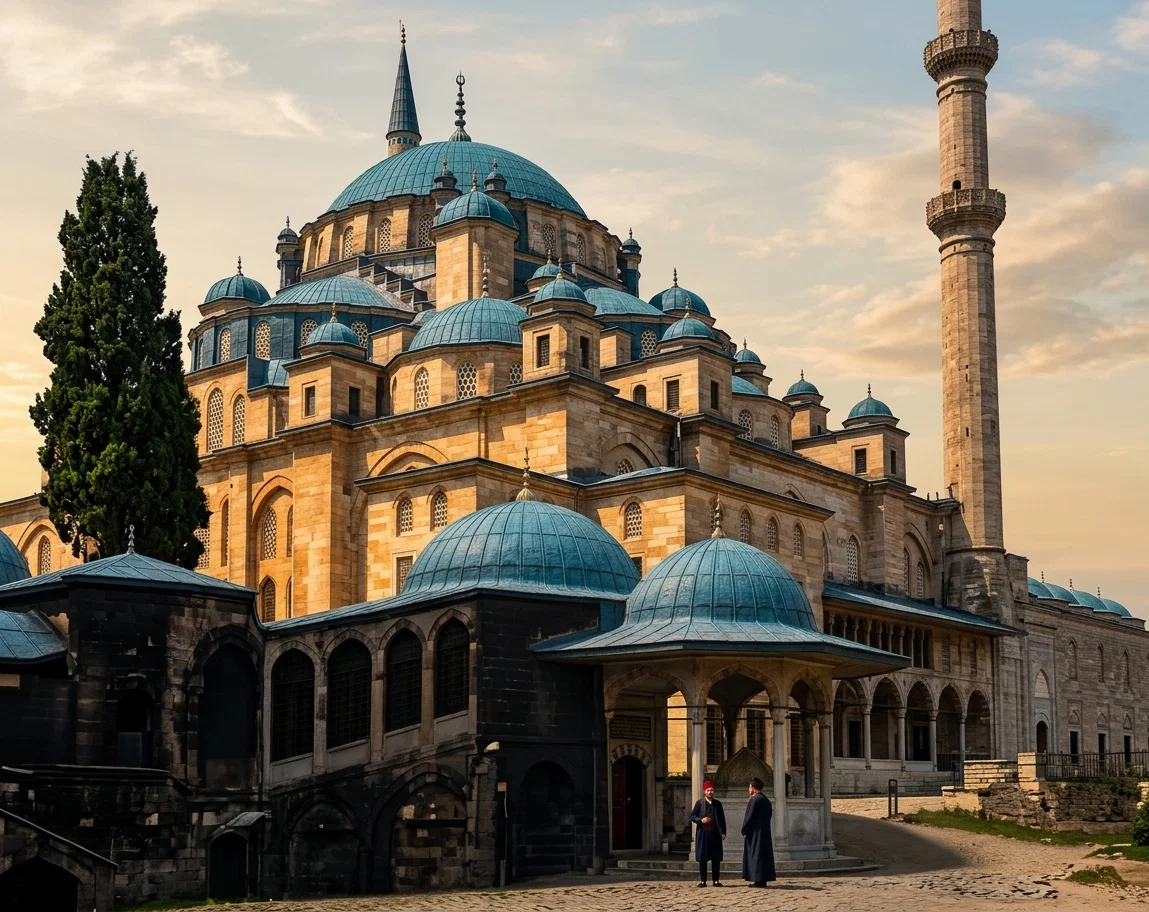
The streets were all adorned with Turkish, Persian, and also German and Austrian flags, in honor of the declaration of the holy war the day previous. This declaration took place in and before the mosque of Mohammed II, conqueror of Constantinople. The Greek architect Christodulos (the servant of Christ) erected this mosque during the years of 1463-1469 on the site of the church of the apostles built by Justinian. Divers earthquakes damaged it so it had to be restored several times. Two minarets about two hundred and fifty feet high adorn this mighty building. It consists really of a complexity of buildings, the main part serving as a mosque, the other parts for schools, dormitories, kitchen for the poor, hospital, inns, and baths.
Mosque of Mohammed II, from Which the Holy War Was Declared
The interior is marked by its great simplicity. On a marble slate the following prophecy of Mohammed is written in golden letters: “They shall conquer Constantinople; blessed the prince, blessed the army, which shall accomplish this.” Nearly eight hundred years passed before his successors were able to conquer this city, and now its fate is at stake, and they are about to lose it again.
The following report from the Osmanic Lloyd, November 15, about this great celebration, may be of interest:
“THE GREAT DEMONSTRATION OF THE OSMANS
“Yesterday Stamboul experienced such a day as she never saw before, perhaps. From the earliest morning hours the city presented a very animated picture. All houses were decorated with Turkish flags. In some streets and quarters there were also Persian flags, and here and there German and Austrian. An immense multitude streamed to the mosque of the conqueror in the Fatih quarter. Great crowds collected from all directions. All trade-unions and societies were headed by brass bands. All were bound for the holy place which should be the theater of a mighty demonstration. The people knew that the caliph had approved of the five futwas (decrees), written by the futwa Emini, which were to declare the holy war, and these decrees were to be read to the believers from the great platform of the Fatih mosque. The large public place before the mosque was crowded by an innumerable multitude of people. A special delegation of the sheik ul Islam arrived at noon, according to the program, in a court carriage, before the mosque. The delegation was accompanied by the fire brigades. The delegation at once went into the mosque to read the futwa shereef. After the noon prayers, the futwa Emini Ali Haidar Effendi ascended the pulpit, and read to the multitudes the text of the five decrees.
THE DECREES OF THE HOLY WAR
The Five Futwas.— These important historical documents which seal the participation of Turkey in the great European war read as follows:
“First question: The enemies assaulted Islam. They have appropriated and taken possession of Mohammedan countries. They have maltreated and subjected Mohammedan populations. As we have full evidence for these facts, the ruler of Islam has called the entire male Mohammedan population from seven to seventy years of age, to participate in the holy war. Is therefore the holy war a duty for all Mohammedans? and shall not old and young on foot or on horseback, Mohammedans of all countries, engage in this holy war, with all their possessions and with their blood, according to the words of the Koran: Raise an army of small and great, and enlist in the holy war with your substance and blood?” The answer of the sheik ul Islam is, “Yes.”
“Second question: The three powers, Russia, England, and France have with their men-of-war assaulted the seat of the caliphate, and the land of the sultan, in order to extinguish and destroy Islam—which God prevent—by hostilities against the Mohammedan caliph. This has come to our knowledge. Is it not a holy duty for all Mohammedans who live under the government of these powers and of the states allied with them to declare the holy war and to engage in battle against all these powers and states?” Answer of the sheik ul Islam, “Yes.”
“Third question: In order to reach this high purpose, it becomes necessary that all Mohammedans on earth participate in this holy war. In view of this, are not those—God forbid that there be such—who do not participate in this holy war, worthy of the wrath of God, and the severest eternal punishment?” Answer, “They are.”
“Fourth question: If the governments of the hostile countries intimidate their Mohammedan subjects by threatenings, even if they say that they would kill their wives and children, is it not still the greatest sin for the Mohammedans to join the war against Islam, and will they not as murderers share the greatest torments of hell?” Answer of the sheik ul Islam, “Yes.”
“Fifth question: As it harms the supreme caliphate if the Mohammedans subject to France, England, and Russia, and the allied states, enlist against Germany and Austria-Hungary, which are allied to the caliphate, is it not to be regarded as the worst sin, attended by the greatest punishment of hell, if they do such?” Answer, “Certainly.”
“Signature: Hari-bin-Avni.”
These decrees being read, prayers were offered for the success of the Turkish empire as well as for that of the allies, Germany and Austria-Hungary. After the prayer, the representative for Smyrna Sejd Bey gave a patriotic speech, declaring that the war of Turkey is not to be compared with a common war of conquest, but that the very existence of the nation depends upon it. This speech closed the historic celebration before the mosque. Then an immense procession started from here to the Sabiline Porte, where speeches were exchanged with the ministers; and thence to the residence of the sultan, who also made a formal reply; and finally to the German and Austrian embassies. These historic decrees were written with the very pen of Sultan Mohammed II which had been preserved in the imperial treasury, and it has since been deposited in the war museum. The tower that the Russians erected at San Stefano, in memory of the war of 1878, was demolished.
While all the English, French, and Russian places of business had been closed, the Ottoman, German, and Austrian banks were open. As I had undertaken the trip mainly to furnish our workers in that field with the3necessary means, I found no difficulty in securing in exchange Turkish and English gold, and the new Turkish paper money is at par with the gold. Before I left the Turkish border, I was, however, closely questioned as to whether I had any gold with me.
The future must reveal what effect this will have on the 200,000,000 of Mohammedans, of whom 74,000,000 live in English colonies, 26,000,000 in the French, and 13,000,000 in Egypt and the Sudan.