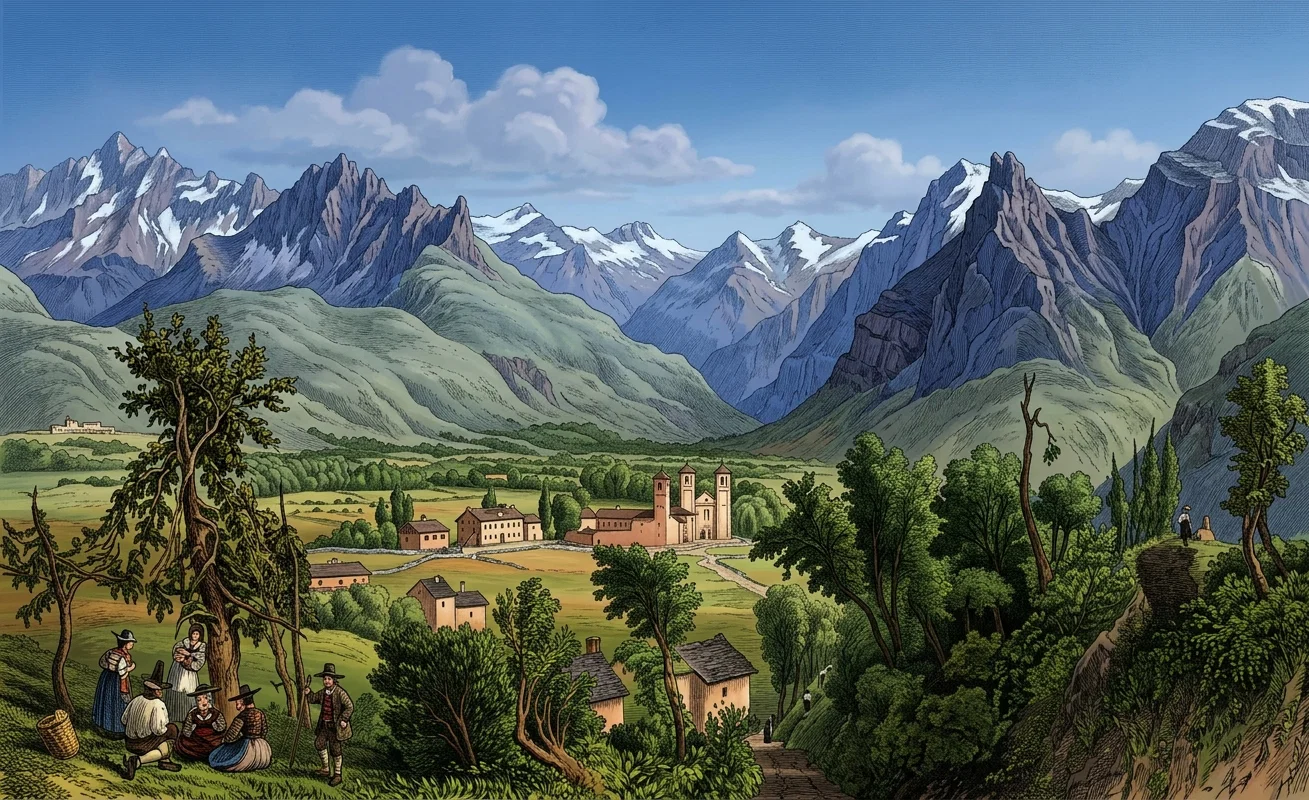
The Waldenses in Their Resolute and Persistent Missionary Activities—All Europe Invaded by Their Devoted Workers
By H. H. Hall
In two previous articles, Mr. Hall has traced the history of the Waldenses back to the days of the apostles, and told some of the leading tenets of their faith that have made them such a vigorous, long-suffering, and interesting people.
EDITOR.
A people who were familiar with the story of Abraham, Joseph, Moses, Elijah, Isaiah, Jeremiah, and Daniel, of the Old Testament, and with the apostles, and particularly their spiritual father, St. Paul, in the New, and who quoted so enthusiastically St. James's statement that “faith without works is dead,” could not but be a missionary people.
Their own conception of their debt to the world is well set forth in their ancient insignia, which is reproduced on the next page,—Lux Lucet in Tenebris, or “Light Shining in Darkness.” This appeared in Jean Leger's history of the Waldenses, printed in 1669, and is also stamped in gold on the cover of the beautifully illustrated edition of the history of the Waldenses by William Beattie, issued in 1838. When they first adopted this motto, we do not know, but it must have been an ancient one. And what a motto this was for a small, poverty-stricken people, walled up in the center of Europe, with the hands of every man against them! How well they carried it out may be at least conjectured from the following facts and incidents.
Their Missionary Methods and Experiences
As their most powerful agency was the Word in the tongue of the common people, and as the inquisitor was ever on their track, they early learned to concentrate their energies upon the transcription and circulation of portions of the Bible706and gospel tracts. One of the earliest documents with which we are acquainted is a poem entitled “A Noble Lesson,” apparently written in the year 1100, but which some authorities assign a somewhat later period. This remarkable missionary document is a summary:
Of the history of the creation.
Of the state of the world before the Deluge.
Of the state of the world from the Deluge to the time of Abraham.
Of the patriarchal and Mosaic dispensations, laws, polity, morals, etc.
Of the sins of the Israelites, and the judgments of God.
Of David, and other good kings and prophets.
Of the captivity of Babylon.
Of the return from Babylon.
Of the advent of Jesus Christ, and a parallel between the law and the gospel.
Of the mission of the apostles, the descent of the Holy Ghost, and the primitive church.
Of the gross errors of the papacy, the simony of the priesthood, masses and prayers for the dead, the impostures of absolution, and the abuse of the power of the keys.
The reader can readily imagine the contrast the poem draws between the primitive church described in No. 10 and that of Rome referred to in No. 11.
A List of Their Books
A wonderful commentary on the quantity and variety of their gospel documents in early days is found in the following extract from Perrin's history of the Waldenses, book 1, chapter 7. He is speaking of a certain pastor, Vignaux by name, who died in 1605, and who had labored for a half-century among the Waldenses, during which time he had gathered up many of their books, a list of which he gives:
“We have certain ancient books of the Waldenses, containing catechisms and sermons, which are manuscripts written in the vulgar tongue, wherein there is nothing that makes for the pope or popery. And it is wonderful that they saw so clearly in those times of darkness, more gross than that of Egypt.”
“First we have in our hands a New Testament in parchment in the Waldenses' language, very well written, though with a very ancient letter.
“Also there is a book entitled ‘The Antichrist.’”
“In the same volume there are contained divers sermons of the pastors of the Waldenses, with a treatise against sin, and the remedies to resist sin.”
“Also a book entitled ‘The Book of Virtues.’”
“In that volume there is another treatise with this inscription . . . ‘Of the Instructions of Children.’”
“A treatise of marriage.”
“A treatise entitled . . . ‘Sentences of Philosophers and Doctors.’”
“A commentary or paraphrase upon the symbols of the apostles.”
“A treatise of the sacraments.”
“A commentary or paraphrase upon the commandments.”
“A commentary upon the Lord's Prayer.”
“A treatise of fasting.”
“A treatise of tribulation.”
“A little catechism entitled ‘Interrogations Menors.’”
“A treatise against dancing and taverns.”
“A treatise of four things to come, that is to say, death unto all, eternal life to the good, hell to the wicked, and the last Judgment.”
“A treatise entitled . . . ‘Of the Dream or Invention of Purgatory.’”
“A treatise against the invocation of saints.”
“We have also a book very ancient whereof the title is, . . . ‘This Is the Cause of Our Separation from the Church of Rome.’”
“There is also a book, wherein there are many sermons of their barbes, and an epistle called ‘The Epistle to Our Friends, Containing Many Excellent Doctrines to Teach All Sorts of People How to Lead Their Lives in All Ages.’”
“In the same volume there is a book entitled ‘Sacredorium,’ wherein is showed what is the charge of a good pastor, and what the punishment of a wicked.”
“There is also come to our hands a book of poetry in the Waldensian tongue, wherein are these treatises following: a prayer entitled ‘New Comfort,’ a rime of the four sorts of seeds mentioned in the gospel, another entitled ‘Barque,’ and one called ‘The Noble Lesson.’”
“We have also an excellent treatise entitled ‘Vergier de Consolation,’ containing many good instructions, confirmed by the Scriptures and divers authorities of the ancients.”
“Also an old treatise in parchment entitled ‘Of the Church,’ and another called ‘The Treatise and Light of Faith.’”
“Also a book entitled ‘The Spiritual Almanac.’”
“Also a book in parchment, of the means to separate things precious from the base and contemptible, that is to say, virtues from vices.”
“From hence we conclude, that that doctrine that hath been maintained in our times against human inventions, is not new but to those that have buried it wilfully, or whose ancestors have detested it, out of their ignorance of the goodness thereof; there being found divers writings, and that in great number, which make good that for these four hundred and fifty years the doctrine of the reformed churches is the selfsame which for many ages hath been buried by ignorance and ingratitude.”—Perrin's “Waldenses,” part 1, book 1, pages 43–45, 67, 68.
“Light Shining in Darkness”
Ancient Insignia of the Waldenses
As the foregoing list was prepared in the sixteenth century, and by a man who died in the valleys at the age of nearly a hundred years, it constitutes a powerful testimony to their missionary activities and methods.
Peter Waldo's New Testament
About the year 1170, Peter Waldo, a rich and influential merchant of Lyons, France, embraced the doctrines of the Waldenses. Some authorities regard Waldo as the founder of the Waldenses; but the facts presented in previous articles, and many more collected by Dr. Muston and the Rev. Mr. Gilly, disprove this theory. All his wealth was devoted to the translation, copying, and circulating of portions of the Scriptures and such writings of the fathers as were in harmony with the gospel. Dr. Gilly maintains that the entire New Testament was translated from the Latin Vulgate into the Romanut, that this was in the twelfth century, not later than 1180, and was the first translation available for popular use, and that it was probably made under the supervision and at the expense of Waldo. His influence was wide-spread, and soon came to the attention of Pope Alexander III, who threatened with the direct punishment any who should dare hold the slightest communication with the reformer. He fled to Germany, where he died; but the Scriptures and the tracts which he had caused to be circulated continued their work. (See pages 20 and 21 of Gilly's “Excursions.”)
Their Missionary Zeal
Of their missionary zeal another author says:
“There was nothing more remarkable about the early Waldenses than their missionary spirit. It was by sending out missionaries, two by two on foot, to visit their brethren dispersed in various lands, that they kept alive the little piety which existed in the world at that day. These missionaries knew where to find their brethren; they went to their houses, held little meetings, administered the ordinances, ordained deacons, and sustained the faith and hopes of the tempted and persecuted ones. It is said that these missionaries could go, at one period, from Cologne to Florence, and stay every night at the houses of brethren. It is on account of the great number of missionaries which these little and poor churches in the valleys sustained, that we read of there being sometimes one hundred and forty or fifty ministers at the meetings of their synods. But few of these were needed at home; the most were engaged in the foreign work.”
“It is also remarkable that almost all the men whom God raised up from time to time, in France and other countries, for more than six hundred years before the Reformation, seem to have had more or less to do with the Waldenses, such as Peter Waldo, Peter Brays, Henry of Lausanne, and Lollard.”
“Not only did preachers go out from the valleys to proclaim the glorious gospel, but humble, pious pedlers, or itinerating merchants, of whom there were many in the Middle Ages, scattered the truth by carrying some leaves of the word of life, or some manuscript tracts, beneath their merchandise, which they engaged those whom they found to be favorably disposed, to receive and read.”—“The Waldenses,” Presbyterian Board edition, pages 43, 44.
And the historian Wylie offers the following beautiful tribute to their faithfulness:
“To maintain the truth in their own mountains was not the only object of this people. They felt their relations to the rest of Christendom. . . . They were an evangelistic as well as an evangelical church. It was an old law among them that all who took orders in their church should, before being eligible to a home charge, serve three years in the mission field. . . . Their mission field was the realms that lay outspread at the foot of their own mountains. They went forth two and two, concealing their real character under the guise of a secular profession, most commonly that of merchants or pedlers. . . . The door of the cottage and the portal of the baron's castle stood equally open to them. . . . They took care to carry with them, concealed among their wares or about their persons, portions of the word of God, their own transcription commonly, and to this they would draw the attention of the inmates. . . . There was no kingdom of southern and central Europe to which these missionaries did not find their way, and where they did not leave traces of their visit in the disciples whom they made.”
“Thus did the Bible in those ages, veiling its majesty and its mission, travel silently through Christendom, entering homes and hearts, and there making its abode.”—“History of the Waldenses,” by Wylie, pages 15–18.
Missionary Work a Business
An interesting side-light is thrown upon their missionary activities through their having befriended Ivo of Narbonne in the middle of the thirteenth century. He gave the Waldenses an oath of fidelity, and promised to propagate the new faith. They gave3him letters to professors of the same belief in different cities, who treated him as a brother. He then reported to the archbishop that—
“They had churches in almost all the towns of Lombardy, and in some parts of Tuscany, which sent up young men to Paris to be instructed in the scholastic logic and theology, with the view of their being qualified for entering the lists with the advocates of the Church of Rome; and that their merchants, in frequenting fairs and markets, made it their business to instil their tenets into the minds of the rich laymen with whom they traded, and the landlords in whose houses they lodged.”—M'Crie's “Reformation in Italy,” page 5.
A Persecutor Converted
The following curiously worded but representative story of a monk's conversion shows how effective were their missionary efforts:
“About the year 1330, they were strangely vexed in many parts of Germany by a certain Jacobin monk inquisitor, named Eckard; but after many cruelties executed upon them, as he pressed the Waldenses to discover unto him the reasons for which they were separated from the Church of Rome, being convinced in his own conscience, and acknowledging those defects and corruptions which they alleged to be in the Church of Rome to be true, and not being able to disprove the points of their belief by the word of God, he gave glory unto God, and confessing that the truth had overcome him, he became a member of that church which he had a long time before persecuted to the death. The other inquisitors, being advertised of this alteration, were much displeased, and they sent presently so many after him that in the end he was apprehended, and brought to Heidelberg, where he was burned.”—Perrin's “Waldenses,” part 1, book 2, page 130.
An Outsider's Impression of a Colporteur
The following was found among the memoirs of Christophe de Saliens, secretary to the bishop of Valence, and as it was written fifteen years after the incident occurred, shows how deeply he must have been impressed with his one experience with a Waldensian colporteur:
“Fifteen years ago, . . . one Talmon of Beauregard said to me, ‘There are two men in my house, whose discourse is full of sweetness and wisdom; will you come and hear them?’ I went; and the most aged of these persons began to read a little book which he carried with him, assuring us that it contained the precepts of the divine law. And, indeed, he delivered excellent maxims, such as, ‘Thou shalt not do to another what thou wouldest not that he should do to thee’; and he said that the Sabbath should be observed with more respect than all the other festivals, which have been established only by the church; that God alone has power to save us, and that good works done by a man before his death, will profit him more than those which are done for him when he is no more; and, finally, that the clergy have been corrupted by wealth, whilst the barbes have always remained in evangelical poverty.”—“Israel of the Alps,” volume 2, page 160.
The Constancy of Girardet
The following is taken from the testimony of a man who was known to have some intercourse with the Waldenses:
“Being at Briqueras in 1529, I met Louis Turin of St. John, who took me into his house on business. Our business being ended, another inhabitant of St. John, named Catalan Girardet, came to see us, and invited us to accompany him as far as La Tour, where he said we would hear things that were good; Louis Turin himself pressed me to accept the invitation, and we set out. When we had arrived at La Tour, Catalan conducted us behind the house of Chabert Ughet. . . . We entered into a great apartment where many persons were assembled. There a barbe, named Philip, preached, and after his duties were over, he asked me some questions, and instructed me in certain points of their religion.
“‘What did he say to you?’
“‘That there is no salvation but in Jesus Christ, and that we ought to do good works, not in order to be saved, but because we are saved.’
“However, as this witness had not ceased to attend mass, he was not disturbed, but a prosecution was commenced against Catalan Girardet, who had drawn him to that meeting.”
“The fear of death had no greater effect in shaking his constancy. He was condemned to be burned alive. On the way to the stake, the monks who attended him still tried to persuade him to abjure. ‘Why should you be obstinate in your heresy?’ said they; ‘your rude and barbarous sect will soon be, like your own flesh, consumed in a moment.’ Taking up two stones from the road, and rubbing them one against another, Catalan Girardet exclaimed in reply, ‘It would be easier for me to rub these stones to powder, than for you to destroy our churches!’”—“Israel of the Alps,” volume 1, pages 201, 202.
Their Work in England
Perhaps the most far-reaching of their missionary labors were those put forth in England by Lollard. Some authorities call him “Friar Rainard Lollard,” while Gilly and Peyran list him among the Waldensian pastors as “Walter Lollard.” He was burned in 1350 at Cologne. He wrote a commentary on the book of Revelation in which he spoke plainly of Rome as antichrist. As in many other instances, the way of the missionary had been prepared by the work and death of humbler confessors. In 1154 Waldenses had been burned in England, and in 1210 John Bale mentioned the burning of a man in London because he professed the religion of the Waldenses. While we do not say that Wyclif received the gospel from Lollard, the reformed doctrines which he represented must have had their influence upon that great man in a general way at least.
Among the historical references to the relation between Lollard and Wyclif is the following:
“Friar Rainard Lollard was then the most powerful instrument which God used, by exhortations and sound reasons, to give knowledge to the English of the doctrine for which the Waldenses were delivered to death. This doctrine was received by Wyclif, . . . who thereby obtained much help for the increase of his knowledge in the truth. He was a renowned theologian in the University of Oxford, and parson of the parish of Lutterworth, in the diocese of Lincoln; an eloquent man and profound scholar. He won the hearts of many English, even of the most honorable of the land, as the duke of Lancaster, uncle of King Richard, Henry Percy, Lewes Gifford, and the chancellor, the earl of Salisbury. By the favor of these great personages, the doctrine of the Waldenses, or of Wyclif, took footing, and had free passage in England.”—Perrin's “Waldenses,” part 2, book 2, page 133.
Wyclif's stand against the domination of the state by the church, his battle with the swarm of begging friars, his powerful appeals to the people through his sermons and the host of tracts which he wrote and which the people gladly distributed, and above all else, his translation of the English Bible, and the army of copyists (for printing was then unknown) and preachers whom he employed and directed,—all this and much more is too well known to require reprinting here. But when we think of Wyclif as “the morning star of the Reformation”—for such he was—let us not forget those other stars who, from their native Alps, shone less brilliantly perhaps, but none the less constantly throughout the long, dark night preceding the dawn.
Yes, the Waldenses were a missionary people. By the side of their insignia, “Light Shining in Darkness,” they held that other motto, “In the morning sow thy seed, and in the evening withhold not thine hand.” Well has the poet set forth in the story of a single missionary, the methods and experiences of thousands of others:
The Vaudois Missionary
“O, lady fair, these silks of mine
Are beautiful and rare—
The richest web of the Indian loom,
Which beauty's self might wear.
And these pearls are pure and mild to behold,
And with radiant light they vie.
I have brought them with me a weary way.
Will my gentle lady buy?”
“And the lady smiled on the worn old man,
Through the dark and clustering curls
Which veiled her brow as she bent to view
His silk and glittering pearls;
And she placed their price in the old man's hand,
And lightly turned away;
But she paused at the wanderer's earnest call,
‘My gentle lady, stay!’”
“O, lady fair, I have yet a gem
Which a purer luster flings
Than the diamond flash of the jeweled crown
On the lofty brow of kings;
A wonderful pearl of exceeding price,
Whose virtue shall not decay;
Whose light shall be as a spell to thee,
And a blessing on thy way!”
“The lady glanced at the mirroring steel,
Where her youthful form was seen,
Where her eyes shone clear, and her dark locks
Waved
Their clasping pearls between,
‘Bring forth the pearl of exceeding worth,
Thou traveler gray and old;
And name the price of thy precious gem,
And my pages shall count thy gold.’”
“The cloud went off from the pilgrim's brow,
As a small and meager book,
Uncased with gold or diamond gem,
From his folding robe he took.
‘Here, lady fair, is the pearl of price.
May it prove as such to thee?’
‘Nay, keep thy gold—I ask it not—
For the word of God is free.’”
“The hoary traveler went his way—
But the gift he left behind
Hath had its pure and perfect work
On that high-born maiden's mind;
And she hath turned from her pride of sin
To the lowliness of truth,
And given her human heart to God
In its beautiful hour of youth.”
“And she hath left the old gray walls
Where an evil faith hath power,
And courtly knights of her father's train,
And the maidens of her bower;
And she hath gone to the Vaudois vale,
By lordly feet untrod,
Where the poor and needy of earth are rich
In the perfect love of God!”