The Indians of South America—The Conditions and the Opportunities
By DELWIN REES BUCKNER
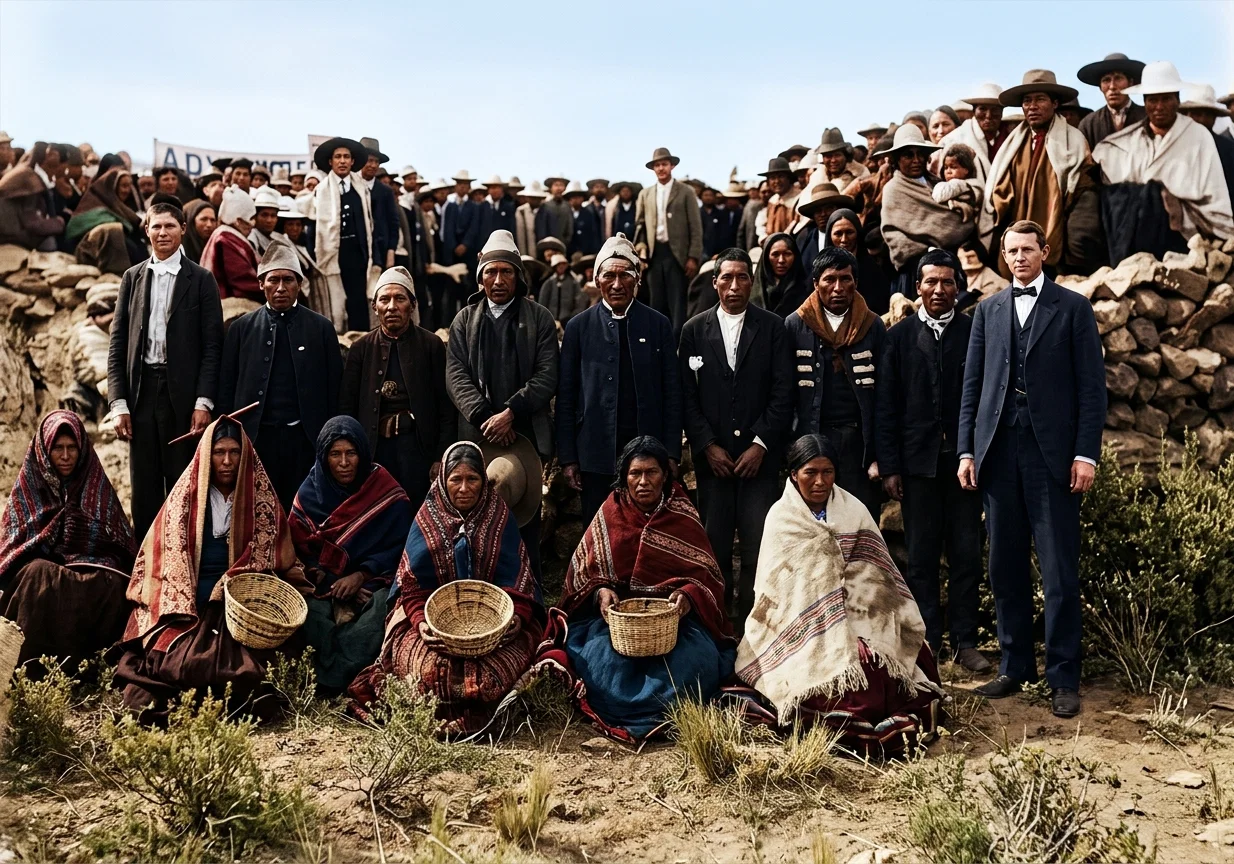
GROUP OF SOUTH AMERICAN INDIANS, WITH SEVENTH-DAY ADVENTIST MISSIONARY TO THE RIGHT
The other day a band of Indians—I do not remember whether they were Matacos, Chorotes, or Tobas—were coming from the sugar-cane plantations of Tucuman and Salta, all laden with “fire-water” and firearms which had been received in exchange for the services they had rendered in the cane fields. As these Chaco Indians very often cause considerable trouble for the colonists and soldiers of the forested northern territories where they live—or, better said, roam, as they do not remain for a great while in any particular spot—having heard that the Indians were nearing their homes, and fearing that later they might go on the war-path, the military officials of the district determined to disarm them, which, however, they succeeded in doing only after a pitched battle in which several combatants lost their lives.
For rum and guns the Indians go scores of miles. Would that there were missionaries now on the plantations who could impress upon these children of the forests the evil of the liquor and firearms—especially if they intend using the latter in a war of vengeance and extermination against the white people who have recently begun to settle as colonists in their territory. O, that they might receive soon the glad tidings of great joy which would make them wise unto salvation! Erelong the time will come when they will rush from the north to the south and from one ocean to another in search of the water of life; but then it will be everlastingly too late to procure it, for ere that day come, probation time will forever have ended.
And they are not the only Indians that should be receiving the message for the present age of the world. We find them all over the Western Hemisphere, but nowhere in such dense darkness perhaps as in the forests of South America. Often have I wondered how they would all be told of the third angel’s message, of the message of the coming Saviour. Yet God will provide the way somehow, and that, too, just at the most opportune time. Before long, aeroplanes will undoubtedly be soaring all over the Amazon Valley, exploring the different corners of the various regions, and describing tribes of men hitherto unknown to us. Railroads, too, are being pushed more and more back into the pathless jungles. The recent Mamore line has opened up a great extent of new territory.
Meeting the Automobile in Peru
Only a few days ago I was reading in Caras y Caretas, a weekly review of Buenos Aires, about a French traveler who, late at night, found himself alone in a dense forest in the eastern part of Peru, not far from the Madre-de-Dios River. As there was not even an Indian hut for leagues around, he began to be alarmed, fearful lest he fall a prey to the jaguar or some other wild beast as savage. Suddenly, however, he heard a strange yet seemingly familiar noise, and a few moments later discerned the glaring lights of an automobile. In it there were two American engineers, who were just returning from a visit to some gold-mines recently acquired by a syndicate in the United States. Even the “neglected continent” is slighted no longer. Excursionists now come in great numbers to the Argentine Republic, as well as the other countries of South America. And when the Panama Canal is completed, many more will turn their faces toward this part of the world.
There are other things, too, which set people to thinking about the countries that determine their directions at night by the Southern Cross in place of the North Star. The Creator of all men recently allowed the atrocities of the Putumayo region in Peru to come to light the same as those in the Kongo under King Leopold’s tutelage, in order that the people who take the name of Christian might interest themselves a bit in the dreadful condition of their red-skinned brethren of the less civilized and less favored countries of the earth.
Scars Caused by the Lash
According to Sir R. Casement, who left Rio de Janeiro, Brazil, and traveled especially to the Putumayo to give this government an unbiased report on the existing conditions of that locality, at least ninety per cent of the Indians bear scars that were caused by the lash. According to a recent Southern Cross, the Irish paper of the Argentine, several Franciscan monks recently left Ireland for the Putumayo district. God grant that erelong some self-denying, fully consecrated bearers of God’s last message to mankind may also find their way to that neglected region.
Protestants are working among the Indians in several places in South America,—in Paraguay, Ecuador, etc. Thank God that in Bolivia and Peru something is now being done by the remnant church of God for the former owners of the Western Hemisphere. Among the Aimaras a school has already been started, and among that tribe of Indians—which, by the way, is supposed to speak the same language that was the secret tongue of the Inca monarchs—and the Quichuas there has already grown up quite an interest in the Bible doctrines and tenets as taught by Seventh-day Adventists.
The young people’s societies of the Argentine are very much interested in the school work among the Indians of Lake Titicaca, Peru. One member has purchased ten shares. Each share is sold for $5.00 Argentine money, which would be about $2.20 American gold. As many as sixty-five shares had been bought, up to last accounts. The plan seems a very good one for interesting young people in missionary work, and money spent in this line of Christian endeavor will certainly yield a hundred per cent of interest in this world, and in the one to come as well. God loves and blesses abundantly the cheerful giver who has His undying interests really at heart.780
Adventist Missionaries Among Those Indians
Concerning the work among the Indians of Bolivia, one who is well qualified to judge as to its progress, has said the following, published in the January number of La Revista, of Buenos Aires:
“The work advances. Daily the people come to us, creoles as well as Indians, desiring to find out about our work and receive help for the many ills of which they complain. Many come begging that kind of medicine that will cure them of the drink habit, assuring us that they know of a number of men who have not drunk since visiting this mission. What an opportunity is presented for telling them of Jesus, that He is a personal Saviour, and that we should at once ask Him to aid!”
“At first they are surprised, but we kneel down and pray earnestly for them, since we feel very anxious to help these poor souls, so utterly in bondage to sin. Then we counsel them, handing them pamphlets or leaflets to study and carry away with them to their homes. Sometimes, too, we call brother Indians to tell them of their own experience, which is, in a few words, this: ‘One thing I know, and that is that whereas I was blind, now I see.’”
“A few weeks ago I baptized eighteen persons, among whom were many young people, all of whom had considered well the cost beforehand. We exert special efforts to win over the young people, explaining to them what an inestimable privilege it is to find the Lord while one is yet young. And a blessed sight it certainly is to see young men and women choosing to serve their Lord. . . .”
“The school is about to open, old people as well as young being anxious to attend. All wish to know how to read the precious word of God for themselves. In each of our meetings, we have all read the Bible who know how to do so. And the Indian is always satisfied with a ‘Thus saith the Lord.’”
By this letter we see how the message speeds. Soon it will go with a mighty impetus which neither men nor devils will in the slightest manner be able to prevail against. There are many Indian tribes which still must hear of the gospel, but some way will be forthcoming. He who formed man from the dust can easily provide the way by which he may be warned of the day of wrath and how to escape it. God did not destroy the antediluvian world before He had given all a chance to repent. After they had had opportunity to accept or refuse Noah’s message of God’s mercy to them, then and only then did the Creator of all flesh overwhelm the world with a flood of waters. To the world of to-day comes the same message of pity and mercy. Ere the sharp two-edged sword mow down the unregenerate, finally impenitent dwellers on the earth, Christ’s Spirit must plead with every heart to soften and repent before it be eternally too late. Poor Indians! But a short time will be theirs in which to correct the habits of years and the inborn hereditary tendencies of ages of darkness. Yet Pentecostal showers of the latter rain will be able to change hearts in a moment by a miracle of divine grace.
Many Tribes to Be Reached
The Araucanians, who for three centuries—until 1883—maintained their independence in the southern part of Chile, unconquered by either Spaniard or Chilean, must receive a knowledge of the advent message as soon as possible. Then there are the Fuegians also still in densest darkness, one tribe of which has a vocabulary of something like 20,000 words. The Puelches and Tehuelches in Patagonia have yet to be warned. In Brazil there are the Maipures and Karaibes between the Amazon and the Orinoco. In the eastern part of the same republic, as also the central and the western, there are the Tupis. Besides these are the Ges and Tupi-Guaranis. In all the other Latin-American countries, too, at the present moment there exist numerous tribes, each with its peculiar complex language, which makes missionary work more difficult for God’s messengers. And yet He who helps His people through all difficulties, bountifully gives of His Spirit, that they may in a short time overcome the inconveniences of a strange tongue. Then, too, as the railroads push out into hitherto unentered territories, and communication with distant points becomes more general, the Indians, to carry on trade with the white merchants or those of mixed race, will learn the language they speak, Spanish or Portuguese, depending upon whether the former or the latter tongue is the official one.
The Pope Shocked by the News
Going back to the much discussed Putumayo horrors, it may be of interest to the readers of the SIGNS OF THE TIMES to know that the pope of Rome has been considerably shocked at the news. The Southern Cross, of Buenos Aires, seemingly an authority on the subject, says:
“The holy father has been greatly shocked at the revelations with regard to the horrible outrages at Putumayo. . . . He is in communication with the Peruvian government on the subject.”
According to the same authority, on June 7, 1912, the pope issued an encyclical dealing with the Putumayo incident, which reads as follows:
“When we consider the crimes and outrages still committed against them [the Indians], our heart is filled with horror, and we are moved to great compassion for this most unhappy race. For what can be so cruel and so barbarous as to scourge men and brand them with a hot iron, often for a mere lust of cruelty; or, having suddenly overthrown them, to slay hundreds or thousands in one unceasing massacre; or to waste villages and districts, and slaughter the inhabitants, so that some tribes, as we understand, have become extinct in these last few years! . . . For our part, indeed, when reports of these things were first brought to us, we hesitated for some time to give credence to such atrocities, since they certainly seemed to be incredible. But after we had been assured by abundant witnesses, we can no longer doubt as to the truth of these statements.”
It seems to us that the pope who wears the triple crown to-day has more compassion in81his heart than his predecessors. There is a saying that Rome never changes, which Protestants at one time generally accepted as true, although some now think that Catholicism must have altered somewhat in recent years. But they forget all about the Inquisition and Torquemada; all about how men endured untold agony upon the rack, which was employed to extort confessions from persons suspected of so-called heresy; how their bones were wrenched out of joint, and agonies of all kinds that men and devils could invent had to be endured by the poor souls who dared think for themselves away from the beaten path which Rome traced out for them. After enduring the rack, they were sometimes allowed their liberty, but even then the rest of their lives they were usually physical wrecks. More often, however, they were sent to the galleys or burned at the stake as heretics.
Rome forgets all this now—or, better stated, pretends to forget it—to win Protestants to her sullied standard. Pope Pius’s heart, outwardly at least, bleeds for the poor Indians of the New World. But does he not know of the crimes that his predecessors on the throne of the Vatican committed in Lima and other South American cities,—how by means of the Inquisition they tortured poor Indians on the rack and at the stake far more than the English company has ever done?
And yet we do not in any way countenance the deeds of the British rubber company. We condemn them. They partake too much of the nature of the Inquisition of the Old and the New World. God grant that after all the agitation over the incident, some good may result for the enslaved rubber gatherers. May the gospel in its purity, untarnished by traditions of men, be carried to these poor, unfortunate men and women—our neighbors, bruised by the wayside. And may some at least receive the freedom that a merciful God ever stands ready to offer those who will accept it.