NGWE ZIN boarded the train with all the nonchalance of his fifteen Burman years. The people of his race are full of the laugh of life, and he was exceptionally so. Head up, walk a swagger, lips ready to accost any and every one with a pleasantry, he sat down on the narrow board seat of the third-class compartment, and deposited his bundle by his side. With the same air, he lighted a cigaret, and blew smoke out the window, his feet perched on the opposite seat. He looked the personification of self-satisfaction. Nothing mattered.
But this was all on the outside. Ngwe Zin was troubled. The careless demeanor was habitual, but beneath it there slumbered a conscience. He wanted satisfaction, that boon we all want. His mother had been a Buddhist nun, and had lost her mind, and his father was rather indifferent about him. He was going to live with his married sister in Rangun. Perhaps the great city held what he desired.
A Burmese Gentleman
The long train curved snakelike among the far-reaching rice-fields. Ngwe Zin looked out, but did not see. He was thinking of a legend of the great Gautama, which his father had told him that day. In a former existence, Gautama had been a calf, and when his mother drank at the brook, he inadvertently drank from a little way up-stream, and muddied the water which his mother was drinking. For this breach, he was fated forever after to have all water become muddy as soon as he raised it to his lips. Strange truth, this! Ngwe Zin recalled a recent experience in which his susceptible conscience had been overurged to get him to seek the jungle places near Maulmain where the priests lived an ascetic life, and had to be supported in their walk because their food was “vegetation.” He sought the peace they seemed to have, but it was not for him. Perhaps the Good Man would yet lead him in the true way. But just now he was on the point of giving everything up that disciplined, and starting to do just as he pleased. What was the use of trying, anyway? Other people were happy, why shouldn't he be? This endless trying-to-do-right-and-can’t was maddening. The Christians were the best favored, and hadn’t their God helped them to rule almost the whole world? Yet every one said that Burma had become more wicked, and there was more disease, since the Christians came. The puzzle of “things as they are” was too much for him.
A Burmese Girl
As the train rolled on, vague plans for the future became a part of his reverie—vague because he knew so little about the city and its ways. With but a change of clothing and his ticket to Rangun, he must now make his own way in the world; and what place would his scant knowledge of English and his little other education find for him? He was eager and willing, but—Nicotin just then called for another puff, and on suiting the action to the desire, he found that the cigaret had “gone dead.” And his matches were gone, too. How careless! (No, how providential!) He looked around, and saw a man and a boy watching him.
“Is there a match with you?” he asked; and after he said it, he noticed the man had been reading a book, and there was a pleased expression on his face.
“No,” came the answer, as the man put his hand on the book, “I have a Light, but I haven’t a match. I don’t drink smoke.”
“Strange,” thought Ngwe Zin; and he asked aloud, “What book do you read?”
“The Bible.”
“O, a Christian!” and there was a tone of dampened friendliness in his voice. “You are a Christian, and you don’t ‘drink smoke’? How is that? I learned to smoke cigarets at a Christian school. Doesn’t the Christian’s God ‘drink smoke’?” This in a bantering voice.
The man looked displeased, and the boy laughed.
“No, God doesn’t ‘drink smoke;’ and true, enlightened Christians don’t, either. It is a bad habit,—bad for the body, and the mind, and the heart. I know a Christian school where neither the teachers nor the boys ‘drink smoke.’ I wish you could go there.”
Well, here was a new thing in Burma, and Ngwe Zin caught at the idea. He was informed of a school at Meiktila where the boys were taught morals and hand-work as well as the book lessons the other schools taught. Yes, poor boys could have a chance; for the tuition fees were low, and if a boy were diligent he could earn his way. He would emerge from the school with a trade, a character, and a trained mind.
Ngwe Zin questioned in his mind about “coolie work” being in any way desirable, but here was a chance to get “book learning,” and it was not to be scorned. This well-appearing man was a teacher in the school, and was now on his way there. Perhaps it was all untrue; but he was absorbed in it, and the time passed quickly till the train arrived at Pegu. Here the erstwhile fellow travelers parted, and in two hours Ngwe Zin was being jostled by the crowd at the Rangun station.
His sister lived in a poorer section of the noisy city. Burma’s metropolis seethed like a caldron at this season. The intense heat was accentuated by the crowded condition. The choky dust, the filth of the foreign element the rabble among whom he was as nothing, disgusted him in a short time. What chance here without money? Then he opened his heart about that school, and a sympathetic sister heard with interest. It appealed to them. A will was born, and a way was sure to follow. Somehow she got13together ten rupees for him, and half of it was spent for a ticket to Meiktila. God bless her sacrifice! She is dead now, but that was the greatest thing she ever did.
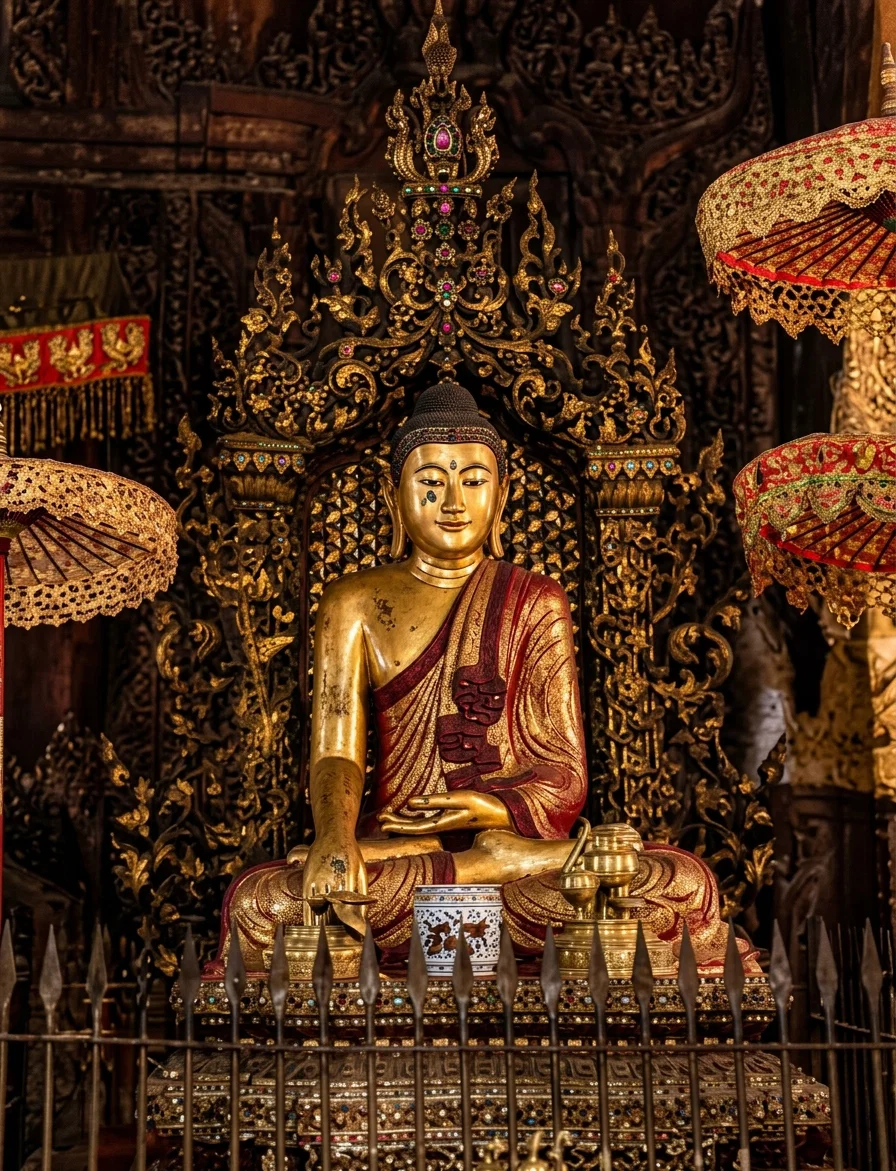
A Burmese Buddha
The boy came without previous notice or arrangement; and the next morning, before daylight, he was landed at the “desired haven,” but hardly knowing “whether he went.” There were no likely persons astir to guide him, so he sat down on a step and waited—waited for some one to come, for he was sure some one would come. At daylight the very boy whom he had seen with the teacher on the train, passed that way. Hailing him and making explanations, the rest was easy. We took him on the recommendation of his efforts to reach us.
At first he was disappointed. His natural love of a big show was not satisfied. There was only a rented building, and no school compound. No trades were taught yet, and there were but few boys. But it offered a better chance for an education than did Rangun or home. Little did he realize that an institution is as great as its principles, and that the most privileged persons in the world are those who do not despise the “day of small things,” but are pioneers in a noble work. The teachers treated him kindly, and took a personal interest in helping him to improve; and soon he was at home, with one exception—the hated Christianity.
He had held the indifference of youth, even to Buddhism, before; but now that he was feeling its hold on him loosen almost before he knew it, he was roused to fight for it with desperation. Ngwe Zin was honest and energetic, and these very traits made him an ardent disciple of the Indian prince, when his cause was assailed. But nothing was said to discountenance his faith in Buddha. The simple truth was told, but it brought forth many a hard-fought argument with the teachers. And this worthy champion of heathenism had the self-confidence to believe that he could reason the best. Perhaps he was right. But there was that Book. He couldn’t fight a book, and yet its contents and spirit were fighting him every day.
Like others who, in spite of their pride, are compelled to acknowledge to themselves that they are gradually losing ground, Ngwe Zin now tried to hide his discomfiture by smoking, and by doing everything else he knew the missionaries didn’t want him to do. Contempt was his last weakhold. His cult sadly needed defending, but he had made poor work at its defense.
Down by the lake, one day, he sat despondently looking at the lap of the wavelets on the pebbly shore. All at once, in that way familiar to Christians who seek God, there flashed into his prejudiced mind a little light. Why, these people had the satisfaction that he had vainly sought! Their religion helped them to live lives of peace in spite of the glaring inconsistencies of it. And after all, isn’t this all that is worth while? Surely the truth alone can beget peace. Why hadn’t he seen it before? Gautama tells us how to do right, but Christ helps us do it. The great gospel truths which had been seeking entrance to his heart, had at last found lodgment. And once entered, they pervaded his whole knowledge, and suffused his entire thought and life. Gautama merits. Jesus saves. This is Christianity. O that he had only known it before! Every one would accept it if they only knew. He must tell them. And right there was born in his soul the saving spirit that was not to pass away. Again nothing mattered, but how different the feeling!
Ngwe Zin is forward, and fights a good battle on either side, when he is sure he is right. He grasped the Bible truths with avidity, and imparted as he learned. At almost one stroke, he stood forth a man in Christ. Rarely are seen changes so complete as his. Enslaving habits were dethroned; the feasts and fasts and foolishness of Gautama-as-he-is-worshiped lost their lure; rice and curry became secondary; and he boldly sought “first the kingdom.” No work was too hard, no place too humble. Like Samuel, he delights to keep in order the house of God. Nothing pleases him better than to lead his schoolmates to Christ. Three years from the time he came to us, he is now preceptor in the school. Rising bravely above objectionable character traits within and strong opposition from without, he stands to-day, just merging into manhood, at the beginning of usefulness for God, a trusted servant, an intelligent student, an energetic worker, a monument to missionary effort.