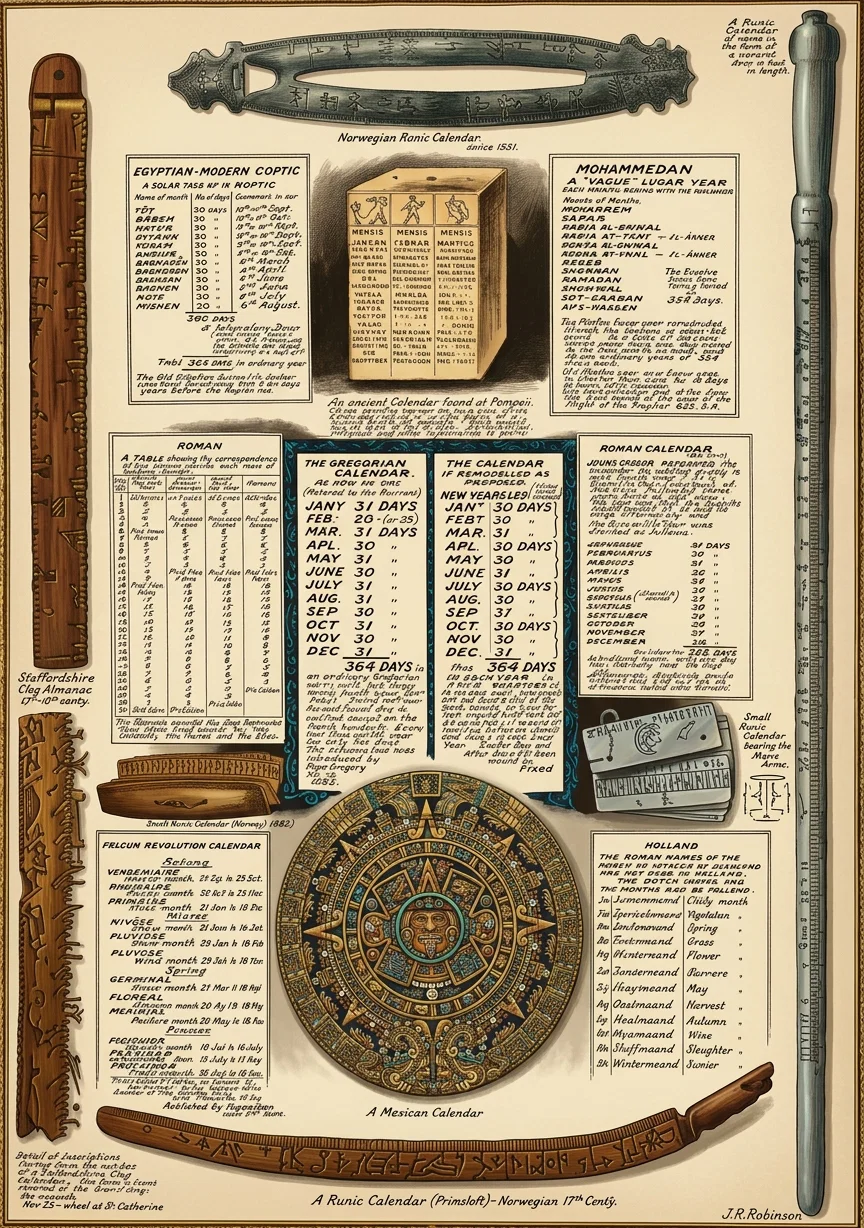
If there has been one thing which has caused more or less trouble since men began to reckon time, and commercial intercourse became prominent between the nations, it has been the calendar. There has been, on the part of men who love order, a great desire to have a uniform calendar. We present on another page a diagram of various calendars which have been used in time past, taken from the “Illustrated London News” of April 22, 1911.
There is the old Staffordshire Clog Almanac; there are the details of the inscription issued from the notches of a Staffordshire Clog calendar; there are three Norwegian Runic calendars, a Mexican calendar, a Holland calendar, a Roman calendar in the time of Julius Cæsar, a Mohammedan calendar, an Egyptian modern Coptic calendar, a cubic calendar found at Pompeii, a Roman calendar showing the correspondence of the Roman months to those of modern Europe, a calendar of the French Revolution, the Gregorian calendar as now in use, and one of the new calendars proposed, which will make the first day of the year an “Anno day,” or, as the English term it, a bank holiday, giving January 30 days, February 30, March 31, April 30, May 30, June 31, July 30, August 30, September 31, October 30, November 30, December 31. That is to say, the last month of each quarter will have 31 days, all the others 30. The year will be a 364-day year, consisting of four quarters of thirteen weeks each, New Year’s Day not being a day of the week, month, or quarter, nor would leap-year day be counted. It would be inserted between June 31 and July 1 in each leap-year. Easter Day and other holidays would then be fixed, occurring at the same time in every year.
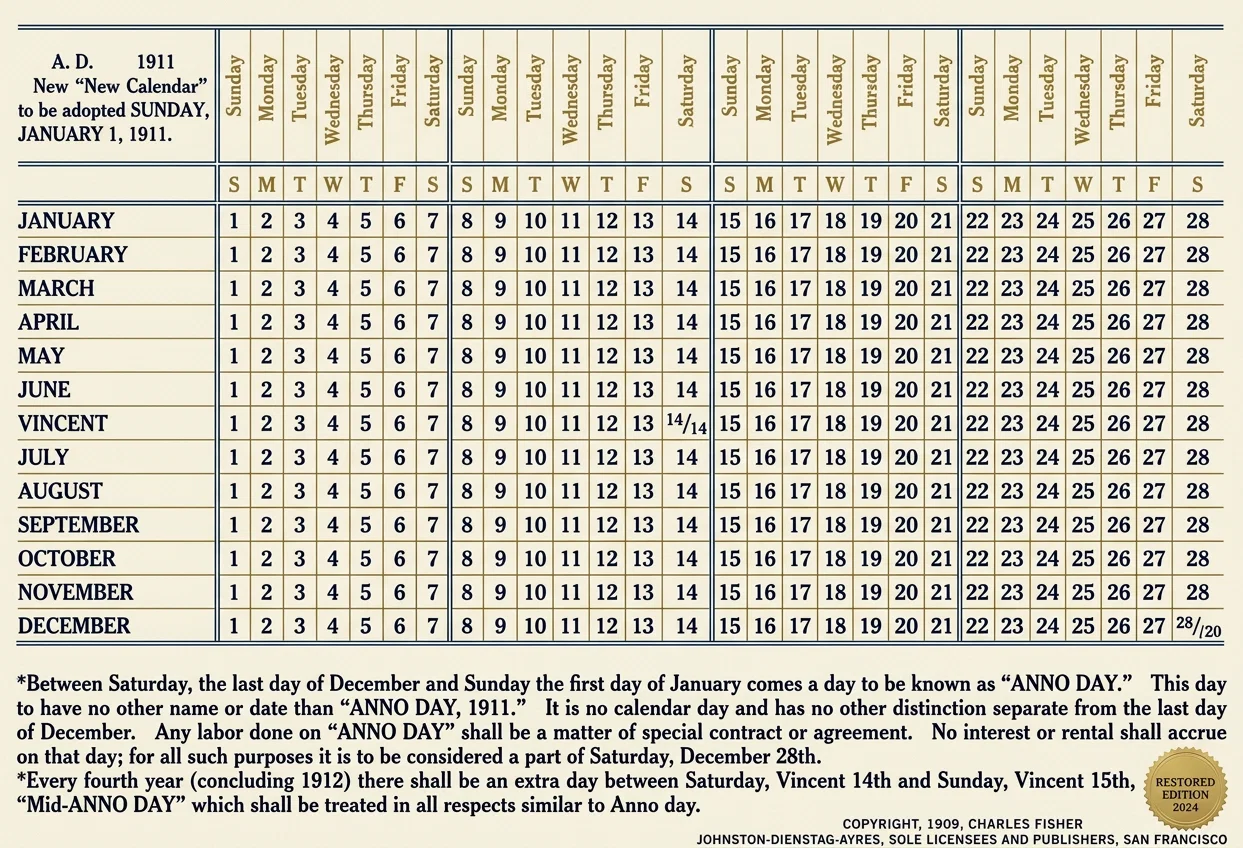
Another calendar, devised by Professor Fisher, of San Francisco, proposes a year of 364 days, but of 13 months. 364 days of 13 months makes 28 days to the month, bringing the same day of the week on the same date of the month throughout the year,—the first day of the week Sunday as at the present time. Sunday in such cases becomes the 1st, 8th, 15th, and 22d of each month, Monday the 2d, 9th, 16th, 23d of each month, and so invariably throughout the year for each month. The extra day, the 365th day, will come between the last of December and the first of January, called “Anno day” or year day. It will not be counted in the calendar. No interest will accrue on that day. Any bargain or labor done on that day shall be a matter of special contract or agreement. It is to be considered a part of the Saturday, December 28. The extra month is placed between June and July, and is called Vincent. Whenever a leap-year occurs, every fourth year, the extra date will come in the middle of the month Vincent. It will be treated in all respects similar to Anno day, and will be called “Mid-Anno day.”
Of all the suggestions made, these two are the most discussed. Among the arguments put forth for the reform of the calendar, one is that it will be uniform; it will be easily remembered. It will help greatly in the calculation of money exchange, interest, rates; in fact, in all the various calculations that are made in the commercial world. It will bring the church days, holy days, holidays, at fixed times. One of the great troubles has been to fix Easter so that it will be easily calculated,—so that it will not be a floating day, so to speak. This will fix it always so that there can be no question about it. It will come at the same time of the month every year. It will, too, in the minds of the calendar makers, give a fair and equal distribution in the months, so as to bring the same time from the equinoxes to the first of the year; and it is believed that when it is made so uniform and simple, people will soon adjust themselves to it with but very little trouble.
Now this is not a matter of mere theorizing or novelty on the part of the men who have suggested these new calendars. There is a real demand for it. In 1911 the British government was invited by the Swiss government to take part in an international diplomatic conference on the subject of fixing Easter and generally modeling the calendar. The same year, there was before the House of Commons a calendar-reform bill, brought in by Mr. Robert Pierce, of “Daylight-Saving Bill” fame, proposing to Parliament the first plan that has been suggested in these notes. Thus in England, bank holidays would occur on fixed dates, Easter would always fall on April 14, Christmas Day would always fall on a Monday, and so on. The bill was supported at that time by Sir William Bull, Sir Albert Spicer, Sir Henry Dalziel, and Mr. Robert Harcourt. While it did not pass at that time, still there was a growing sentiment for it. The matter has come before various religious bodies, and so far as we know, has been approved.
The Fifth International Congress of Chambers of Commerce, held in Boston some time ago, looked with favor upon such a calendar. Looking at it from a purely commercial viewpoint, there is much to be said in favor of it; but looking at it from a religious viewpoint and the standpoint of the Bible, there is an obstruction that can not be met in the 364-day year and the elimination of one day each year and of two days every four years. This is so well expressed by a correspondent in the San Francisco “Call” of September 29, 1909, that we have reproduce it:
“Editor Call: ‘Shall we have a new civil calendar?’ asks a writer in yesterday’s Call. I hope so, but it won’t be Mr. Fisher’s; at least, not in its present form. I have myself wrestled with this problem in much the same form. The calendar and perpetual motion microbes are first cousins, and bite many people.
“I tried my apprentice hand long ago. I invented a thirteenth month, found a beautiful niche for the 365th day, placing it comfortably between the last of December and the first of January, called it New Year’s Day, and sailed serenely along in a most complacent frame of mind until my calendar ran on that rock of ages, the Sabbath, and thus I went out of the calendar business.
“That Mr. Fisher has neither removed nor steered clear of this rock is easily shown. Take the calendar for 1911, as printed in yesterday’s Call, ignoring for the present ‘Mid-Anno day,’ which belongs to 1912, and everything goes smoothly until we strike the first ‘Anno day,’ when the trouble begins. The last, or seventh, day of the week, according to his calendar, is on a Saturday, the day kept as a Sabbath by the Jews and the many Christians who take the fourth commandment as they find it in the Bible. Now, the next day after the seventh is the first day of the week, no matter what other name we give it, and the great majority of Christians would keep the first ‘Anno day’ as their Sabbath, if we adopt Mr. Fisher’s calendar; but the next day, according to his calendar, is also a Sunday. If, now, the seventh day is the Sabbath (and this can not be changed), the Jews and seventh-day Sabbath Christians would keep the next Friday, and the first-day Christians would keep Saturday, and we would find the world keeping Friday and Saturday as the Sabbath, until we struck another rock, ‘Mid-Anno day,’ the following June, when the days would be changed to Thursday and Friday, only to be set ahead (or back, which is it?) the next ‘Anno day!’ and so on, every time we overlook one of these old-man-of-the-way days.
“I attempted to overcome this by going right along with the changeless week, saving up the extra days11until I had enough to make an extra week, and then—then I quit. C. B. “Oakland, September 26, 1909.”
We will say that this correspondent is a scientific man and an astronomer of note.
Norwegian Runic Calendar, dated 1651.
We can not understand how the religious people who have approved of it, among whom is said to be the pope, can harmonize the new calendar with the holiness of Sunday. If the first day of the week is a holy day, certainly that can not be made the first day of a fixed week, because the religious day must of necessity take into account the 365 days of the year, while the fixed week would take into account only 364 days of the year. The Sunday keeper who would approve of the new calendar, forever yields all his arguments and contentions for a holy first day. The Sabbath-keeper, of course, could not adopt the new calendar. He believes that the seventh day is the Sabbath. He believes that seventh day12has come down to us from the very beginning to the present time, that the seventh day is holy time, and that such a reform would set aside God’s calendar and God’s numbering of the days.
We present these facts and thoughts before our readers as something that is worthy of consideration concerning things with which we will have to deal in the future. The problem is not solved. It will be agitated more and more. If there shall come a time when the influence of these scientific men shall have so taken hold on the legislative bodies of some of the great countries, there is no question at all but that the calendar will become worldwide. If international action is taken upon it, it will be international action against the Sabbath of the Lord. Being against the Sabbath of the Lord, it will be framing “iniquity by a law,” as the psalmist has expressed it. It would, of course, in that case, place every consistent, faithful Jew, and every consistent, faithful, Sabbath-keeping Christian, out of harmony with all the rest of the world, not only as regards the day which he ought to observe, but with the entire commercial week itself.
These are things over which we should become intelligent, so that when the time comes to act we may act with understanding, and decide either for the convenience of human regulation or for loyalty to God. As the letter we have quoted states, the theory runs up against that rock of the ages, the Sabbath. The loyal to God will stand by the rock of ages.