One of the difficult problems which confront the new republic — one which, before it is worked out to the satisfaction of those concerned, will require careful investigation, wise planning, and frequent adjustments — is the matter of education.
With a population ninety per cent of which is illiterate, combined with poverty which compels the larger percentage of children to go to work almost as soon as they are able to walk, it is easy to see that this question of how the rising generation is to be educated so they will be fit to take upon themselves the responsibility of running the affairs of the nation, is a problem which will not be immediately solved.
Mission Schools
That much has been done is unquestionably true; but when compared with what is left to be done, it is infinitely small. It can be truthfully said that whatever advance has been made along educational lines, whatever changes have been wrought toward better standards of schools and methods of teaching, can be directly traced to the influence of the mission schools, which were the first object-lesson China had of the benefits of proper methods of education.
At the time when the first missions in China opened schools, the majority of the youth would not attend them, and it was necessary in many cases to offer inducements to secure enough pupils to open a school. From that time to the present a great change has taken place. As these students graduated from the various schools, and went out into society, and mingled with their fellows who had been educated along the line of the old style Confucian classics, their superiority over those educated by the old methods, manifest both in the ability which they possessed, and in the manner in which they were able to conduct themselves and use their acquired learning, proved at once an unanswerable argument in favor of popular education.
A company of the many missionaries who, since our General Conference, have gone or are going out into the great dark, needy fields of the world. These sailed from San Francisco on August 16 for China. Their names are as follows, beginning at the left: H. J. Doolittle and wife; Merrit C. Warren and wife; A. L. Ham and wife; R. C. Porter and wife; J. P. Anderson and wife, returning to China; O. J. Grundset and wife, Bernhard Peterson and wife, for Manchuria. Pastor R. C. Porter goes as the president of the Eastern Asiatic mission field, headquarters at Shanghai, Box 523, U. S. Postal Agency.
At the present time it is safe to say there is not a school anywhere for any mission but that has more applications for attendance than it can accommodate. And this is especially true since China has become a republic.
Free Schools Needed
Mission schools, however, will never fulfil the needs of the great mass of the people, nor can they take the place of properly established government schools. This is apparent for two reasons. One is that their attendance will always be restricted to a certain class; and the second is that the instruction imparted is of a distinctly religious nature, many times to the exclusion of other necessary branches. The most marked criticism, however, which is advanced against the mission schools, and this not without reason, is that their graduates, while able to converse freely and write a fairly good composition in the English language, are totally unqualified in their own language, not being able either to read or to write a good Chinese composition in the classical language, Wenli. They thus are greatly handicapped, and appear at such a disadvantage in any office where they are called upon to labor for the public good, that they are practically barred from participation in the affairs of the government, and their usefulness is restricted to the narrow circle of the mission which has educated them.
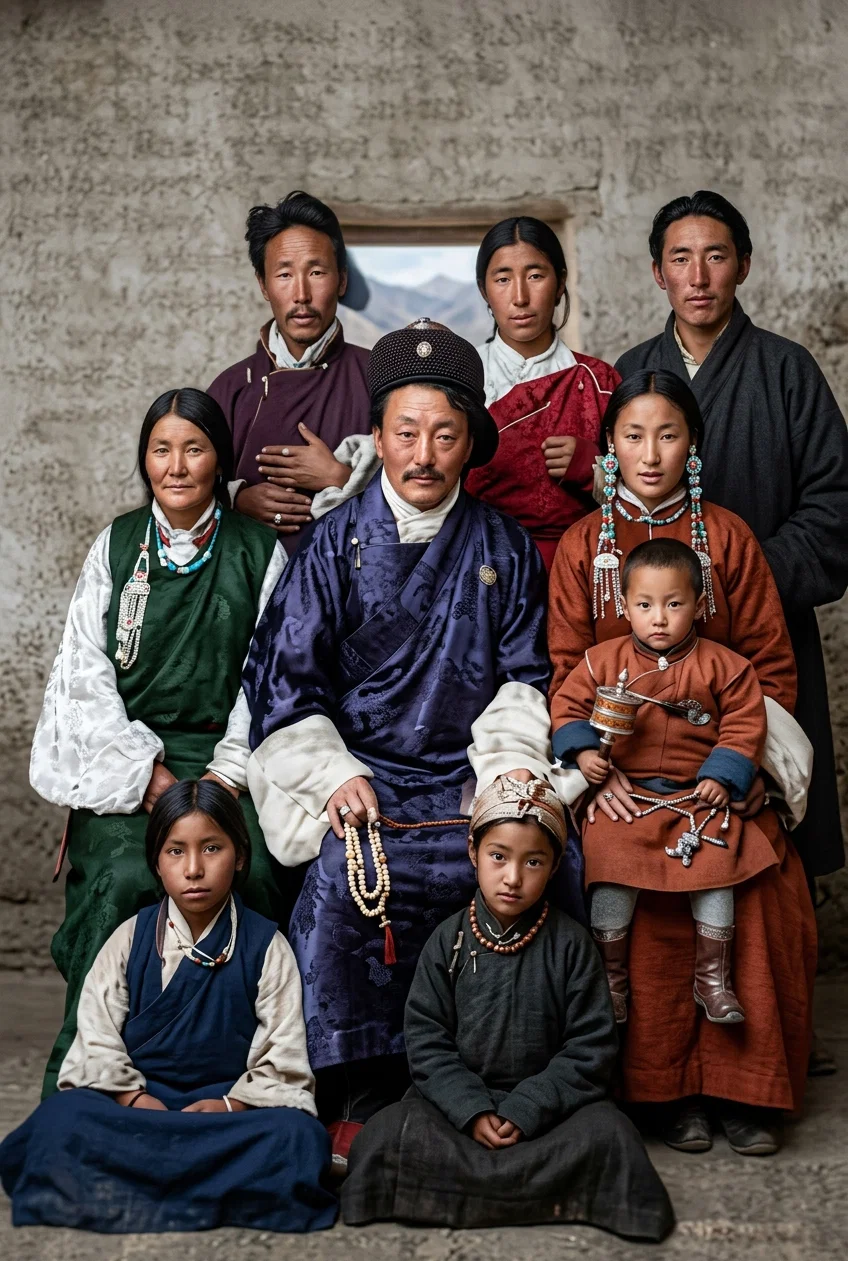
A Tibetan Family
It remains, then, for the government to establish free schools and make them compulsory to such extent as is possible. They have opened some schools, but none of them are free, and it is only the youth who are in fortunate circumstances that now have the privileges of education. In the large cities, such as Shanghai, the last two years has seen the opening of hundreds of private day-schools for children of the grammar grades, and not a few night-schools where English reading, writing, and composition, and arithmetic and some bookkeeping, are taught; and these night-schools are attended mostly by clerks and young people who are aspiring to business positions. Of high schools and colleges there are a number which were started at first by the influence of foreigners, and are now conducted by the Chinese themselves; but where these schools are conducted in a way that makes the instruction valuable, they invariably charge a high rate of tuition.
Colleges to Be Founded
We note with pleasure that the minister of education has announced the intention of the government to establish three large colleges, in three of the largest educational centers, namely, Wu Chang, Nanking, and Hongkong.
It has been decided that part of the instruction will be given in English, French, and German. Thus the student will be required to have a speaking knowledge of four languages.
The government university has been conducted in Peking for a number of years, under the supervision of foreign instructors, and has done very creditable work in educating China's young men. Many graduates have gone from this college to America and other countries to complete their education, and have returned to China, and are holding responsible positions of influence now.
The United States has given China the privilege of paying a large part of her Boxer indemnity by supporting young men of promise11in the universities of America in place of paying the cash over to the United States government. Several hundred Chinese students have already profited by this arrangement, and more will follow, as every year a certain number of those having the highest grades are selected from the best schools in China.
This is a worthy example, which might well be imitated by other nations, as there is nothing that could be done to benefit China more at the present time than to help educate her young men, thus giving them the training which will fit them properly to guide the destinies of the new republic.
A meeting of the British House of Commons was held on June 18 to consider the advisability of asking the government to permit a certain amount of the Boxer indemnity to be assigned to the proposed British university which will be opened up in Central China. It is hoped that other nations will follow.
“Spheres of Influence”
One proposition which the infant republic has found to be like a sore thumb, “always on hand,” a continual source of worry and inconvenience, is the matter of determining how to pacify and maintain the integrity of her dependencies, Tibet, Mongolia, and Manchuria.
It is many times difficult to determine the “status quo” of these countries. Sometimes they appear part and parcel of China; often they claim to be independent; and not infrequently they seem to be right on the verge of being annexed by some strong power that has taken pity on their weak condition and offered to extend a right arm of protection, ostensibly to keep avaricious nations from gobbling them up.
These three countries were theoretically part of the old China under the Manchu reign, but practically they were often in revolt. By treaty agreement, Great Britain has exercised a suzerainty over Tibet for a number of years; Russia has had practical control of “Outer Mongolia” for a long time; and there is no question but Japan has her covetous eyes fixed on Manchuria as the natural outlet of her ever-flowing population, and is only waiting for an opportune time to assert her protectorate in the same manner as she did to Korea.
Tibet has been endeavoring, for several years, to assert her independence; and constant wars have been going on with Chinese troops, who have made frequent invasions from the Szechuen border. One day it is reported that the Chinese troops are winning out, and the next day we hear that they have been driven from Tibet with great losses; and as the country is very mountainous, and in many places inaccessible, it is impossible to determine the exact state of affairs. Great Britain notified China, some time ago, that China would not be allowed to exercise any control over Tibet without an agreement with Great Britain about it, in accordance with her treaty. China has never given a satisfactory reply to this, and it is hinted that this is one of the reasons for Great Britain's delay in recognizing the new republic. As it is highly desirable to come to an understanding regarding this question as soon as possible, the government has decided to send Ivan Chen, commissioner of foreign affairs in Shanghai, as a special commissioner to Tibet, to find out the true conditions, as well as the mind of the Tibetan people themselves. He is preparing to leave on this mission in a few days.
Russia and China
The most dangerous situation of all, one that appears to be very difficult to settle satisfactorily to China, and is attracting the attention of all the great powers right now, is the Mongolian question, and Russia's threatening attitude toward China. Russia's representatives took advantage of the unsettled conditions following the revolution, to stir up the minds of the Mongolian people, and encouraged them, with flattery and handsome promises, to set up their independence. So we find that almost immediately following the setting up of the new republic, Mongolia declared herself to be independent, and sent word to China that she would not become a part of the Chinese republic.
From the latest photograph of the Dalai Lama of Tibet. For years he was concealed, no one was allowed to see him on pain of death; now he tolerates even the photographer, the familiarity may "breed contempt."
That Russia was behind this action no one denies, for when Yuan Shih Kai sent a deputation to Mongolia to treat with them in regard to an understanding, before the negotiations could be settled, Russia came to the front and notified China that a secret protocol had been signed with Mongolia, and that it would be decidedly undesirable for China to take any action not in harmony with that protocol. The Chinese minister immediately lodged a violent protest against Russia's action stating that she had violated in every sense the treaty guarantee of the territorial integrity of China, and the principle of the open door and of equal opportunity for all in Mongolia. She stated further that she regarded Mongolia as part and parcel of China, and that Mongolia had no right to conclude any agreement with any foreign country, without China's consent. Unfortunately, China, being in a disorganized state, was not able to back up her protest with any show of force; so nothing came of the protest, and Mongolia effectively bound herself to Russia by a protocol the terms of which are published in the papers as follows:
Russia shall resume responsibility for the protection of Mongolia from invasion by other powers. (China?)
Mongolia shall not borrow money from any other country than Russia.
Russia shall have the privilege of working the mines in Mongolian territory.
No other country than Russia shall be given the privilege of constructing railways in Mongolia.
The Russian government shall have the right to establish consulates in Mongolia wherever they are deemed necessary.
Russian post-offices can be established throughout Mongolia, and the Russian consuls shall have the right to use the Mongolian post-offices free of charge.
Grazing lands can be used for traveling flocks belonging to Russian subjects three
Russia provides Mongolia with good arms, and twelve Russian officers are appointed to drill Mongolian troops.
Russia endeavors to persuade the other powers to acknowledge Mongolia's independence.
Russia will represent the Mongolian interests at Peking.
This protocol was written in Russian and Mongolian, signed and exchanged at Urga on November 3, 1912. As it was done in secret, no one seems to be absolutely sure of the concessions Russia gained; but if they are as published, it appears that Mongolia sold herself very cheaply, and in the end it is hard to see what benefit she can hope to reap, as none of the Asiatics have ever profited by contact or relations with the ever-aggressive Russia.
Russia's Aim
There is in this matter, however, something greater and more important than the loss of Mongolia to China. It concerns the ultimate aim of the Russians. The absorption of Mongolia brings Russia some hundreds of miles closer to the province of Chili, and to Peking. The railway from Kiatka to Urga or from Moscow to Peking can now be built whether China says yes or no, and Russia is within easy striking distance of the goal she has long desired,—an ice-free seaport.
It is the confident belief of most of the Chinese people, that the Mongolian people at large never consented to this bold-faced agreement with Russia; and it has been quite apparent that during the last few months, a reaction has set in unfavorable to Russia.
Many of the Mongolian people are anxious to show their allegiance to China; and if they can not succeed in being independent, they would prefer China rather than Russia to dominate them. There has been such an open rebellion against Russian influence, that Russia has been forced to alter her plans; and she now proposes a new agreement with China in regard to Mongolia, which would in theory at least give China a chance to exercise some control over Mongolian interests.
This agreement, when compared with the agreement of last year, is much more favorable to China; yet the present Chinese parliament refuses to ratify it, and has drawn up a new agreement, based on the Russo-Chinese treaty of 1881, which thoroly restored China's position in Outer Mongolia. This has been submitted to the Russian minister; and at this writing, June 30, no reply has been given. However, it will be surprising indeed if Russia consents to it, as she has practical possession of a large part of Mongolia, and possession is ten tenths of the law, as far as she is concerned; while China is in no position to dictate to Russia at this time.
It is the expressed hope of many of the prominent Chinese, that the parliament will not take too radical a position on this question, as it would be much better to conclude an agreement that would at least be favorable to Chinese interests, than to balk because the agreement is not strong enough, and thus lose altogether. China to-day is in a situation where almost any course taken by the government will be at best only an unsatisfactory compromise with exigencies. This is true of nearly every important issue which requires solution. Rarely in history has a government been confronted with so numerous and complex problems within and without, as those which beset China now.
Therefore, just criticism of the government will not condemn its policy and actions solely because imperfections can be discerned, but rather consider how nearly it comes to making the best possible arrangement under the circumstances.