With the modern means of studying such diseases as diphtheria, measles, mumps, chorea, la grippe, tuberculosis, smallpox, infantile paralysis, scarlet fever, typhoid fever, cholera, dysentery, and yellow fever, our understanding of the means of transmission of disease has been very materially increased.
In practically all these diseases, there are certain specific microorganisms, which can be seen under a high power microscope, and which can be isolated and grown outside the body, and which are capable of producing the same disease in another person when he is inoculated with them. In this way, it is possible to experiment with these different microorganisms until we have a clear understanding of how they get into the body, of the surroundings which are suitable to their development, as well as those conditions which are unsuitable or fatal to them, and the best means of keeping them out of our system.
HOW CARRIED FROM ONE TO ANOTHER
These so-called germs are carried from one individual to another principally by fingers, food, and milk.
With the possible exception of tuberculosis, none of them are carried by the air to infect another person, except as one person may cough or sneeze in another's face, and the particles or spray of sputum carried from the mouth may also carry the disease and infect the second individual.
Such infections as measles, mumps, la grippe, tuberculosis, diphtheria, and smallpox are spread largely by the use of the public towel and drinking cup, and to an almost equal extent by the use of dishes and silverware that have not been placed in boiling water after being used by a diseased person; also by the common practice of putting the fingers in the mouth, or picking the nose, or getting the fingers infected from the handkerchief, and then handling articles that are to be handled subsequently by other persons, who, after getting their fingers contaminated, thoughtlessly place them about their lips or nose.
The intestinal diseases, cholera, dysentery, and typhoid fever, are taken by the use of drinking water that has been contaminated with infected human discharges, by eating fresh green vegetables washed or irrigated with infected water, by the use of food or milk infected by flies from infected garbage or sewage, or by handling a typhoid patient and neglecting to wash the hands in some disinfecting solution before touching food or the face. In fact, these are the filth diseases, and are contracted only upon taking into the mouth substances contaminated with infected fecal discharges.
OUR MEDICAL MISSION DISPENSARY AT SOONAN, KOREA
Malaria and yellow fever are carried by the mosquito; the intestinal diseases, and probably also infantile paralysis, by the fly.
INCREASING RESISTANCE OF THE BODY
The normal human body has a certain degree of resistance against all these diseases; and unless the germs are taken internally in large numbers, the system is able to destroy them before they multiply to sufficient number to cause harm. This body resistance is greatly increased by a moderate amount of physical exercise, by plenty of fresh air and sunshine, with deep breathing, and by a plain, wholesome diet. Of course, it should be mentioned that vaccination or antitoxin also very greatly increases the body resistance toward the disease against which the inoculation is made.
When any of the contagious diseases, as typhoid fever, cholera, dysentery, diphtheria, or scarlet fever, are in the community, all water and milk should be boiled before using for drinking or for the washing of eating utensils, and the hands should be washed always before eating. The eating apartment and the kitchen should be well screened against flies, and general war waged against them.
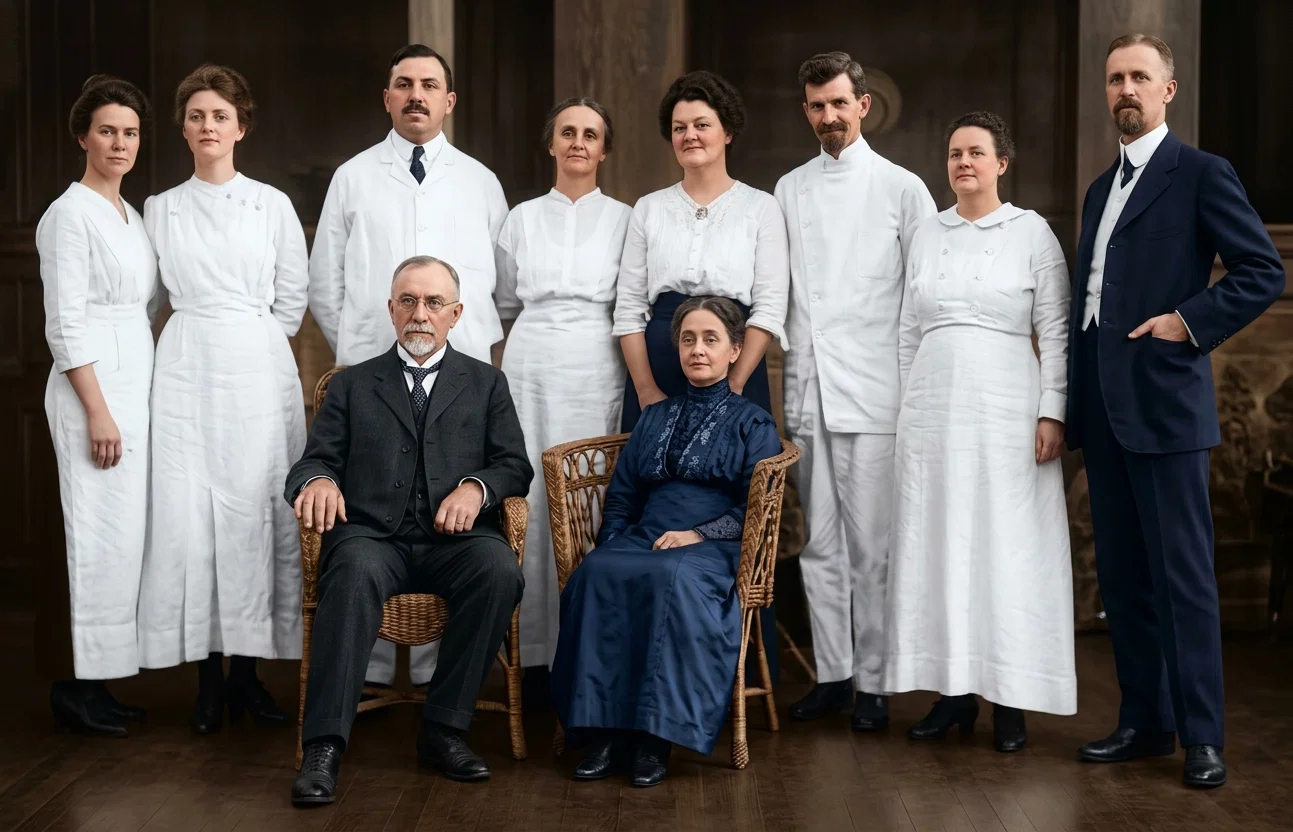
The persons standing and dressed in white are the group of workers connected with our medical mission in Kalyan, India. Elder A. G. Daniells and wife are seated. Professor Salisbury, standing at the right, is the superintendent of our work in India.
SUNSHINE AS OUR FRIEND
Sunshine is the friend of man, and the enemy of disease-producing bacteria. In case of sickness, as a rule it is well to let all the available sunshine into the sick room, as by this means many of the germs are killed which otherwise might live and later infect other persons.
For those who are caring for the sick, it is of special importance that they use no dishes used by the patient; that they keep their hands away from their faces; that they disinfect their hands often, and always before eating, in some such solution as soapy water, followed by a one per cent solution of lysol, and then rinse in water; that they take regular sleep and fresh air exercise; that they disinfect discharges from the mouth and nose of the patient, in case of tuberculosis, by burning, and in case of the intestinal diseases, disinfect stools and urine in three per cent chloride of lime; and that in all these diseases, they instruct the patient not to cough in others' faces, and to avoid, as far as possible, contaminating body and clothing with discharges from the body.