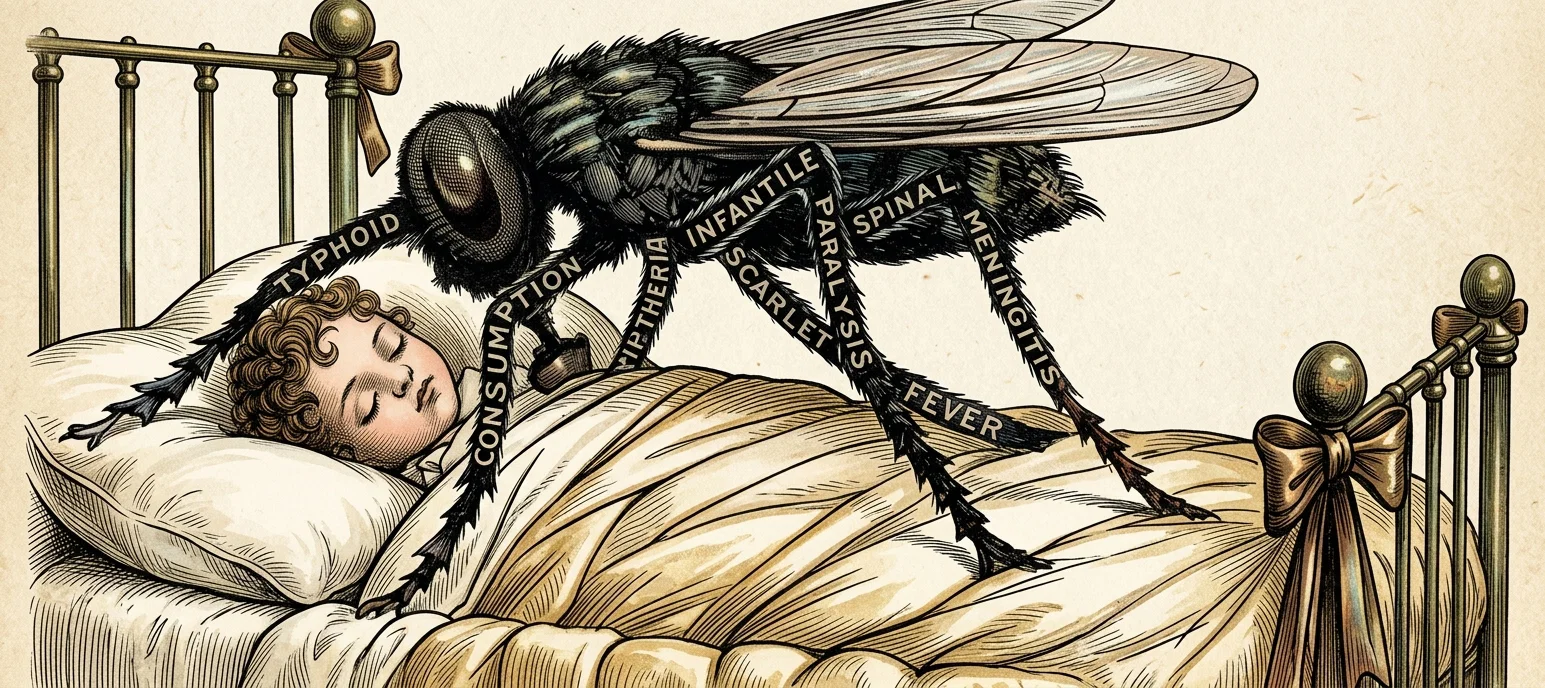
No Race Suicide with Him — What He Does to Spread Disease — How to Get Rid of Him
By A. W. SEMMENS, M. D.
THERE is probably no other agency that has such capacity to spread disease as has the ordinary house fly. Because it is more or less a domestic insect, and lives about the habitations of men, it has great opportunities to get into infected matter; and because it can move from one place to another more rapidly than any other insect, and because it thrives in greater numbers, and because its hairy feet, with sucker-like terminals, can gather more certainly whatever infected matter it lights upon, the dangers from its presence are far greater than those from any other infecting agent.
“Swatting the fly” does away with many of the pests, fly poison destroys many more, and fly papers destroy thousands. Still they exist by the million.
A TRILLION A YEAR
It has been estimated that one female fly hatching in April will multiply itself into thirteen figures (1,000,000,000,000)—so many times that the human mind is unable to calculate the number. To get rid of this pest, then, we must have some very decided means of preventing this propagation.
Investigations carried out on new lines have proved that many of the most deadly diseases, which cause the untimely death of thousands of people, are due to the presence of the house fly and the mosquito. In the near future, when people are educated as to these facts, no civilized town will allow any filth to accumulate or remain uncovered to breed flies; and all tanks, drains, ponds, and swamps will be covered, or else treated so that no mosquitoes can breed in them.
THE TYPHOID FLY
“Dr. Howard, of Washington, D. C., has proposed that we should drop the name ‘house fly,’ with its harmless sound, and call it the ‘typhoid fly.’ While we talk about it as the domestic or house fly, we will never realize that it is the active agent in spreading typhoid fever. We all know how flies swarm over all kinds of food that are left uncovered, how they feed upon it by sucking up the moisture, or if it is hard, how they discharge a little fluid down their proboscides to soften it.
“Not only do they feed upon all exposed food, but they discharge their excrement upon it; and then a thoughtless person eats this contaminated food that has been left in the pantry or on the dining room table. Out in the yard and the street, swarms of flies may be observed resting and feasting upon every bit of decaying matter. From such things they come flying into the house, their feet and mouths reeking with filth.”
NOT PARTICULAR WITH THEIR FEET
They are not at all particular in cleaning their feet or mouths before their entrance into the house.
Another great danger from these insects is this: Flies that have been feasting upon a dead beast, where decay has set in, or upon a beast that has died from some such deadly disease as anthrax, can, if they settle upon an open cut or wound, infect it, and cause blood poisoning, by inoculating the cut or the wound with putrid material, or with the deadly germs of anthrax.
While visiting some of the islands in Polynesia, the writer observed the great prevalence of purulent conjunctivitis among the natives, and on investigation found that flies would swarm around these diseased eyes, which were not covered and were seldom washed. Hence the propagation of this virulent malady.
Dysentery is only too well known in many countries; and among young children, in particular, many deaths occur from this cause, particularly in the summer months. In this country and elsewhere, it has been shown that this intestinal disease is always most prevalent in the summer months, when flies are at their worst.
THEY SPREAD TUBERCULOSIS
That flies play a part in the spread of tuberculosis too, seems probable, for the specific bacilli have repeatedly been found in virulent condition in their intestines and in their excrement.
Dr. Frederick T. Lord, of Boston, published a paper on this in the Boston Medical and Surgical Journal, 1904. His important conclusions are as follows:
1. Flies may ingest tubercular sputum and excrete tubercle bacilli, the virulence of which may last for fifteen days.
2. The danger of human infection from tubercular flyspecks is by the ingestion of the specks on food.
3. Tubercular material should be carefully protected from flies, lest they act as disseminators of the tubercle bacilli.
4. During the fly season, greater attention should be paid to the screening of rooms and hospital wards containing patients with tuberculosis, and laboratories where tubercular material is examined.
5. As the precautions would not eliminate fly infection by patients at large, foodstuffs should be protected from flies, which may already have ingested tubercular material.
The number of bacteria on a single fly may range all the way from 500 to 6,000,000. Early in the fly season, the numbers of bacteria on flies are comparatively small; while later, the numbers are comparatively large. The domestic fly is passing from a disgusting nuisance and troublesome pest to a dangerous enemy to human health, a distributor of typhoid fever, dysentery, cholera, tuberculosis, blood poisoning, and other similar diseases.
WHERE THE HOUSE FLY BREEDS
House flies deposit their eggs chiefly in horse manure. Any heap of horse manure piled up about a stable or a yard will within twenty-four hours be found to contain swarms of small, white, naked maggots, the house fly larvæ. On the second day, they are full-grown. On the third day, they have changed to pupæ; and instead of white maggots, the more or less drying manure will be found full of the oval, reddish brown pupa cases of the flies, from which, in three or four days, the perfect flies will swarm out, ready to lay their eggs and produce the next generation. This goes on all through the summer.
Packard placed a house fly in a bottle at six o’clock in the evening, and at 8 o’clock next morning he found that it had laid one hundred and twenty eggs.
HOW TO MAKE AWAY WITH THEM
1. Keep clean homes. Few flies enter such homes; and their cargo of bacteria is usually less than that of flies found elsewhere.
2. In dirty homes, the diarrheal sickness among cases exposed to flies is twice that among cases protected from flies.
3. There is more than twice as much diarrhea among all cases exposed to flies as among cases protected from flies.
4. There is nearly twice as much diarrheal sickness in dirty homes as in clean homes.
5. Two and a half times as much sickness among infants, and three and a half times as much diarrhea, occurred among infants exposed to flies in dirty homes as among infants protected from flies in clean homes.
6. Destroy the eggs before they hatch.
7. Sprinkle powdered borax over manure piles, and in cracks and crevices, and wherever flies can breed.
The United States Department of Agriculture, in Bulletin No. 118, gives the following directions for applying borax as a fly egg destroyer: “Apply through a fine sieve or flour sifter two ounces of borax to a can of garbage daily; apply ten ounces in the same way to eight bushels of fresh manure, and sprinkle with water.” Borax should be applied also to floors and crevices in barns, stables, and markets, to street sweepings, and to such places in the hospital or the home as are likely to be chosen by flies in which to lay their eggs. After the borax is sprinkled, water should be sprinkled over the powder.
We must not wait till flies are here. We must prevent their breeding; and those which survive our preventive measures, must be starved to death. Fly starving, and especially preventive measures against their hatching, will end the nuisance for all time.