Our London Letter

3%

Pacific Press Publishing Association · Mountain View, California · Jun 3, 1913

FromSigns of the Times, Vol. 40, No. 22.

Read the full edition

Our London Letter

From Our Own Correspondent
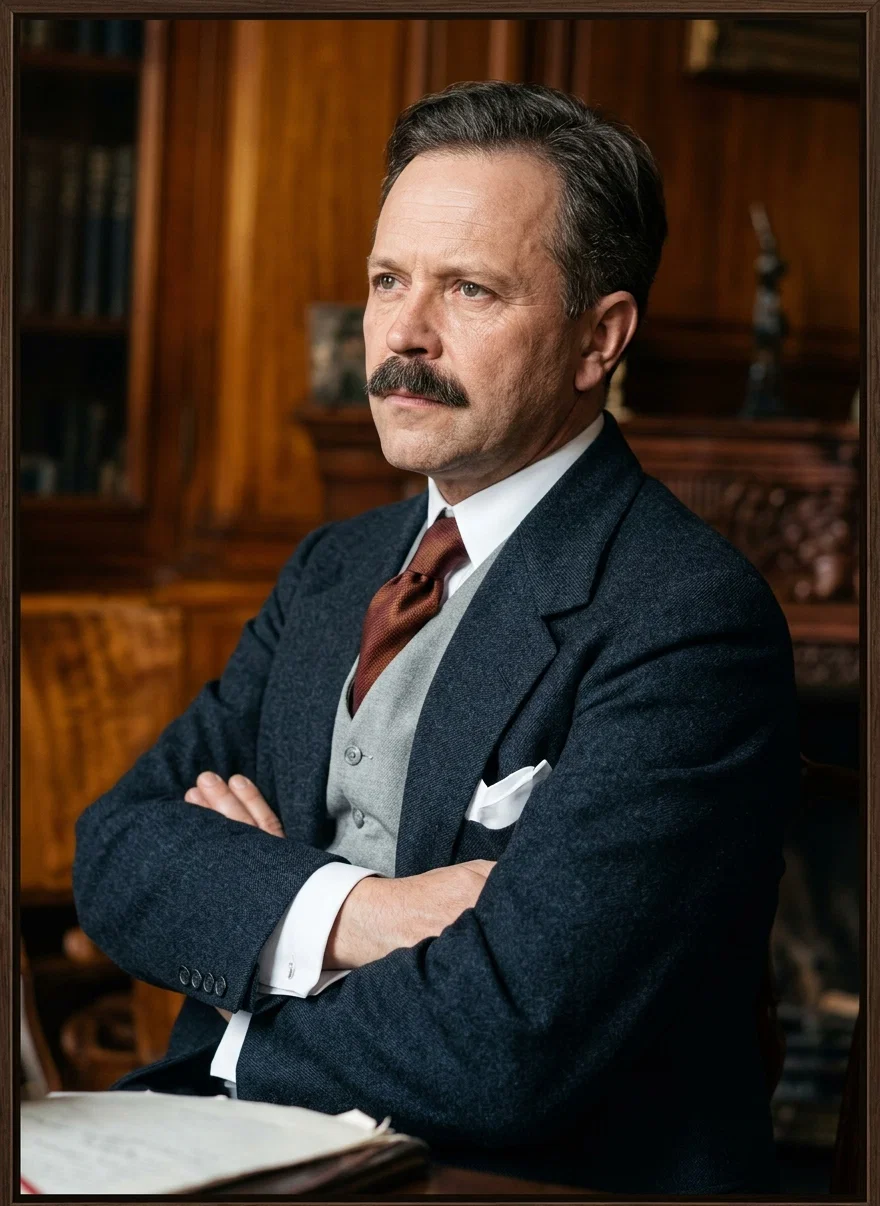
Sir Edward Grey
Sir Edward Grey
[[FIGURE]] UP to the present time, the ambassadors in conference in England, under the patient chairmanship of Sir Edward Grey, have succeeded in prolonging the peace, but almost every morning brings to light some new and perplexing factor in the confused situation. The great powers are still talking firmly about what they will allow Montenegro to do, and are calling upon her in stern tones to evacuate Scutari. But people can not forget that very firm tones were used before hostilities began in the Near East, and that the little nations paid no attention to the great powers, but managed their own affairs, and did surprisingly well. Austria, however, seems to have made up her mind that a death struggle between herself and some of the Balkan peoples is only a matter of time, and that she may as well fight now as later. The question for the other powers is whether they will support Austria's selfish and unscrupulous policy, or run the risk of being involved in a European war. It grows clear that Austria is not going to yield this time, and unless she gets her own way in Albania, will not hesitate to precipitate a war in which Russia, Germany, France, and Italy may soon be involved. The other European governments do not want war; and so it is probable that Austria, being determined, will get what she demands, unless the little nations themselves defy her.

The Price of Peace and the "War Devil"

Public opinion in England is far from satisfied with the position. There is nothing glorious about the idea of the concert of Europe combining to coerce tiny Montenegro, and the English people do not relish the part they are made to play. Mr. Zangwill has given vent to the general feeling in an explosive article in the "Daily Chronicle," in which he says:
"The price of peace is paid not only in hard cash but in honor. The fear of the Lord is the beginning of wisdom, but the fear of the war devil is the beginning of madness. Worse than war is the death of the soul of a people. For if there is a peace of God which passeth all understanding, there is a peace of the devil which passeth all endurance. It is a peace purchased by sacrificing to security every high national ideal, every generous instinct. Such a peace we enjoy to-day. . . . We have the cost of greatness, only no greatness. And the same spiritual blight has spread over the bulk of Europe. Hampered by their coats of mail, the nations can scarcely move a finger. The Balkan States rush in where the great powers fear to tread. and when at last united Europe nerves itself to demonstrate, it is against—Montenegro."
Mr. Zangwill's article is headed "The War Devil." The term is significant. Several of our writers are beginning to use language, when they deal with the present situation, which expresses an uneasy conviction that some malefic being is at the helm of Europe's ship of state, controlling the minds of its politicians and diplomats, and leading the nations on to certain destruc- tion. Again and again our public men denounce the insanity of our vast armaments; and yet, altho common sense revolts at the appalling sacrifices demanded of the civilized nations, an irresistible force seems to urge them all ever on the downward path. Says Mr. Zangwill:
"Imaginatively incarnated, this subtly pervasive necessity would appear as the spirit of a war devil, chuckling with grim humor as he watches the writhings of his minions and marionettes—statesmen primed with culture and Christianity, their lips chanting the praises of peace, yet condemned by their mocking master to add brick after brick to the temple of Apollyon, and to build not God's kingdom on earth, but the devil's!"

Familiar to the Student of Prophecy

How familiar are these sentiments to the student of prophecy! They are but the echo of what he reads in the Scriptures. He turns to the prophecy of Joel about the arming of the nations in the last days, and the prophetic word, "Prepare war," comes in resounding echoes back from the dockyards and arsenals and battle fleets, where the din of preparation goes unceasingly forward. The book of Revelation shows us the kings of the earth and their armies led by the spirits of demons to the field of Armageddon, to the battle of the great day of God almighty (Rev. 16:13, 14); and lo, to-day, when this prophecy is on the verge of fulfilment, men's mouths are full of the phrase "war devil." There is no mistaking the grim reality that lies behind the expression.
What but the madness that precedes and ensures destruction could have induced the leading nations of Europe to take upon themselves the gigantic burdens which have lately been added to their already heavy loads? Germany is to raise $250,000,000 dollars by an extraordinary tax on capital, and to increase her tremendous annual expenditure by $50,000,000. Her army is to be enlarged by another 160,000 men. France at once feels that this move imposes upon her the necessity for equal sacrifice, and promptly adds fifty per cent to the strength of her standing army. Russia, too, takes from her population another 150,000 men to swell her vast armies.

To Make Service Compulsory

The same spirit is making its way in England. The government has so far stood firm against the demands for conscription, but the movement in favor of compulsory service gains ground steadily. Conscription has already become a live issue in the political world. Lord Roberts continues to go up and down the country preaching the necessity for universal military service, and he is assisted by powerful advocates, who join in declaring that nothing but conscription will ever save the English nation from the rot that is eating away its vitality. Soon it will be proclaimed as the highest moral duty to serve in the national armies. In England the "war devil" appears as an angel of light.

"Armor-Plate Patriotism"

It is interesting to note, however, side by side with the glowing appeals to patriotism and the eulogies of the militarist ideal, reports of the gross scandals unearthed on the continent in connection with what is cynically termed "armor-plate patriotism." It appears that a good deal of the fuel that keeps the flame of military ardor burning briskly among the nations is supplied by the people who sell armor and guns to the European kingdoms. While the journals subsidized by these wealthy organizations are extolling to the skies the patriotic spirit that arms itself to the teeth against all its neighbors, the big armor-plate trusts are enriching themselves by selling their wares to all and sundry, regardless entirely of whether the weapons are likely to be used against their native land or not. German firms getsinflammatory articles printed in the French papers to stir up race hatred in the two countries and promote business. French capitalists control concerns that supply weapons to Germany. Austrian firms extend their operations to Russian soil, and supply Russian armies with munitions of war that are more than likely to be used against Austria itself, making large profits out of the transaction. Everywhere the noble business of supplying war equipment seems to be a remunerative one; the shareholders draw annual dividends of thirty per cent. Thus the game goes on merrily, and the peoples pay and bleed, while the armament manufacturers organize scares, and run a department for the creation of embittered public sentiment.
All that the firms concerned have found to say, as yet, in their own defense, is to deprecate the introduction of too much Pharisaism into the criticism. Their motto is that business is business, and that they must advertise to succeed. If only the peoples and the governments would take this view of the whole matter, it might help them to keep cool when the next press campaign rages; but unfortunately, public passion seems to rise too readily to every suggestion of a holy war against some prosperous rival. The "war devil" has enough well-paid talent at his disposal to make his ideas popular.

Financial Prosperity

England is at present enjoying a good measure of financial prosperity, according to the recent budget of the chancellor of the exchequer. He estimates an expenditure, for the coming year, of about $978,000,000, an increase on the past year of some $35,000,000, but expects that the twelve months before us will prove so prosperous that the income will rise sufficiently to pay the bill. Fifty years ago the income tax yielded $4,375,000 for every penny levied, now every penny brings in $15,000,000. During the same period, national expenditure has risen by 180 per cent, while taxable capacity, as gaged by the income tax, has risen by 242 per cent.

The Militant Suffragettes

Our militant suffragettes have been very active during recent weeks. Mrs. Pankhurst, one of their foremost leaders, has in the most open way invited the destruction of property as a means of compelling the country to give women the vote. Railway stations have been burned down, houses set on fire, golf links injured by corrosive chemicals, telegraph wires cut, and a number of bombs have been found in public buildings. These latter, however, having universally failed to go off, it is doubtful whether they were ever intended to explode.
Mrs. Pankhurst was arrested, and charged with inciting to the commission of crime, and being found guilty, was sentenced to three years' penal servitude. However, she announced to the court that she would refuse to take food so long as she was kept in prison, and she was true to her word. No attempt was made to feed her forcibly, and when her life became endangered she was released on a license for fifteen days. The term has expired, and she is still too weak to leave her home. The government has made no fresh move in her case as yet, but the sentence of penal servitude empowers them to rearrest her at any time before the three years has run out. This will enable them to put her in prison again as soon as she creates further trouble.
Photo by Paul Thompson

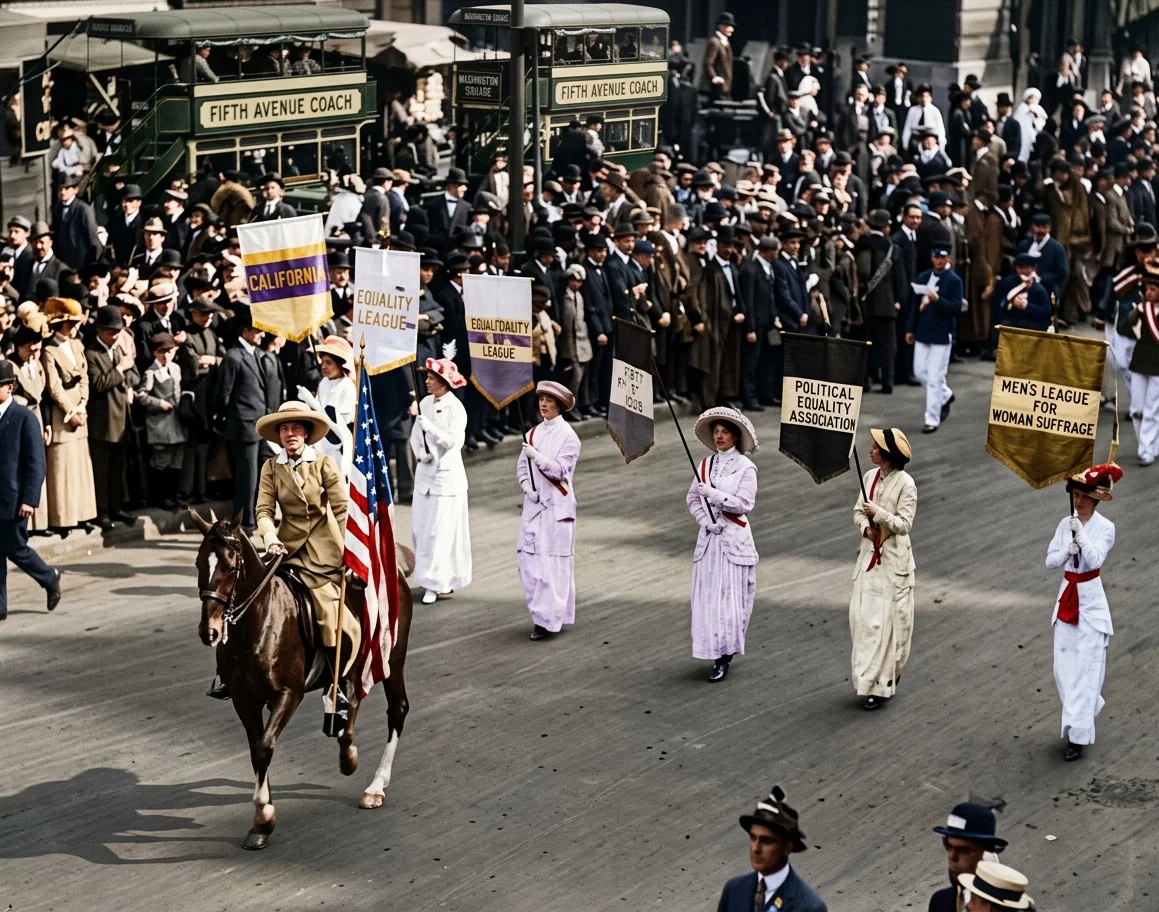
Suffragette parade in New York City May 3. This is the head of the procession that was 30,000 strong.
Photo by Paul Thompson Suffragette parade in New York City May 3. This is the head of the procession that was 30,000 strong.
[[FIGURE]] The authorities have been sorely perplexed to know how to deal effectively with the militant suffragettes and put a stop to their destruc- tion of property. One member of Parliament thought it would solve the problem if they were deported to some small island in the British dominions, supplied with sufficient food, and left to their own devices. This, he said, would be treating them as prisoners of war, and as they claim to have declared war against the government, the militants could not complain.
The government, however, has brought in a bill, known as the "Cat and Mouse" Bill, which authorizes the authorities to let the hunger striker out of prison when her health renders such a step advisable, and rearrest her at some future time to serve the full remainder of her sentence. This would mean that a person sentenced to a year's imprisonment and needing to be released after a week, might have to go back to prison another fifty- one times before she had served her sentence.
The English suffragettes have certainly made a considerable impression upon the public mind, but that impression is hardly favorable to their movement. Now they are unable to hold meetings in the parks or other public places, because the meetings are invariably broken up by mobs, and in view of the continual disorder thus created, the police have prohibited the holding of open-air meetings by the militants.
Since the foregoing lines were written, the police have taken vigorous action, closing the offices of the militant party, arresting their leaders, and confiscating all inflammatory literature. They give notice that it is their intention to proceed against the militant movement in all its manifestations. So the authorities also have declared war now. They have waited a long time to strike, but they seem to feel that they have now waited long enough. W. T. BARTLETT.
Copyright by Underwood & Underwood
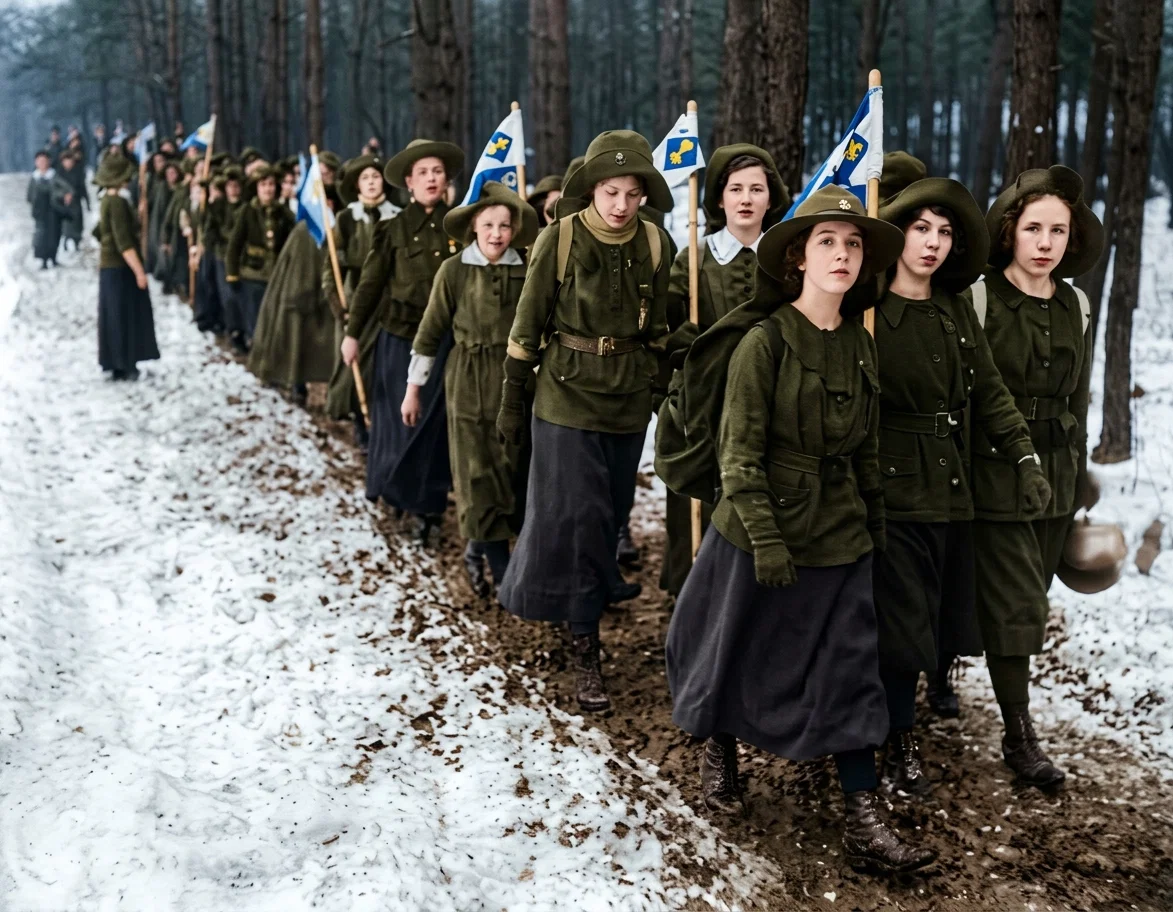
Marching Girl Scouts in Germany