Shiloh: the Man of Sorrows

2%

Pacific Press Publishing Association · Mountain View, California · May 31, 1910

FromSigns of the Times, Vol. 37, No. 21.

Read the full edition

Shiloh: the Man of Sorrows

Copyright, 1910, Pacific Press Publishing Association
By Mrs. L. D. Avery-Stuttle

Chapter XIII.—A Home in Bethsaida

Let us visit the home of the young fisherman Bar-jona and his family, over at Bethsaida, in sight of the blue waters of Galilee. The slanting sunbeams dance over the waters as the light evening breeze sets the waves aquiver. The sun is already receiving his nightly baptism in the mighty Mediterranean at the far west, and the shadows of the great sycamores outside the court are long and indistinct.
The house is much larger and better equipped with the comforts of life than those of most fishermen.
A sweet-faced woman in the prime of life is preparing the evening meal, while a happy young mother, with a babe at her breast, is seated beside her husband.
Possibly the reader may need no introduction to the family; but as some of its members act an important part in the succeeding pages of our story, it is well to have a clear understanding at the outset.
We are acquainted with the young husband Bar-jona and the brown-eyed lad Matthias well enough. We met them very recently in the temple at Jerusalem, whither they had journeyed to attend the Passover. It is the evening after their return.
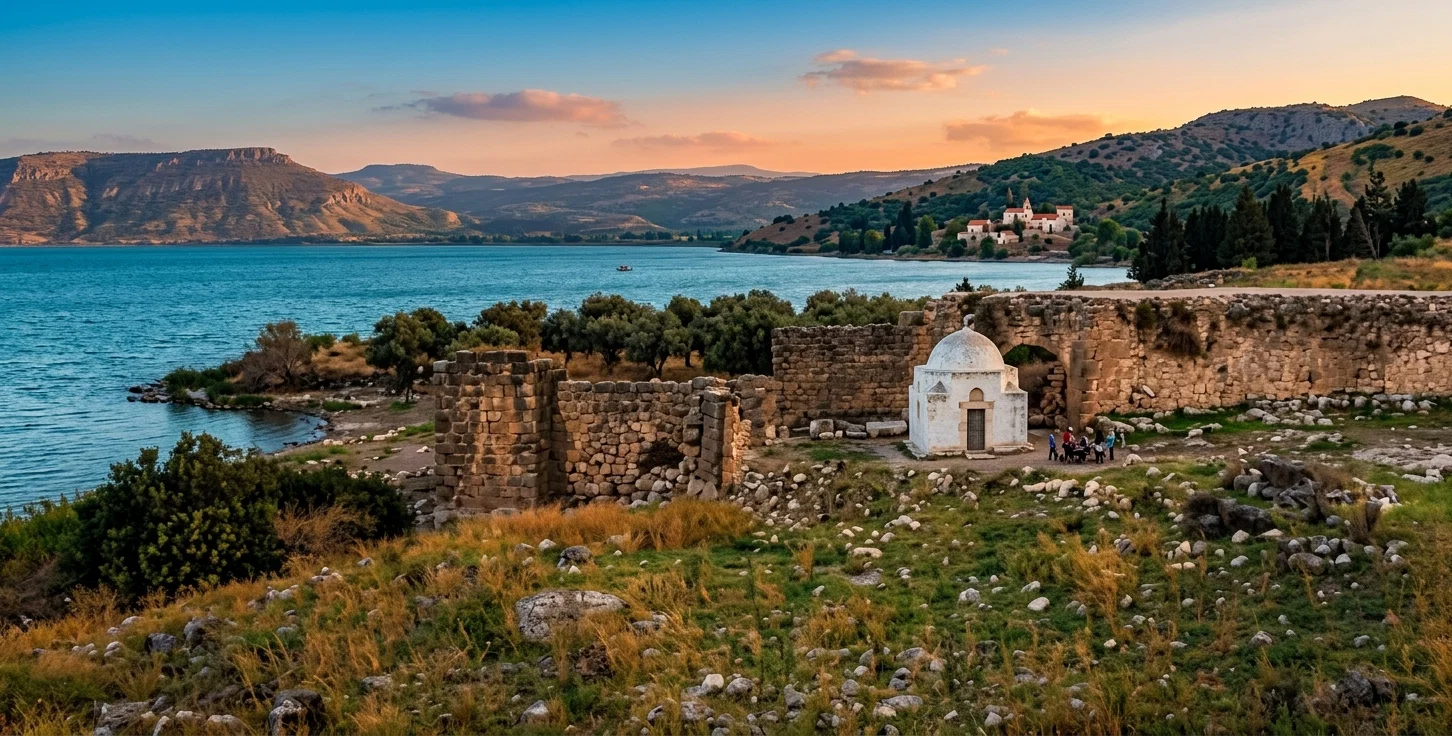
Bethsaida was the city of Andrew and Peter, one of the populous towns on the Sea of Galilee. Now there is naught but ruins to mark the once busy town.
The other members of the family we have not seen in twelve years. The man sitting by the doorway is Sylvanus the shepherd, who has returned from the Passover three days since. The sweet-faced woman preparing the meal is Esther, his wife. The young mother with the babe is their daughter Perpetua, grown to womanhood, now the wife of Bar-jona. The lad Matthias, whom we met with Bar-jona at the temple, will need no further introduction. Father Eliab, who met death at the hand of the Roman centurion, has been missed and mourned all these years; while poor Heber is lamented as dead, for the light of reason has never returned to him. The horrors of that night at Bethlehem have done their cruel work,—work which the hand of a dozen years has been powerless to undo; and so, altho a strong man of a score or more years, the mind is that of a babe. Following that night of horror, the sensitive lad had been stricken with a deadly fever; since when he has been the constant care of his parents, Sylvanus and Esther.
At the death of the elder Jonas, father of Bar-jona, the family of Sylvanus removed from Bethlehem, and took up their abode at the commodious home of the son-in-law, young Bar-jona, at Bethsaida.
“Come, Bar-jona,” pleaded Esther, with all a woman’s curiosity, “we would hear an account of the Passover and its happenings, at thy mouth, for verily Sylvanus is slower of tongue than thou,—and thou, Matthias, lad, what sawest thou? and what canst thou tell thy mother? for hath not this been thy first attendance at the Passover?”
“Many things were indeed new and strange unto me, my mother,” replied the lad; “but O Bar-jona, speak thou,—I can not,—speak thou of the Lad whom we saw, and whose voice we heard in the temple; as for me, I can think of nothing else.”
“Yes,” interrupted Bar-jona, “and thou couldst speak of nothing else all the journey homeward. The Child, I suppose, must have been about the age of our lad Matthias. For three days this Child visited the temple, at the close of the Passover, and discoursed so learnedly, even with the lawyers and doctors and some members of the Sanhedrin, that I trow He hath set half the tongues of Jerusalem wagging. Verily it is a hard task thou hast set me, mother Esther, to repeat unto you His conversation,—and O, as the Lord liveth,” continued Bar-jona, with sudden emotion, “the Child is unlike any other in Jerusalem—or—the world!”
“I saw Him not, my son,” replied Sylvanus.
“Nay; I saw Him not myself until thou hadst left Jerusalem; not until the confusion of the feast was ended. Then came He into the temple and discoursed with the teachers. Having occasion to pass through the temple, Matthias and I, we heard voices engaged in earnest conversation and discussion, and so we entered the door and paused to listen.”
“The high priest was propounding a question to the Child: ‘What sayest Thou, Lad? when the Messiah cometh, shall not our nation rest from her enemies? Shall not the glory of Jerusalem spread from sea to sea, and from the river to the ends of the earth? If not, why saith the prophet, “And He shall sit upon the throne of His father David, and of His kingdom there shall be no end”?’”
“Then,” continued Bar-jona, “I heard the voice of the Child as He made answer; the voice was low and earnest, but the words sounded clear and distinct as the notes of a silver trumpet: ‘Verily, when the Messiah cometh as King of Kings, O Annas, then shall He reign forever, and His glory shall fill the earth. But first must be brought to pass the words of the prophet, “He was despised and rejected of men; a Man of Sorrows, and acquainted with grief.”’”
“Then Jazer, the scribe of the temple, cried out, while a fierce scowl overspread his hateful face: ‘Wherefore protest Thou thus? Knowest Thou not, Thou Child of Nazareth, that Thy words are odious unto us? Saith not the prophet concerning Messiah, that He shall smite the earth with the rod of His mouth, and with the breath of His lips shall He slay the wicked? Surely the Gentile dogs shall lick the dust when the Shiloh of Jacob cometh.’ And the scribe cast a look of scorn upon the slight form which stood beside good Rabbi Ben Israel, as he continued: ‘It seemeth to me worse than folly to listen to this Lad. I mine own self have somewhat to say further; and if the word of a master in Israel be accounted of value, let this Child be silenced.’”
Bar-jona rested a moment as if to collect his thoughts before proceeding with his tale.
“But tell me, my son, did the words of the scribe prevail?” questioned Sylvanus, arising from his seat and coming closer to the side of the narrator. “Verily I have known him many a year to be a man hard of heart and stubborn of mind, who hath a tongue sharper than a sword.”
“Prevail? Nay, verily, they prevailed not; for at once some of the lawyers and doctors cried out earnestly, ‘Let us hear the Child; we care not to listen to the scribe.’ At this, the face of the scribe Jazer was black with madness, while the high priest gathered his rich robes closer about him, and his face took on a look of malignant hatred, as he glanced at the Child. His lips moved as if to speak; but for a moment his tongue seemed paralyzed.”
“I saw that the eyes of Jazer and the Lad met; the one full of deep hatred, the other mild, tender, gentle, and unspeakably sorrowful. Then the high priest turned to the lawyers and doctors. ‘Ye men of Jerusalem, what think ye? Shall we yield the faith of our fathers, that when Shiloh cometh, He shall rule the nations as with a rod of iron, and break the heathen in pieces as a potter’s vessel,—shall we yield this doctrine because of the foolish prattling of a babe?’ and the speaker glanced scornfully at the small figure before him.”
“Then,” continued Bar-jona, “the Child spake once again: ‘What saith the prophet Isaiah? “For the leaders of this people cause them to err; and they that are led of them are destroyed.”’”
“Then the voice of the scribe was again heard, harsh and shrill as the notes of the cornet: ‘Speak, Child! what sayest Thou of the Messiah? Surely He cometh in splendor and in glory greater than that of Solomon. Speak Thou.’”
“And I tell thee, father Sylvanus,” continued the narrator, “I have heard no voice like the voice of the Child as He answered; it seemeth even now that the sound thereof is in mine ears. It soundeth mournful as the sighing of the night wind among the cedars. It seemed that the fountain of tears was about to break from the sorrowful eyes as the Child made answer: ‘What then meaneth the prophet? “He is despised and rejected of men; a Man of Sorrows, and acquainted with grief: and we hid as it were our faces from Him; He was despised, and we esteemed Him not. Surely He hath borne our griefs, and carried our sorrows; yet we did esteem Him stricken, smitten of God, and afflicted.”’”
“‘Hear ye the Lad, ye men of Israel,’ interrupted a lawyer, ‘while I question Him. Verily we shall judge of His wisdom by the answer He maketh. Hearest Thou, O Child? Thou hast been speaking of Shiloh, and Thou sayest that He cometh in poverty, as a Man of Sorrows. But answer me, Lad, and verily it behoveth Thee to answer wisely. When cometh Messiah?’”
“Then,” continued Bar-jona, “a silence as of death followed the question of the lawyer.”
“What answered He?” questioned Sylvanus and Esther in one voice, while Perpetua bent her head to listen.
“What said He? Amid the breathless silence of the company, the Child stooped, for He was standing, took a roll of parchment from the lap of Rabbi Ben Israel, and unbound it with His small hands. Fixing His finger upon the place, He read: ‘Therefore understand the matter, and consider the vision. Seventy weeks are decreed upon thy people and upon thy holy city; . . . tomake reconciliation for iniquity, . . . and to anoint the Most Holy. Know therefore and discern, that from the going forth of the commandment to build again Jerusalem, unto the Anointed One, shall be seven weeks and threescore and two weeks.’”
“It is the word of Simeon the prophet!” interrupted Sylvanus eagerly; “the same which he spake unto us the day of his death. Rememberest thou, Bar-jona?”
“Verily, my father, I remember well, and I did remember even as the words of the Child sounded in mine ears. And truly the lawyer was much astonished at His reply.”
“Who art Thou, Lad, that Thou knowest the prophets like a master in Israel?” exclaimed one whom they called Nicodemus, while a look of deep admiration rested upon his countenance. “Who art Thou?” he repeated in astonishment.
“The lawyer did not wait for a reply, but fixed his eyes upon Rabbi Ben Israel, and then turned them full upon the high priest, as he said: ‘Now we know that it hath been near four hundred sixty and five years since Artaxerxes, king of the Persians, gave command to restore Jerusalem. And his was based upon those of Cyrus and Cambyses. It seemeth to have been this threefold decree to which the vision of Daniel the seer referred. Am I right, O Annas?’”
“Thou hast well said,” reflected the high priest slowly. “Indeed we know that the coming of Shiloh can be delayed but little longer. Verily there be scarce a score of years remaining of the nine and sixty weeks of years. There is little dispute concerning this among the teachers of Israel. But that He, the Star of Jacob, shall come in obscurity and poverty is too absurd to be taught by aught save ignorance and imposture;” and the high priest fixed his eyes scornfully upon the Child.
“Before any could make answer,” continued Bar-jona, “a pleasant-faced man, with a look of deep anxiety upon his countenance, ascended the stairs and touched me, as we—Matthias and I—stood in the doorway; and behold, it was the father of the Child. In a moment more the Lad had joined him, and together with the mother, who awaited them in the court of the women, they left the temple.”
“But Jazer the scribe declareth that the family dwelleth at Nazareth, and that the father is a carpenter.”
At these words, Sylvanus clasped his hands devoutly, as he exclaimed with conviction:
“Bar-jona, my son, behold THIS Child is the Babe of Bethlehem—the Shiloh of Jacob!”
(To be continued)