Out of Babylon to Zion

8%

Pacific Press Publishing Association · Mountain View, California · May 17, 1910

FromSigns of the Times, Vol. 37, No. 19.

Read the full edition

Out of Babylon to Zion

By Prof. Lucas A. Reed
Rejoicing of the Israelites upon the Building of the Temple

VI. Dedication of the Temple

THERE seems to have been a thorough organization of the work of rebuilding the temple, for we find that by the second year of their coming into Jerusalem there was such an arrangement of workers as to “set forward” the work of the house of the Lord. Persons were appointed to oversee and direct the work, for we read that “then stood Jeshua with his sons and his brethren, Kadmiel and his sons, the sons of Judah, together, to set forward the workmen in the house of God: the sons of Henadad, with their sons and their brethren the Levites.” Ezra 3:9.
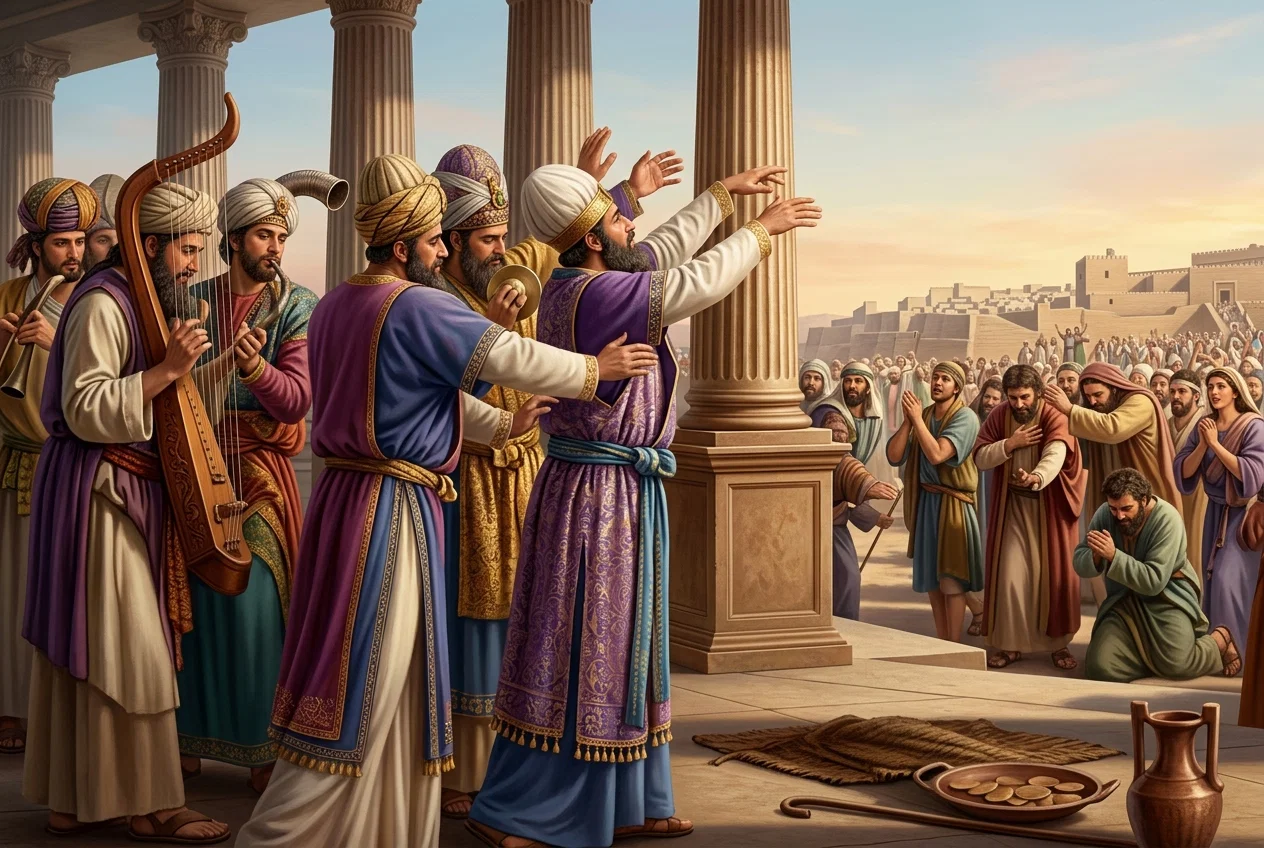
At last the wreck and rubbish of the years of captivity have been cleared away and the foundation-stones of the new temple have been laid. Then in gratitude to God for His wonderful mercy to His people in bringing them back to their old home and in opening the way for a new city and temple, and to dedicate that which they were about to establish, God’s people gathered in one grand dedication service. The priests in their glorious apparel with the trumpets, and then the Levites with the cymbals, praised the Lord in accordance with the ordinance of David king of Israel.
“And they sang together by course in praising and giving thanks unto the Lord; because He is good, for His mercy endureth forever toward Israel. And all the people shouted with a great shout, when they praised the Lord, because the foundation of the house of the Lord was laid.” Ezra 3:11.

Songs of Praise

One division of those who were to take part in the sacred song sang the first strain of the 136th psalm, “O give thanks unto the Lord; for He is good;” and the second division answered with the second strain, “For His mercy endureth forever.” Then the first division would again take up the opening strain of the second verse of that wonderful psalm, “O give thanks unto the God of gods;” and the second division answered, “For His mercy endureth forever.” Thus they rendered that wonderful psalm which records God’s goodness and His wonderful work toward the Jewish nation. And as the singers praised and thanked God for His goodness and for His mercy, all the people shouted with a great shout.
In the midst of that gratitude and that wonderful singing and praise, magnifying the goodness of God, there came in another element. There were those in that company, gray-haired men, that had seen the first house, that glorious temple covered with gold, one of the grandest buildings that was ever erected, and counted in its time as one of the wonders of the world. They could not forget; and as now they saw the small beginning of the new temple, the contrast between the former glory and this more humble edifice was something that saddened their hearts. We read that when the foundation of this house was laid before their eyes, they wept with a loud voice. While many shouted aloud for joy, these who remembered the old days wept. “So that the people could not discern the noise of the shout of joy from the noise of the weeping of the people: for the people shouted with a loud shout, and the noise was heard afar off.” We are very glad that the Inspired Word can say that the shout of joy drowned out the voice of weeping, and that the enemies of God outside the borders of Jerusalem could not discern any difference between the shout of joy and the shout of weeping. It was one loud, glad acclaim for the providence of God.

Such Changed Conditions

And yet we are not surprised at the feeling of these gray-haired men. How different was the condition of the Jews now from that splendid time when their king ruled from the Euphrates to the Mediterranean with no one to say nay. At that time the ports of the Red Sea poured in the treasures of India and Africa; the great caravans now passed far beyond the borders of Jerusalem. True, the merchants of Tyre were glad now to exchange their timbers and stone and furnish artisans, for the corn, wine, and oil of Palestine. But how different was all that wealth of treasure that passed between Hiram and Solomon in the days of old. Altho a large amount of gold and silver had been carried by the Jews from Babylon for the restoration of the work, notwithstanding its liberality, there is no question that it would raise a melancholy remembrance in contrast with the almost incalculable treasures which formerly sheeted Solomon’s temple with gold. Altho Cyrus and the wealthy people of Babylon, and the willing-hearted Jews, had gotten together a large store of treasures, it was as little compared with the unbounded treasures accumulated by David and his son through two generations and more; and where, too, were now the ark and the prophetic Urim and Thummim and the Shekinah, or divine presence, and the celestial fire upon the altar? The builders had dug down until they had found the original foundation-stones of Solomon’s great and glorious temple; but the very fact had reminded these gray-haired men of Israel, of that wonderful work of the former time, and their hearts broke in remembrance of the sufferings and humiliations of God’s erring people, and their tears of sorrow fell, while the loud shouts of joy made their sobs of grief inconspicuous amidst the noise that was heard even afar off.
(To be continued)