Shiloh: the Man of Sorrows

2%

Pacific Press Publishing Association · Mountain View, California · Mar 1, 1910

FromSigns of the Times, Vol. 37, No. 9.

Read the full edition

Shiloh: the Man of Sorrows

By Mrs. L. D. Avery-Stuttle
Holy Night
Holy Night

Chapter I

For weary centuries the iron heel of the conqueror had rested upon the neck of God’s chosen people.
Under Cæsar Augustus, haughty emperor of the civilized world, Herod the Great, an Edomite by country, but professing the Jewish religion, and now an old man, held in his trembling fingers the scepter of Israel. But the hand that held the scepter dripped with the blood of those who had stood in the way of his unholy ambitions.
Among the cities under the jurisdiction of Herod, was the little town of Bethlehem Ephratah.
O Bethlehem, city of David! what hallowed memories cluster about thy sacred name! Here dwelt the generous Boaz, in whose fields gleaned the mild-eyed maiden through whom was to be born “the sweet singer of Israel.” Over these historic hills roamed the simple shepherd lad with his flocks; and here the holy oil of anointing, which set him high above his envious brothers, was poured upon the youthful head by the aged prophet. Here also, in this unpretending city, must He be born who was to be “Ruler in Israel”—the Messiah of the prophets—according to the words of Micah, whose prediction of the event was given seven hundred long years before its fulfillment,—seven centuries before occurred the events about to be narrated.
The little city, small and unimportant, except for its sacred associations, was perhaps considered of no greater importance in the days of which I write, even though being the place in which the Messiah was to be born. About two leagues from Jerusalem, it is situated upon an eminence at the foot of which lies a valley extending to the Dead Sea.
The hillsides about the town of Bethlehem were well adapted to the keeping of sheep, and from time immemorial had been dotted here and there with the flocks of the shepherds. To this peaceful vocation a goodly number of the men of Bethlehem were joined.
On the evening of which I write, two shepherds might have been seen making their way hastily toward the village. Events of vast import had taken place within the past few weeks, and all Judea was stirred.
“I am glad, my father, that Achbor keepeth the sheep this night,” exclaimed the younger, a lad of ten or twelve years; “my mother and my grandsire will delight to hear the tale we have to tell them, and Perpetua, my little sister, also.”
“Verily, my son,” replied the elder, “my own heart beateth with expectation and longing, since meeting the strangers from the far East to-day. Let us hasten our steps, Heber. Seest thou, the shadows deepen in the valley, and the storm-clouds grow darker in the heavens!”
As they hasten onward, the lights in the little city grow nearer and brighter. They pass the one hospitable inn, hastily turn into a narrow alley, and anon stand before their own door.
“Sylvanus, is it thou? And Heber, lad? Thy mother gives thee welcome. I trust the sheep are housed; the storm to-night might chill the tender lambs.”
“Ah, Esther, verily thy mother-heart careth for every living thing,” returned her husband, stooping to caress his little daughter. “Where is the babe Matthias, my Esther?”
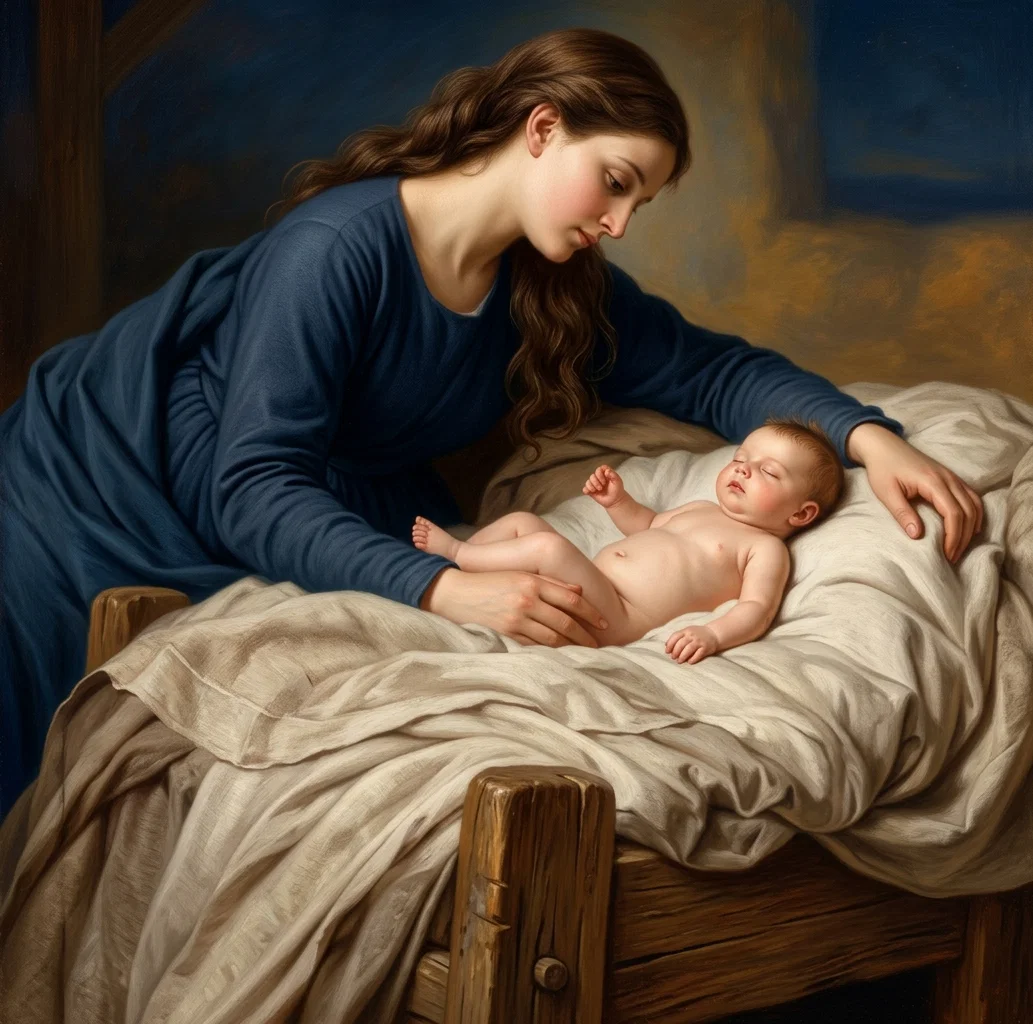
“Look; he sleepeth quietly. I laid him in his bed before the sun went down. But see, the evening meal is spread. Haste, Heber, lead thy grandsire to his favorite seat.”
“How camest thou to return so soon, my son?” queried the old man as they ate their simple meal. “Did Achbor keep the sheep? He’s but a hireling. Right well I knew his father; many a lamb has furnished a supper to the hungry bear because he slept.”
“But O grandsire, listen!” cried the lad Heber, unable longer to restrain his eager tongue.
“What is it, lad? I see by the shining of thine eyes that thou hast news—good news—to tell us,” interrupted his mother.
“Yes; we have learned more of the Child, the Messiah.”
“Shiloh—the Messiah!” echoed Eliab the patriarch, his dim eyes shining with eagerness, “the Messiah of the prophets!”
At this moment a knock at the outer door demanded their attention.
“Ho, Bar-jona, is it thou? Come in, young man,” exclaimed Sylvanus heartily. “Whither dost thou journey? and is Jonas thy father in good health?”
“I will tell thee, my good friend,” smiled the young visitor; “I came but lately from the city of Bethsaida by the sea, for we removed thither a long time ago, and are fishers. More than forty and five days ago,” he continued, “a number of merchantmen from Jerusalem came up to Bethsaida, and there spread the report that, in the opinion of many godly men of the seed of Israel, the long-looked-for Messiah had been born. Now my father Jonas is an old man, as thou knowest, and could not make the journey to Jerusalem; and so I am come hither that I may know the certainty of the matter.”
“Thou hast done well that thou hast come, young man,” said Sylvanus, while the old man Eliab murmured softly: “He hath been born,—the Desire of Israel. But I, alas, I may not see Him; for I am old, and my strength faileth. O that I might behold Him,—the Shiloh of Jacob.”
“I am glad thou hast come, Bar-jona,” said Esther, stepping lightly to the cot where slept the babe Matthias; “thou hast come in a favored day. Surely it is time for the words of the prophet to be fulfilled. Come, Sylvanus,” she smiled, turning to her husband, “what hast thou learned to-day, that thou wast about to tell us when Bar-jona entered?”
“But first,” interrupted Heber, “tell thou Bar-jona of the heavenly beings thou sawest above the fields of Bethlehem,—it may hap he hath not heard the tale.”
“Verily it is a strange tale, and will bear repeating many times,” replied Sylvanus, while his young guest bowed his head and moved nearer the speaker.
“One night, scarcely two months ago,” began the host, “while the town was filled to overflowing with many visitors who had hastened hither at the command of Cæsar, at about the sixth hour, while we watched our sheep, we beheld a wonderful sight. We had been talking of the miseries of Israel, and of the prophecies concerning One who was to reign in splendor and who would sit upon the throne of David and release our nation from the hated Roman yoke. Suddenly as we talked, behold, the hills and valleys of Bethlehem seemed lighted with the glory of Jehovah. My companions were so affrighted that they fell to the ground upon their faces.
“Then there stood by my side a beautiful being, bright and shining as the sun; and a voice richer than music fell upon my ear: ‘Fear not, son of Israel. I bring thee tidings of great joy; for this night in the city of David has been born a Saviour, which is Messiah the Lord!’ Nor is this all,” continued Sylvanus; “the heavenly being said unto us that we would find the holy Babe wrapped in swaddling clothes and lying in a manger by His mother’s side. Then the angel took his departure. But as he ascended heavenward, the sky was filled with myriads of shining choristers, who chanted heavenly music; and the music was set to words sublime and beautiful, which floated earthward; ‘Glory to God in the highest, and on earth peace, good-will toward men.’”
“At length, while the sweet harmony held me enraptured, my companions lifted up their heads, and in an ecstasy of joy they joined with me in shouting the high praises of God.”
Sylvanus paused, overcome with deep emotion as the remembrance of the vision thrilled his being. Eliab the aged was the first to speak. “Verily Jehovah hath showed mercy to Israel, my children,” declared the patriarch, as he slowly stroked his long, silvery beard.
“It is indeed a wonderful story,” repeated young Bar-jona, enthusiastically; “but tell me, Sylvanus, mine host, didst thou see the Babe?”
“Verily; for my two companions and I followed the angel’s directions, and found even as he had said. With joyful hearts we prostrated ourselves before the Child, and hastened to make known the truth to all who would listen to our tale.”
“Who were they that would not listen?” questioned Bar-jona, while a look of astonishment and indignation passed like a shadow over his expressive face. “Didst thou confer with the priests at Jerusalem?” he continued hotly; “surely would they be dismayed at this unbelief in Israel. Well they do know that the time is ripe for the Messiah. I shall speak with the high priest to-morrow.”
The countenance of Sylvanus fell, and his voice trembled: “Young man, the priests and rulers of our unhappy nation are neither prepared for nor willing to receive the Messiah. The manner in which they have slighted the messages from Jehovah that have been sent us during these past few days and weeks, has convinced me that this is true.”
“But father,” urged Heber impatiently, “tell of the strangers we have seen to-day, and of their astonishing story, the which when we had heard repeated by their own lips, caused us to hasten homeward, leaving the sheep in the care of a hireling, that we might make it known.”
“Let us hear at once, my son,” pleaded the old man eagerly; “why art thou so slow of tongue! My flesh and my heart cry out for the living God.”
“Verily, my sire,” replied Sylvanus, “I would God the priests and the rulers were like-minded with thyself.”
“To-day, about the eleventh hour, as the lad and I were driving the sheep toward the fold, our attention was attracted by a cavalcade which proceeded southward from Bethlehem. That they were strangers we had no difficulty in determining; and from their princely bearing, we judged them to be of royal blood. Just as they were passing us, while we were gazing upon them with admiration and curiosity, one of their number, an old man, with locks white as the hoar frosts, stepped from his company and approached us.
“‘The peace of God be with thee!’ he exclaimed.”
“‘Peace be unto you,’ I replied.”
“‘Canst thou tell me how many leagues distant is Mamre?’ he questioned.”
“‘Hebron is about five leagues from Bethlehem,’ I replied.”
“‘But in the days of Abraham the friend ofGod, the old city was called Mamre, and we journey thither.’”
“‘From whence art thou, Master?’ I asked, ‘for I perceive thou art not from Judea nor yet from Galilee nor Perea.’”
“‘Nay; we be come from the far East. To see Him who is born King of the Jews are we come; and behold, Jehovah hath granted our prayer, for we have both seen and worshiped, and now do we return to our own country.’”
“‘It is the Messiah!’ exultingly replied my son Heber, who stood by my side,—‘Shiloh, the Messiah; we also have seen and have worshiped Him.’ Then I quickly related to the stranger the story which I have repeated to you this night, Bar-jona, of the song of the angels as they hovered over the fields of Bethlehem, and of the beautiful Babe whom we had found even as they had directed us.”
“‘But how could ye find the Babe?’ I asked; ‘and who directed thee and thy companions on thy journey from so far a country?’ and he answered:”},{
“‘We saw no angels, and we heard no voices. The tread of the camels was light and noiseless, and we heard naught but the beating of our own hearts, save when we spake, the one to the other, his fellow. Yet were we not left without a guide. For behold, a shining star, brighter than Arcturus with his suns, brighter than Orion, or the soft and silvery Pleiades, appeared, led on before, and beckoned us to follow. It led us onward toward Jerusalem, and hung like a blaze of glory over the famous temple built for the worship of the one true God, Him who formed the heavens and the earth. Then Herod the king heard of our coming and of our errand, and his heart was troubled. “Where say the prophets that Christ will be born?” he demanded of the wisest men of Jerusalem, of Annas and of Hillel and of all the learned Sanhedrin. And when they made answer that according to the words of the holy prophets, Messiah must be born at Bethlehem of Judea, King Herod hasted and called us to his presence. But he called us not publicly, for why should he appear, in the eyes of the people, to pay heed to the sayings of the strangers from the East?’”
“‘What said King Herod unto you?’ I questioned eagerly.”
“‘He bade us seek the young King at Bethlehem, and as soon as we had found Him, to hasten again to Jerusalem to his palace, and acquaint him with the exact whereabouts of the royal Babe; so that he might come at once to worship Him!’”
Thus far during the recital of this story by the host, the silence was only broken by the voice of the narrator and the soft breathing of the infant Matthias, as he lay in his mother’s arms. But now the patriarch Eliab could no longer restrain the eager questions which leaped from his tongue.
(Continued next week)