The Ottoman Empire

3%

Pacific Press Publishing Association · Mountain View, California · Feb 4, 1913

FromSigns of the Times, Vol. 40, No. 5.

Read the full edition

The Ottoman Empire

Items of Interest in Asiatic Turkey
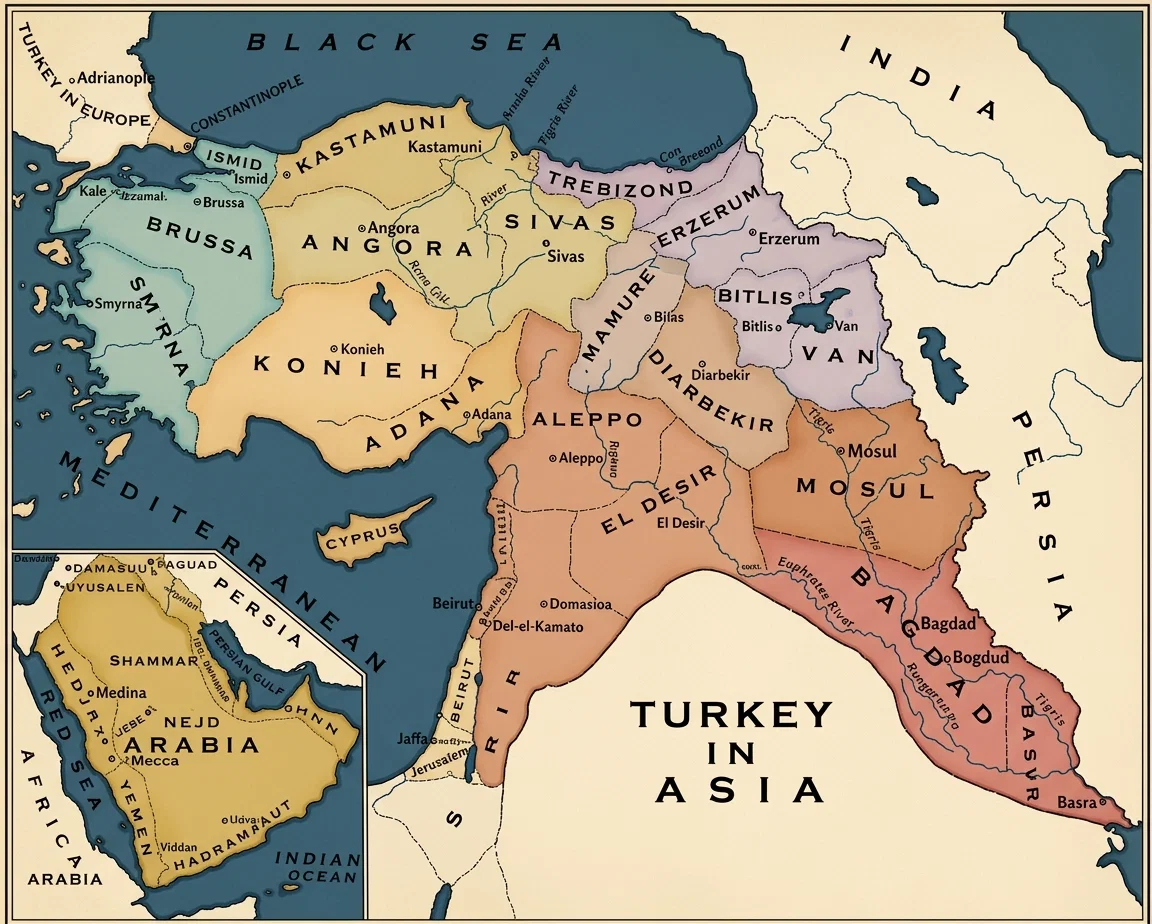
The scale of the large map is 240 miles to the inch; the map of Arabia, in the lower left-hand corner, is 1,000 miles to the inch. We have given only the most important towns, and capitals of the vilayets, or provinces. There are many other towns not given. Arabia, if the map were extended, would occupy the place of the title, and extend southward a thousand miles or more.
LAST week we gave a chronicle of the history of the Ottoman Empire from the time of Osman, its founder, to the present time.
This week we wish to say something of its territory in both Europe and Asia, stating just the facts as we are able to gather them, previous to the present war.
European Turkey, at the beginning of the present war in the Balkans, covered a territory of about 65,350 square miles, with a population of 6,130,200. What it will be when the war is over and the final settlement takes place, it is pretty difficult to imagine. There may be left only Constantinople and a few miles of territory at the back. That city even may be lost. The population is not wholly Mohammedan, by any means. Many belong to the “Orthodox” or Greek Catholic Church. The people are largely, however, of Slav, or Turkish, descent. Besides this, there are many Greeks and Albanians. The two chief religions are Mohammedan and Greek Catholic. The adepts, or the advanced ones in the study of the Koran, are called the Ulemas, who decide all doubtful cases relating to religious and social life, and who can fill judicial as well as ecclesiastical posts. The patriarch of Constantinople, of the Greek Church, presides over the permanent synod, and nominates all the lesser dignitaries, subject to the confirmation of the Porte. The Armenian church has its patriarch at Constantinople, while the Roman Catholics have nine archbishoprics in the Turkish Empire.

The Government

The Turkish Empire is a theocratic monarchy under the sultan, who is also called the calif, or successor of the prophet. His chief representative in functions is called the grand vizier, while the chief vicar in religious affairs is the Sheik-ul-Islam. The constitution provides for a parliament composed of a senate, the members of which are appointed by the sultan, and a lower house elected by the people, or indirectly by manhood suffrage. Effort has been made during the last few years to bring it into harmony with Western practice and progress. General conscription, that is, the bringing of all classes into the army, has been in progress since 1800. For a long time Christians were not permitted to serve in the army, but paid an army tax instead. Certain of the Arabian and Kurdish tribes were also exempt; but in 1909 a decree was issued extending the liability to military service to non-Mohammedans, and this liability to service extends from twenty to forty years of age. In 1911 the strength of the army was fourteen army corps, with a numerical strength of 420,000 men. In 1911 there were eight battle-ships in commission, two others nearing completion, three armored cruisers, twenty-four destroyers and torpedo boats, and a number of small gunboats.
The empire is divided into what is called eyalets, or vilayets. According to the last census, not taking into account the present war, these were about as follows:

Vilayets

In Europe:
Vilayet Area, square miles Population
Constantinople 2,702 1,136,000
Adrianople 15,015 1,106,500
Saloniki 13,684 1,165,400
Monastir 10,690 847,400
Kossovo 12,100 961,000
Scutari (Albania) 4,516 322,000
Janina 7,045 648,000
Total in Europe 65,752 6,186,300
In Asia: Asia Minor
Vilayet Area, square miles Population
Ismid 4,323 222,800
Brusa 28,486 1,626,900
Bigha 2,625 129,400
Archipelago 2,744 325,900
Smyrna (Aidin) 20,844 1,396,500
Kastamuni 19,184 1,018,900
Angora 26,055 892,900
Konieh 39,779 1,088,000
Adana 14,359 403,400
Sivas 24,240 1,086,500
Trebizond 11,850 1,163,800
Subtotal 194,489 9,355,000
Armenia and Kurdistan
Vilayet Area, square miles Population
Erzerum 19,686 597,000
Mamuret-ul-Aziz 13,240 575,300
Diarbekir 13,703 471,500
Bitlis 10,345 398,600
Van 15,517 430,000
Subtotal 72,491 2,472,400
Mesopotamia
Vilayet Area, square miles Population
Mosul 29,220 300,300
Bagdad 54,503 850,000
Basra 16,482 200,000
Subtotal 100,205 1,350,300
Syria
Vilayet Area, square miles Population
Aleppo 30,340 995,800
Zor 32,849 100,000
Syria 23,816 955,700
Beirut 11,773 533,600
Jerusalem 8,222 333,000
Lebanon 2,509 399,500
Subtotal 109,509 3,317,600
Arabia
Vilayet Area, square miles Population
Hedjaz (approximate) 96,500 300,000
Asir, Hodeida, Sana, and Tais (all until recently included in the vilayet of Yemen) 77,200 750,000
Subtotal 173,700 1,050,000
Total in Asia 650,394 17,545,300
Besides these vilayets, there is also Egypt, with its 400,000 square miles, and 9,821,000 population, of which the sultan is the nominal ruler. Tripoli has recently been lost by the Turkish government, to Italy.
It is of interest to note some of the large towns in Turkey in Asia, besides the cities of Constantinople in Europe, with a population of 1,125,000, and Alexandria, Cairo, and Allahabad in Egypt, with populations respectively of 332,246, 654,476, and 172,000. Westerners sometimes seem to get an idea that all of Turkey is in Europe, but Turkey’s largest dominion is in Asia, as shown in the tables before given from “The International Encyclopædia.”
Damascus. Damascus is the capital of the Turkish vilayet of Syria; contains the world renowned Ommiade Mosque; built as a heathen temple; made into a Christian church; converted at last into a mosque. In it also is the street called Straight (Acts 9:11). Population is estimated at 225,000.
Smyrna. Population 201,000. The seat of an early Christian church; noted for its carpets and rugs. Like many other cities of Asia Minor it has suffered greatly from earthquakes.
Bagdad. Capital of the vilayet of the same name. A town in ancient Mesopotamia, situated on both banks of the Tigris River, on the projected Bagdad railway, which Germany is building from Constantinople to the Persian Gulf. Population estimated last year at 150,000.
Beirut. A city in the vilayet of the same name. Situated on a bay at the foot of the Lebanon Mountains. Said to be the healthiest place on the coast. Possessing a university, astronomical observatory, and a society of Oriental languages. Population in 1900, 140,000.
Aleppo. The capital of the vilayet of the same name. Extending from the Mediterranean to the Euphrates. The town has been captured and sacked, and devastated by earthquakes, and ravaged by plague and cholera during its history. It is a great commercial center, in spite of its inland position. There is here a mosque which contains the alleged remains of Zacharias, the father of John the Baptist. At one time contained about 300,000 inhabitants.Its population at the present time is estimated to be 129,000.
Brusa. The earliest capital of the empire, and the former capital of Bithynia. Population in 1900, 76,303.
Mecca. The holiest place on earth to Mohammedans; noted as the birthplace of Mohammed; in the vilayet of Yemen in the western part of Arabia on the Red Sea. There is here a peculiar cubic structure called the Kaaba, said to have been built by Abraham. Its four sides are covered with black silk, annually renewed, and the covering is known as the holy carpet, sent every year from Cairo, and carried in procession from Jeddah to the city. Openings in the silk are left to show two sacred stones. The black stone at one of the angles is a special object of veneration. It stands in a mosque enclosure capable of holding 35,000 people. The permanent residents of the city are 60,000. Pilgrims sometimes number 100,000. Non-Mohammedan visitors enter at the risk of their lives. It is supposed to have been the home of Ishmael. The sheriffs since 1513 have ruled in the name of the Turkish sultan, who also sends a governor to the place.
Jerusalem. The holy city of Jews and Christians. Population about 60,000.
Medina. A walled city of 50,000 inhabitants, in the western part of Arabia, 245 miles north of Mecca; second only to Mecca in sanctity. Here is Mohammed’s tomb behind the mosque where he died. Abu-Bekr and Omar are buried in the same spot. Non-Mohammedans are rigidly excluded.
Konieh. The ancient Iconium where Paul preached (Acts 13:51). Has a population of 44,000.
Mosul. The capital of a vilayet of the same name, in ancient Mesopotamia, opposite the mounds of the ancient Nineveh. Population 40,000.
Trebizond. A town on the Black Sea; an important shipping point, the trade of which reaches about ten millions annually. It is fortified and walled, and was the capital of the empire of Trebizond under Alexis Comnenus in 1204. Captured by the Turks in 1461. Has a population of 40,000. In 1895 was the scene of fearful Armenian massacres.
Erzerum. An important military center. Famous for its copper and ironware, shawls, and carpets.
Bitlis. A thriving city in central Asiatic Turkey; engaged principally in the manufacture of firearms and cotton cloths of a bright red dye. Population of the town, 38,800.
Adana. A town in the southern part of Asia Minor, a railway terminus. Population of 32,000.
Antioch. Noted especially from the fact that it was a city well known in New Testament times. Built by Seleucus the first king of Syria, and named by him after his father. Noted at one time for its wealth and luxury. There the name “Christian” was first used (Acts 11:26). Almost destroyed by an earthquake in 1872, but has since recovered, and has now a population of 28,000.
There are many other towns ranging from 44,000 to 10,000 in population.
The chief interests in Asiatic Turkey are, first of all, the silks, drugs, cloths, etc., that come from there, and also the fact that it connects us so strongly with Bible lands and the ancient wars between the early powers of earth, such as Babylon and Persia. It has this lesson for the student of government, as well as religion, that no people are governed well, and no government is strong, unless it has the consent of its people and union and harmony among them. That has not been the case with the Turkish government. A state religion always proves a curse. Turkey has had serious troubles without, but its troubles within have been even more serious, and no government can by cruelty and force perpetuate itself.