An intense love of the beautiful in nature is a marked characteristic of the Japanese people. The full moon on a calm evening draws crowds of admiring beholders. A Japanese will walk miles to see a fine display of flowers in bloom, or of scarlet autumn leaves. Special excursion rates on the railways are arranged when the plum blossoms open in February, the cherry blossoms in April, and when the maple leaves turn scarlet in autumn; and great crowds throng the resorts made famous each by its particular flower or tree.
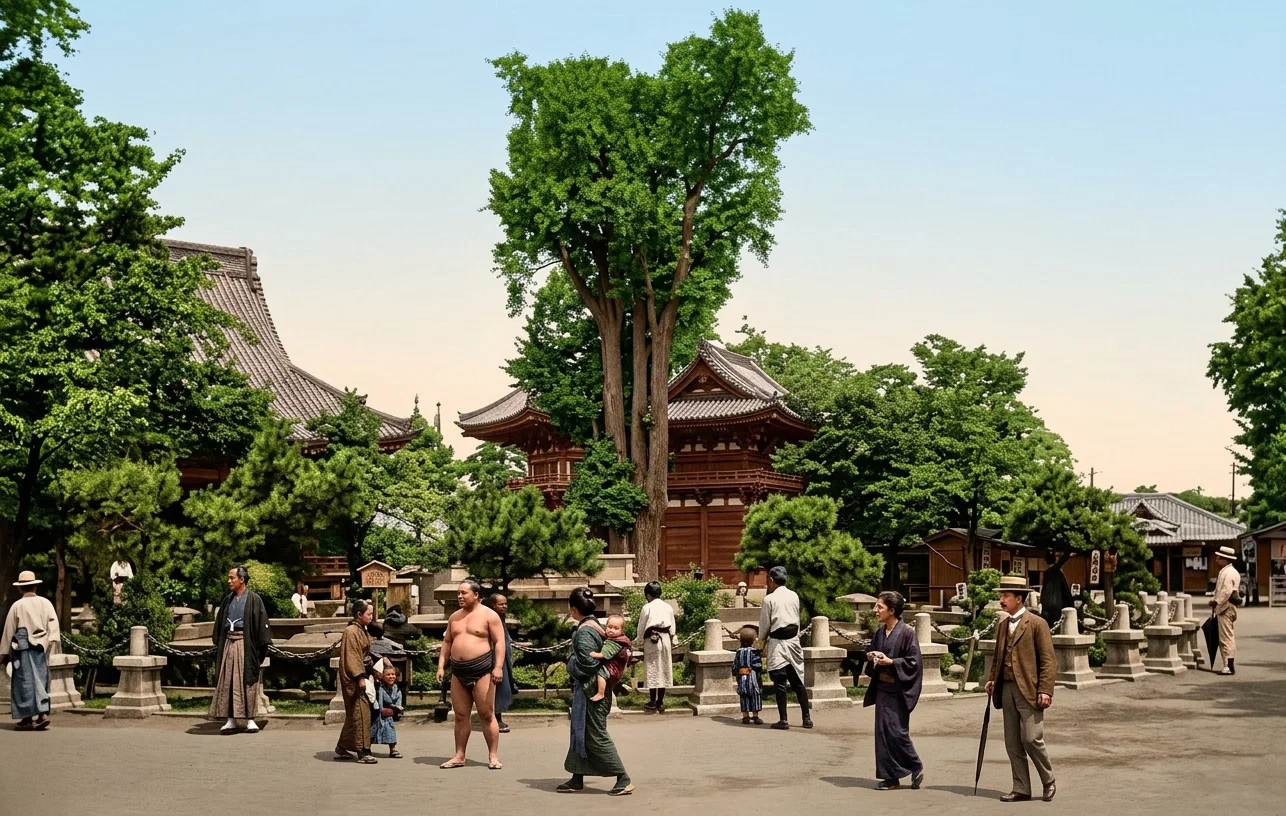
Asakusa Park, Tokyo
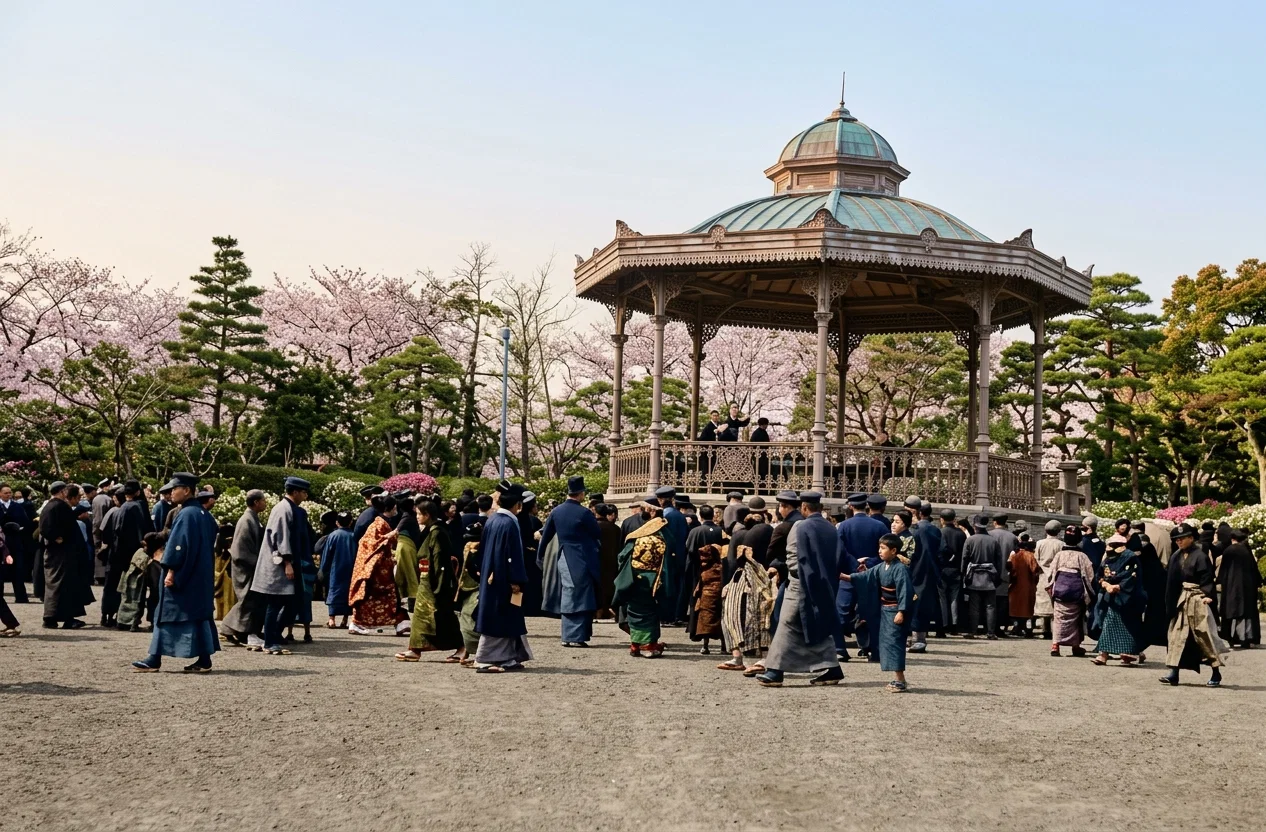
Band Stand, Hibiya Park, Tokyo
So it almost goes without saying that public parks are common in Japan. Every town of any considerable size has its park. But the parks of Tokyo excel all others in size, if not in beauty.
Ueno Park (pronounced Wayno), in the northern part of the city, is said to be the largest park not only in Tokyo, but in all Japan. For the most part the grounds of this park are quite elevated, affording good views of the city. The extensive grounds enclose the Imperial Museum, an art school, a zoological garden, besides various temples and shrines. Tall evergreen trees afford a dense shade. But of all things that it contains, Ueno Park is most famous for its flowering cherry-trees. The blossoms open early in April; and at this time the park is thronged with gaily dressed sightseers.
Asakusa Park, farther east, is not so large as Ueno; but the attractions are of such a nature that crowds of people visit it on almost any pleasant day, but especially on Sundays. There is a “Garden of a Thousand Wonders” containing flowers, animals, birds, life-size figures arranged in historic tableaux, with an entertainment of trained birds, moving pictures, or automatic dolls, every half hour. One street in the park is taken up with various cheap shows and play houses. On the whole it is an interesting place to go to see the people, as they worship at the big Buddhist temple, and enjoy the various amusements.
Far to the south is Shiba Park, in the gloomy shade of whose towering evergreens stand the great temples dedicated to certain of the Tokugawa shoguns who are entombed here. The booming of the great temple bell in this park can be heard for miles as it is rung morning and night.
Hibiya Park, fairly near the center of the city, is the newest of all the parks in Tokyo, having been laid out only six or seven years ago. It is also peculiar in that it is laid out according to Western ideas of landscape gardening. It has become one of the most popular resorts in the city, and is a common place for holding all sorts of out-of-door meetings. This park was the scene of the great mass-meeting preceding the riots of September, 1905, when the people expressed their dissatisfaction with the terms of the Portsmouth Treaty. In summer the Yokosuka marine band gives a weekly concert in this park, and renders very creditable music on a good complement of instruments.
The childlike love of beautiful things is one of the most apparent traits of the Japanese character, and must certainly tend to smooth the asperity of life in this world of hardship and trouble. But love of the beautiful in nature is no substitute for the love of moral beauty. In fact, the first is often found in a heart that is sadly distorted by sin. These four great parks and other smaller ones afford the people opportunity for physical relaxation and recreation, where they can take delight in the beauties of flower and shrub and tree. But these do not minister directly to their spiritual needs. So we are planning and laboring to provide a resort, in the form of an attractive church building, to which we can invite the people, that they may have held up before them the moral beauty of the Man of Calvary, and that by beholding they may be changed.