When the present asks the future, “Comest thou peaceably?” does the future answer, “Peaceably”?
ROBERT B. THURBER
This question fairly throbs with significance and interest today. Though it has been raised every morning and asked every evening for years, it still remains absolutely the most up-to-date question. Leagues, legislatures, vox populi, press, and pulpit have scores of replies to it—but no answer. There is but one answer, and that emanates from the only One who knows. The best that any man can do is to give clear voice to that answer, and then stand by.
Here is the answer:—
“There shall be signs in sun and moon and stars; and upon the earth distress of nations, in perplexity for the roaring of the sea and the billows; men fainting for fear, and for expectation of the things which are coming on the world: for the powers of the heavens shall be shaken. And then shall they see the Son of man coming.” Luke 21:25-27, A.R.V.
“Proclaim ye this among the nations; Prepare war; stir up the mighty men; let all the men of war draw near, let them come up. Beat your ploughshares into swords, and your pruning-hooks into spears: let the weak say, I am strong.” Joel 3:9, 10, A.R.V.
“For yourselves know perfectly that the day of the Lord so cometh as a thief in the night. When they are saying, Peace and safety, then sudden destruction cometh upon them.” 1 Thess. 5:2, 3, A.R.V.
A fair, serious study of these passages, with their contexts and related texts, proves conclusively, to the candid mind, that these are prophecies of our own times. The Almighty predicts no peace for the immediate future, nor does He picture any till the great Prince of peace shall come and put an end forever to all strife.
But the thoughtful reader questions: Isn’t such a prophecy blind and unreasonable? What are the indications of such a dire outlook? There was never such a desire for peace as at present.
Possibly this prediction is blind, to human eyes; but much less so than a similar prophecy which might have been made early in 1914. There are many more straws in the wind now than there were then, and withal the wind is stronger.345
From the standpoint of reason, why should there be any more fighting, since the world has learned its bitter lessons? Isn’t enough enough?
The individuals we meet seem to have learned the lesson, in theory at least; yet the world is plunging on under some hidden, irresistible impulse that seems to make impossible the end of hostilities. A year after “peace” had come, there were said to be forty wars in active operation.
In an ancient day, when a trembling king enquired of the man who drove “furiously,” “Is it peace, Jehu?” the intrepid revolutionist answered, “What peace, so long as the whoredoms of thy mother Jezebel and her witchcrafts are so many?” And a similar answer may be caught up and sounded today. What peace, when the seeds of strife have been and are being sown in the heart-soil of every people, with utter disregard of the harvest? Still, as through all time, thorns do not produce grapes.
We do not need to make a far search for signs of tomorrow’s times. Take the scalpel of observation, and lay open some of the seeds that are now germinating in the soil of every land on the globe, and the future is plain. Far be it from the writer’s purpose to seek out the thousand and one omens of evil, and scan them through the magnifying glass of pessimistic prejudice. But to the man who is heading up into the current of international events in these days, there are certain unescapable facts which beat into his consciousness as a blizzard into the face. They are so patent, that only those persons cannot see them who deliberately close their eyes, with the mistaken idea that not admitting the presence of the facts, will help to eradicate them. Such persons let their optimism border very closely on cheerful foolishness. Let us look at some of these things squarely.
Pathe, Photo. THE PREMIER OF VICTORIA (MR. LAWSON)
SPEAKING AT LORNE
All through the wreckage of the late combat, may be found a sinister aftermath of joy-consuming hatred, an intense and uncompromising antipathy of one race or nation against another, and this of the no-quarter-given-or-asked variety that makes one shudder. And this hatred does not die with the dawn of peace, though it may find less opportunity for expression.
Practically all the different races commingled in the great struggle, and had a chance to size each other up. The backward and subject races saw the weak points of the more progressive and dominant races, and went home to spread the news. Distinctions that have always been made, favouring more civilised peoples and detrimental to less civilised ones, were made more evident by the close contact of millions of every sort of men in the long-drawn-out conflict. War in itself is a most uncivilised affair anyway, as those who have been in it are the quickest to testify; and in the great issues which it was used to decide, the less advanced races could not but compare themselves favourably with the more advanced, and therefore feel dissatisfied with the rewards which the sacrifice brought to them. This consciousness of equality—or superiority—made itself felt in numerous race riots afterward.346
Again, there grew up a most unnatural hatred against every individual on the side of the enemy, as if it were impossible that a good German, or a good Frenchman, or a good Englishman, as the case might be, could exist; as if goodness or badness inhered in nations as such. This feeling was by no means universal, but it was surprisingly wide-spread. Among peoples so compact and interwoven in mutual interests that all must be neighbours, even though not neighbourly, nothing could be a greater breeder of misunderstandings and future disturbances than this.
Ranking of Injustice
When the Paris Peace Congress met, every national government sent its delegates to make claims in the settlement of boundaries and rights. These claims ranged from the legitimate to the preposterous, from the hopeful to the hopeless. Not all of them could be met in a way satisfactory to the claimants, especially since, in many cases, several nations wanted the same territory. No doubt the peacemakers did the best they could; but as they were men, and dealing with men, some injustice, or fancied injustice, was done. And injustice, whether real or visionary, rankles. It continues to rankle. Nations never forget the invasion of their rights, and only await the opportunity to retrieve.
The small ones especially feel this injustice; and it is usually by smaller States, or their troubles, that great wars are begun. In history, the typical contest is that of little brothers getting into a fight, and the big brothers joining the conflict with the ostensible purpose of helping the little ones.
The war has left in the hearts of millions of people who feel that they got the worst of it, the surging desire to “get even.” As long as this hope remains in the hearts of a considerable number of people, peace is jeopardised every hour. And the history of the last century proves that such a desire does not pass away with the years, but may be willed to the children of the originators with added intensity. Peace can come only when every one feels that he is “even.” But there is only one way to “get even”; and for some reason, that way was not taken at the Peace Conference.
In spite of the national and race antipathies engendered, it is remarkable with what success class solidarity has developed; for class distinctions cut directly across those of race and nation. The advance wave of the class spirit is seen in Russia at the present time. Whether we say that the Soviet Government of Lenine and Trotzky is simply applied socialism or not, the extreme socialists of every nation are strongly advocating recognition of the Bolsheviks of Russia.
With their enemies beaten back and fast becoming discouraged because the great Powers have decided to let Russian Bolshevism work itself down or up in its own way, the Soviet Government seems in a fair way to become established and fairly stable. But this experiment in class rule, while it desires to be let alone just now to develop its scheme of government, is very far from the intention of letting others alone. It plans to spread Bolshevism all over the earth, by force of arms if necessary. There is a bare possibility that the ideas and ideals of the Bolsheviks are misunderstood by the rest of us. But it is very evident, as far as outward appearances go, that the majority is at present opposed to them with a flame of intensity that needs no fanning. Considering the fanaticism and determination—and withal the success so far—of the Soviets in converting others to their views, and the strong opposition of those outside of central Russia, I ask, Is Bolshevism tending to “follow after the things that make for peace”?
As to the desperate methods of these millions of men inspired with class hatred, E. T. Colton reports in Association Men, December, 1919, a conversation with one of their leaders:—
“He looked at me in a pitying sort of way, and said: ‘Mr. Colton, you have missed the whole point. There can be no compromise. This is war. No class has ever risen above self interest, and none ever will. When the other group were in power in Russia, they did not think of the workers; and now that the workers are in power they govern for themselves. We will either win it all or we will lose it all. We will either be exterminated or we will exterminate.’”
This is the war to the knife which we face in the growth of Bolshevism.
It is a notable fact that those most active in promoting peace and a league of nations are most apprehensive of another call to arms. With whatever visions peace commissioners went to the congress, they347saw something there that was far from reassuring, as is shown by what they did when they came home—not by what they said, but by what they did. What shall we think when the hearts of statesmen, who come the nearest to seeing the condition of the world as it is, fail them for fear, even in the midst of negotiations? At the peace table, there was a sincere proposal to bring about “universal reduction of armaments,” and this is involved in the treaty that was signed; yet the governments concerned continue to make preparations for future hostilities. Military and naval programmes for years to come give the lie to peace talk, and sow universal distrust.
The “peace” footing of the armies of the several greater countries is far beyond what it was before the last internecine grapple, which, according to the sanguine advocates of immediate and everlasting peace, is never to be repeated. But the most influential of the peace-desiring nations find it hard to get the world to trust them when they do not trust themselves.
The stanch proposers of compulsory military training are on every hand. Already the State of New York has taken the lead, and her young men must spend some time learning to fight. As other States follow, we wonder about dreams of peace. But we are assured that this preparedness is simply preventive. Because the boys are made better men, at least physically, it is declared to be a good thing for the country. But no mention is made of the numerous insidious temptations and dangers that haunt camp and barrack life.
“Prepare for war, and you get war,” says General Sir Frederick Maurice, former director of military operations of Britain. Or as Marshal Foch is quoted as saying: “War has ceased to be an art, and has become a science and an industry. As such, it can be evolved infinitely.”
Hand in hand with the development of industry will go preparations for war. No war ever ended wars, and no preparation for it will ever prevent one. History blazons the fact that the nations most active in preparation were most active in provocation. And wisdom cries that just in proportion as a man learns to do an act and do it well, just in that proportion will he be anxious to try his power and skill at that act.
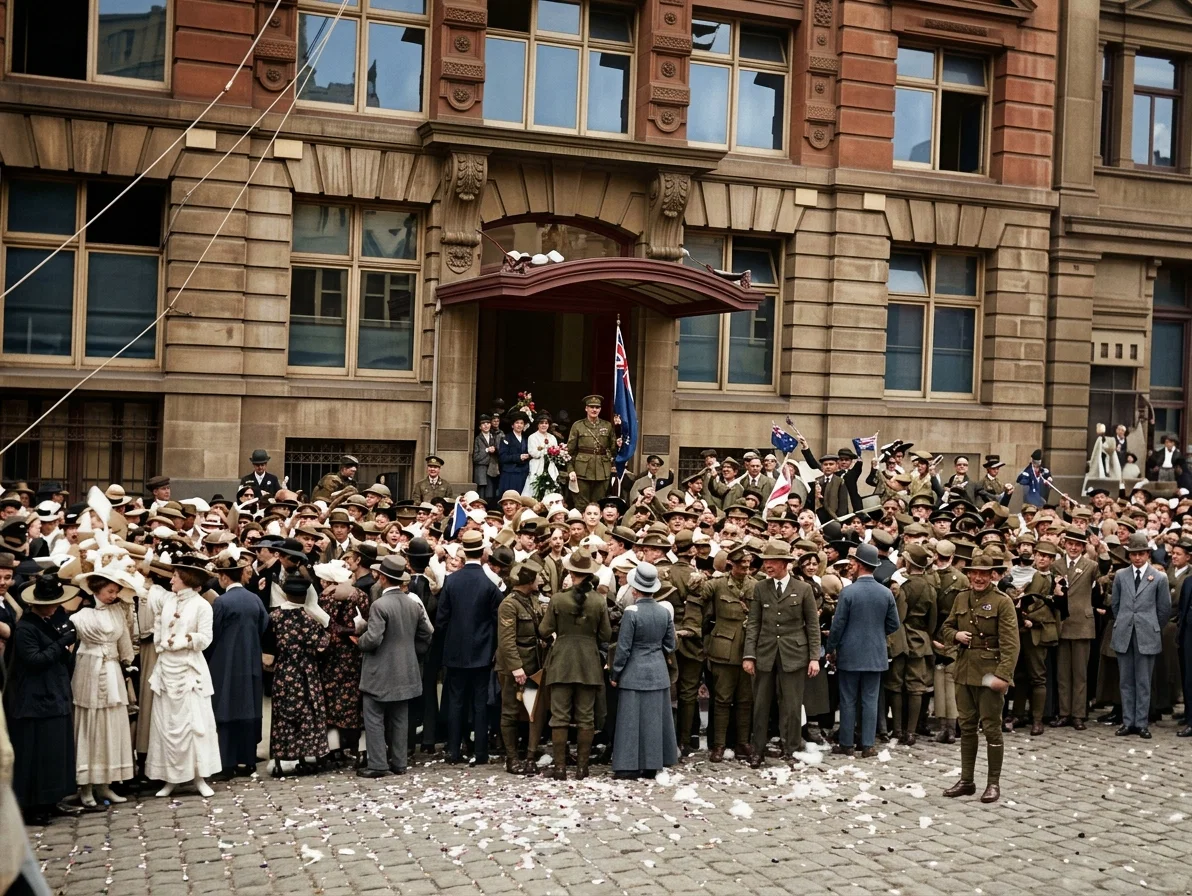
Pathe Photo.
CELEBRATING THE ARRIVAL OF THE LAST BATCH OF A.I.F.
RETURNED MEN AT MELBOURNE
What revolutionary changes five history-making years will bring! It is significant that in the four counts mentioned,—namely, race and national hatred, injustice real or fancied, class strife, and readiness for further conflict,—there are infinitely more indications of cause for future bloodshed than there were along the same lines early in 1914. And facts and present tendencies do not lead us to place faith in the explanation that the unsettled conditions we see are simply reactions, and that soon the world will stop swinging to extremes and will settle down to “wag” as formerly. No; the nations have learned the game, have perfected it to a science, and there seems to be a determination on the part of many to make no promise not to play it again in case of a serious dispute.
In view of the glaring signs that multiply about us, it is evident that peace for the near future exists only in the want-to-have-it-so of foolish optimists who close their eyes to the facts and to the prophecies of348God’s Word, and take the wish for the deed. There is only one remedy; and that is not civilisation, education, social and financial equality, or every man possessing his rights, although all these make for peace. The cure is the plain, simple religion of Jesus Christ in every man’s heart; and this condition is impossible until sin is exterminated and its author destroyed.
We may look, therefore, for “new heavens and a new earth”—a conception unknown to the popular mind, yet strictly according to Bible prophecy. Not an earth made new by the throes of a thousand years of revolutions and reforms, but one renewed by the utter and immediate destruction of everything that is wicked. Not a world repaired by evolution, but a world renovated by demolition and re-creation. Not a reformation, but a transformation. This is the real hope of peace, that “maketh not ashamed,” for it is not man-conceived, and will be realised. The citizens who will inherit that super-Utopia of which the half has not been told, are being transformed in character by a process similar to that which will renew the world—the redemptive power of Jesus Christ.