THE WITNESSING OF GOD: THE BASIS OF OUR CONFIDENCE
By Editor
By the Editor
VI. God’s Word Twice Written in Prophecy and Fulfilment.—No. 2
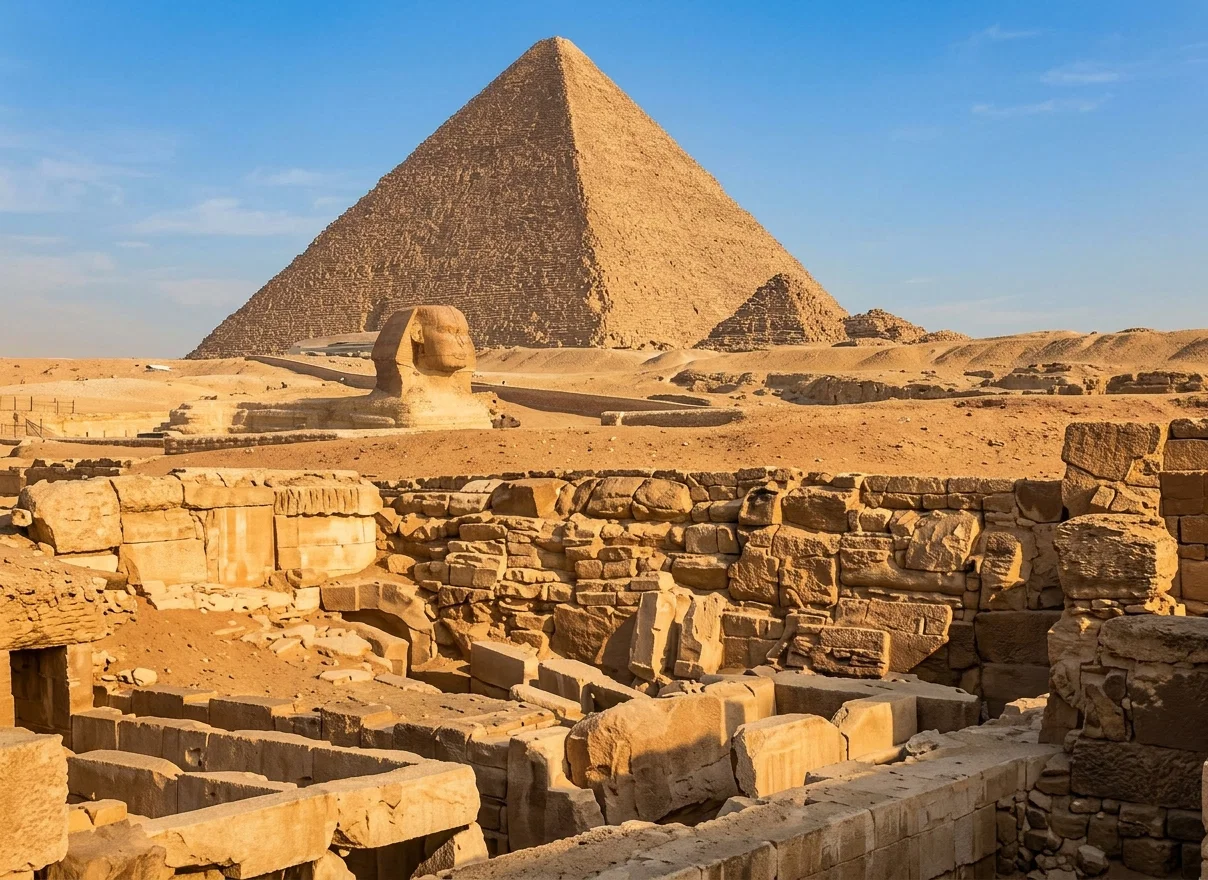
The great pyramid of Cheops, the Sphinx, and ruins of the temple of Armachis, Gizeh, Egypt
Let us note, in this, two other instances among the many of the twofold witness of prophecy and fulfilment. They are both clear and definite. The first we will consider is that of another very ancient empire which rivaled Babylon in antiquity. Once the glory of kingdoms, the prophecy predicts that it shall be—
“The Basest of Kingdoms”
Egypt has been one of the great and mighty and molding empires of earth. In the days of Ezekiel it was still great. Over and over again backslidden Israel looked to Egypt for hope against the all-conquering, on-coming Babylonians. They felt that the only salvation that they could have from Babylon was in the strength of Egypt. Some of those who fled from Babylon fled to Egypt. To these God’s prophet Ezekiel bore this testimony: “Thus saith the Lord Jehovah: Behold, I am against thee, Pharaoh king of Egypt, the great monster that lieth in the midst of his rivers, that hath said, My river is mine own, and I have made it for myself.” Because of this overweening pride, God pronounces the doom of Egypt. He declares, “I am against thee, and against thy rivers [or canals, or delta], and I will make the land of Egypt an utter waste and desolation, from the tower of Seveneh even unto the border of Ethiopia.” “It shall be the basest of the kingdoms; neither shall it any more lift itself up above the nations; and I will diminish them, that they shall no more rule over the nations. And it shall be no more the confidence of the house of Israel.” Images and idols should be destroyed, and there should “be no more a prince from the land of Egypt.”
There is very much more of detail regarding the doom and punishment of Egypt. The very one that should break its power is told—Nebuchadnezzar. He “caused his army to serve a great service against Tyre,” in the fulfilment of God’s prophecy. God gave him the spoils of Egypt for his prey. How true is the prophecy!
We can imagine that the Israelites and the Egyptians who read it, laughed the prophet Ezekiel to scorn. But the days go by, and the years roll on, and the prophecy is fulfilled, and the army of Nebuchadnezzar comes and strikes the first blow at the authority and power of Egypt. It becomes a dwindling monarchy. In the same connection we are told not only that Egypt would no more rule over the nations, but that strangers themselves should rule in Egypt, that Egypt should become the basest of kingdoms. How true it has been! From that day since, it has never lifted itself up above the nations. Marvelously rich in historic lore, it is of no power among the nations of earth. For many years, not a native Egyptian has served among its rulers. And yet Egypt stands there still, enfeebled and humbled to the very dust, a mighty witness to the truthfulness of the word of God. God gave the prophecies through Ezekiel; in His own time and way those prophecies were written again in the history of Egypt.
Christ’s Prophecy Concerning Jerusalem
We confess that it is a temptation to linger longer, and mention many other prophecies of like import; but we name only one more in this article, and that is Christ’s prophecy concerning Jerusalem, uttered but a little while before His own death upon the cross, given to the nation that rejected Him who came to save them, telling so clearly and so definitely that they could not misunderstand His meaning. It was not, like Babylon, to be covered in oblivion; but so far as that nation was concerned, it would no longer be their center of worship and seat of authority. Read His prediction in Luke, the nineteenth chapter, beginning with the forty-first verse: “And when He drew nigh, He saw the city and wept over it, saying, If thou hadst known in this day, even thou, the things which belong unto peace! but now they are hid from thine eyes. For the days shall come upon thee, when thine enemies shall cast up a bank about thee, and compass thee round, and keep thee in on every side, and shall dash thee to the ground,6and thy children within thee; and they shall not leave in thee one stone upon another; because thou knewest not the time of thy visitation.”
How true it was! “How often,” He declares, “would I have gathered thy children together, even as a hen gathereth her chickens under her wings, and ye would not! Behold, your house is left unto you desolate.” When they declared, in their foolish, stubborn pride, that they would have no king but Cæsar,—when they rejected Him whose life and teaching condemned them for their sins, but invited them to the fullest salvation,—they chose their merited doom. They went on from worse to worse. Many of them followed false christs, and the great mass of them rebelled against the power which they themselves had chosen, that of Rome. In the year 70 the great climax of the national destruction and scattering was completed. When Titus took Jerusalem, thousands and thousands of the Jews were destroyed in the siege; many were led away captive and sold into slavery. Some died by slow starvation, but the words of the Galilean were fulfilled.
Two hundred years after this, Julian the apostate came to the throne of Rome. At first professing Christianity, he afterward apostatized; and when he apostatized, he made up his mind that he would prove the words of the Nazarene false, and so proclamation was made for the rebuilding of the Jewish temple and the restoration of Jewish worship. We are told that he made decree to this effect among the Jews, that many came to assist in the rebuilding of that city, that wealthy Jewish ladies began to carry away the rubbish from the ruins of the temple. Gibbon declares that eye-witnesses testified that horrible balls of fire burst from the ruins. Supernatural manifestations drove away those who would rebuild the temple, and the work was discontinued.
Jerusalem stands to-day a mighty witness of the words of the Nazarene and the prophet, in the hands of the Moslem. Where the temple stood, Mohammed is honored by a mosque. The few words of Jesus were mightier than all the subsequent plans and power that have endeavored to make them of none effect. Written in the Word, written again in fulfilled event, a twofold witness which could not in any wise be collusive, they testify to the strength of the evidence upon which the child of God may rest.
There are scores of other prophecies in God’s word. It is God’s witness all along the way; from the time of the first sin in Eden to the last great judgment-day. It tells not only of the things through which the world is passing now, but of the great future which lies before. It is God’s witness of Himself, and in view of this He appeals to the children of men to give heed to the counsel: “Remember this, and show yourselves men; bring it again to mind, O ye transgressors. Remember the former things of old: for I am God, and there is none else; I am God, and there is none like Me; declaring the end from the beginning, and from ancient times things that are not yet done; saying, My counsel shall stand, and I will do all My pleasure: . . . yea, I have spoken, I will also bring it to pass; I have purposed, I will also do it.” Isa. 46:8-11.
Once more we appeal by the words of the apostle, “We have also a more sure word of prophecy; whereunto ye do well that ye take heed.”
[Our next article will be “God’s Word Twice Written in Precept and Character.”]