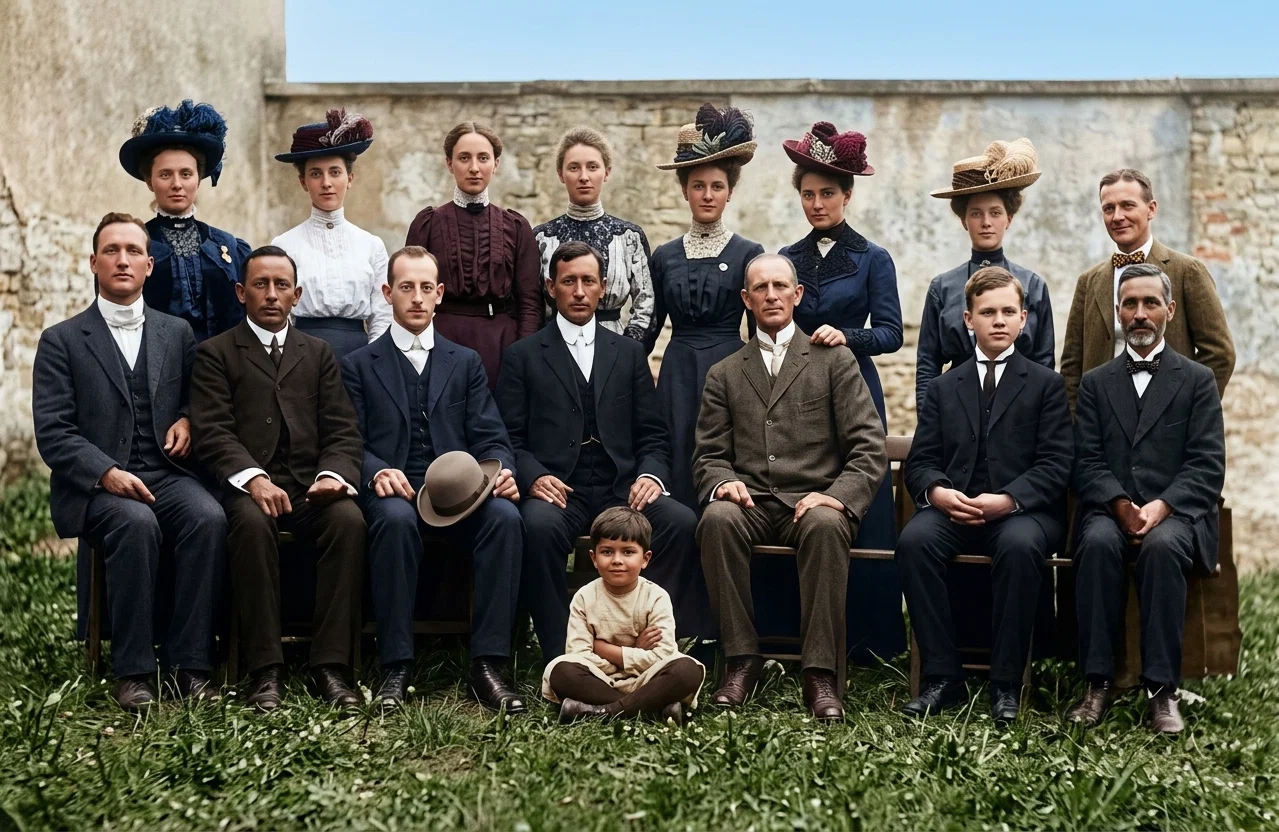
Delegates and visitors from India to the General Conference
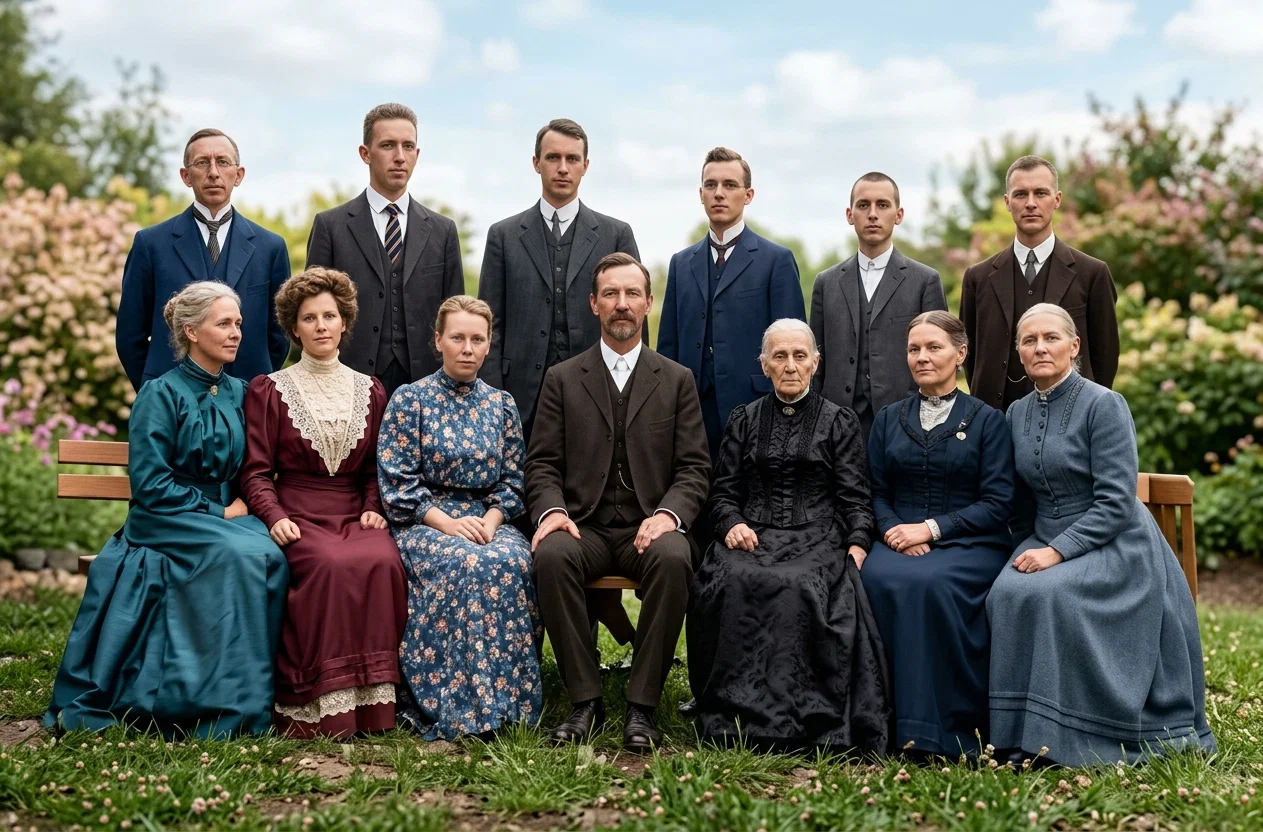
Delegates and visitors from Australia to the General Conference
Seventh-Day Adventist General Conference
By T.
In our last week’s issue, we gave a few illustrations representative of our General Conference, now closing its session in Washington, D. C. We also gave some of the principal facts of the marvelous growth of our work, and particularly how this work has grown during the last few years. We had hoped to receive, before this, a communication from the editor-in-chief, M. C. Wilcox, who is attending the meeting; but he was taken ill on arriving in Washington, and had to miss a number of the first days of the meeting, and since being able to get around again he has been so pressed with duties in connection with the conference that he has not taken the time to write for the paper.
A number of additional photographs of scenes on the ground and groups of delegates have been sent us, and we will give some of these on this page. Our work, however, has grown to such proportions that only sample illustrations and a few of the leading facts can be presented here. Reports from leading workers, representing practically every corner of this whole planet, were a great feature of the conference. The pushing forward of our work in foreign fields, as our editor, Mr. Wilcox, assures us, was the one central theme of the conference. The one impression, strong above every other, that must be made upon the mind of the beholder, is that the men who compose that conference are literally consumed by the idea that they have a definite message to give to this world. They believe in the very depths of their souls, and they believe it upon evidence, that we are in the very last days of this world’s history, and that the glorious event of the second coming of Christ awaits every one who is prepared for it. And thrilled with this great message, they are strengthening and broadening their plans to carry it, in the shortest possible time, to the ends of the earth.
Our work has developed to the place that there seems need that our organization be further extended. In fact, expanding and perfecting our organization has been one of the encouraging features of our work during the last fifteen or sixteen years. At the first of our organization, we had simply the General Conference itself to handle our general work. Then we organized a tract society, which had for a time the general supervision of the circulation of our smaller publications. Then came our Foreign Mission Board, which was a world organization. Then we had our General Conference district superintendents, each of which had a division over which he had a kind of general oversight, but there was no detailed organization in connection with their work. Then finally we organized our union conferences, each one of which has its complete organization, its president, its vice-president, its secretary and treasurer, its auditor, its regular headquarters and office—in other words, as complete in all its details of organization as the General Conference itself. These union conferences have supervision over several of our local conferences; and the greater part of the world was divided among them, and the whole united to form our General Conference.
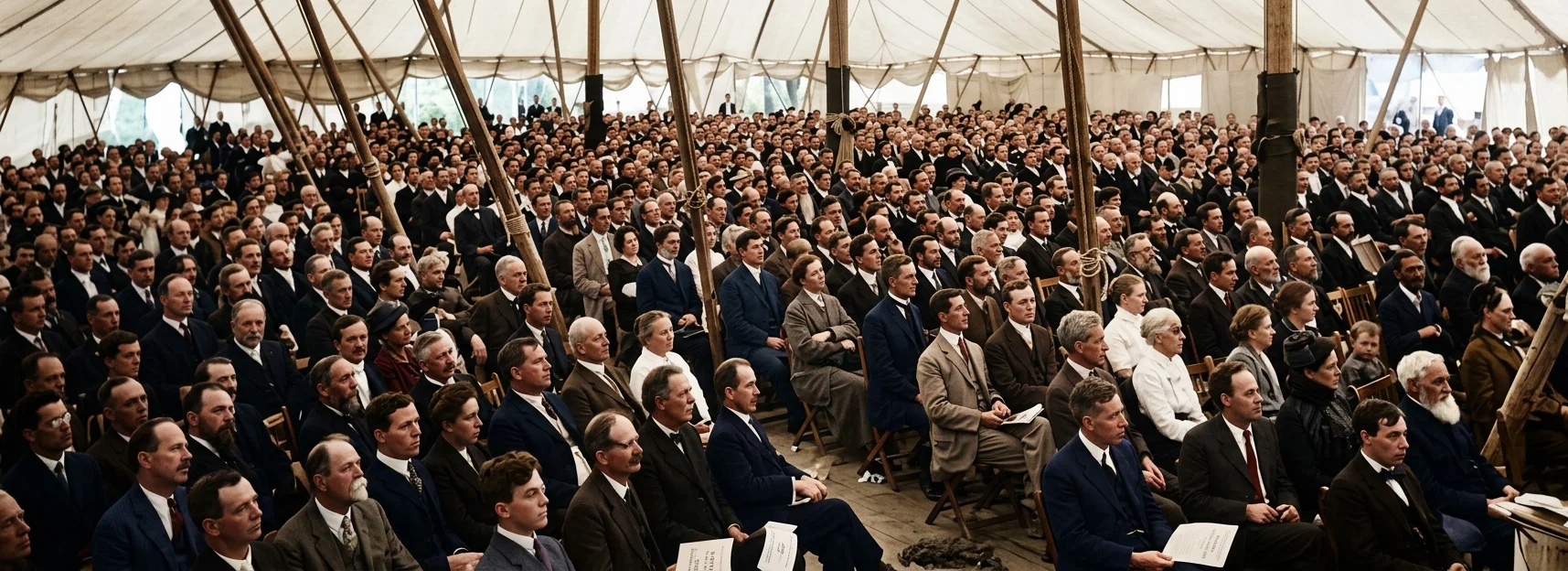
View in big assembly tent of the Seventh-day Adventist General Conference, Washington, D. C.
Then as a further growth in the matter of more perfect organization, the conference now in session has organized the European Division of the General Conference, and the North American Division of the General Conference. The completion of this plan will be that as soon as our work develops just a little further in South America, there will be the South American Division, to be followed, without question, by the African Division, the Asiatic Division, and possibly the Polynesian Division, which will embrace Australia and the islands of the Pacific.
In prosecuting a world-wide work such as we are carrying, and pressed beneath the burden of conviction that this work must be consummated as quickly as possible, it is highly important that the most complete and most fully detailed organization should be maintained, in order to reach the highest possible achievement and effectiveness. Each soldier in the great army needs to have his duties well before him, so that he may know his field of labor and usefulness, and what is expected.
Elder A. G. Daniells was reelected president of the General Conference, W. A. Spicer secretary, and W. T. Knox treasurer. Elder Daniells was first elected to this position in 1901, and has been reelected at each successive General Conference up to the present time. Elder Spicer has held his position for about the same length of time. This is Elder Knox’s second term as treasurer.
The delegates at the conference representing the European Division have already had several meetings and adopted a constitution and perfected their organization. L. R. Conradi has been chosen as president, J. T.13Boettcher as vice-president, Guy Dail as secretary, and Alice Kuessner as treasurer. An executive committee has been chosen to act with these officers.
The North American Division has also had several meetings and adopted its constitution, but up to the time of going to press we have not received reports of the officers chosen.
One of the very interesting features of the conference, and much in keeping with the central theme of pushing vigorously our foreign mission work, was a missionary reception held in the large pavilion where the great conference is in session. Upon the rostrum were assembled leaders in our missionary operations from every field on the globe. This representation included the principal islands of the sea as well as every continent. Seated on the front were Elders Geo. I. Butler, S. N. Haskell, and J. N. Loughborough, who are veterans in this work, having been in it almost from the very beginning. The privilege was extended to these old pioneers to be the first to tell something of their experiences in connection with the foreign mission enterprises of this people. Elder Butler was president of the General Conference when the late J. N. Andrews was sent as our first missionary to a land outside of the United States. Elder Haskell represented the first company of missionaries that this people sent to Australia to carry this message to that great island of the British Empire and there establish headquarters that would enable us to reach the adjacent islands of the Pacific. Elder Loughborough was sent to establish our work in England.
The brief story that they gave of their experiences was inspiring and intensely interesting. Following these brethren, missionaries representing many languages and many peoples in the many lands of earth, arose one after another, and in a few sentences gave a statement of how they began the work, and their purposes and determinations. As it progressed, Elder Farnsworth arose to say that a lady in the audience had accosted him and asked him to accept a check for $1,000 to assist in advancing our work in foreign fields. Sincere and thoughtful people are bound to be impressed with the fact that we have a definite and convincing message to carry to the world, for the evidence is overwhelming; and as they see this evidence, they will gladly join in helping, not only by giving their means to the work, but by giving themselves as well. Many of these missionaries said that they were anxious to get back to their fields of labor as quickly as possible. In coming to this conference, they had bought return tickets, and so had no thought of remaining in the home land; however pleasant such a thought might be.
Our medical college at Loma Linda received a due share of attention. The determination was expressed and the plans were well advanced for making it one of the best equipped and most thoroly competent medical institutions in the world.
One afternoon of the conference was given up to the district W. C. T. U. ladies. In introducing these noble women, who had come to the meeting from many different denominations, Elder Daniells said that he was presenting them to the representatives of a people who were more than 100,000 strong, and who not only were non-users of any kind of alcoholic drinks, but there was not a single individual among them who used tobacco in any of its forms. Tea and coffee and other similar stimulants were likewise tabooed. The many women who spoke upon this occasion told of the earnest and successful work that is being done by their great organization. 46,000,000 people in the United States are now under prohibition law. There are nine states that have prohibition, besides many localities in states that have not completed their prohibitory work.
The foregoing paragraphs give only a few samples of the features of this important conference, for our space is limited; but they will suffice to present something of an idea of the great work that is being done. — T.