No doubt the trans-Pacific passengers remember with pleasure the thrill of excitement which is experienced when, after twelve days on the restless water, it is announced on board ship that land will soon be in sight.
First, perhaps a tiny sail will be visible on the horizon, and then another, and soon a hundred or more of Japanese fishing-boats will come into view. Then while we are busy watching these interesting sampans, some one has discovered land; but where? Not on the horizon; but high up in a bank of clouds looms the glorious Fujiyama, the Japanese sacred mountain, the source and center of their worship and art.
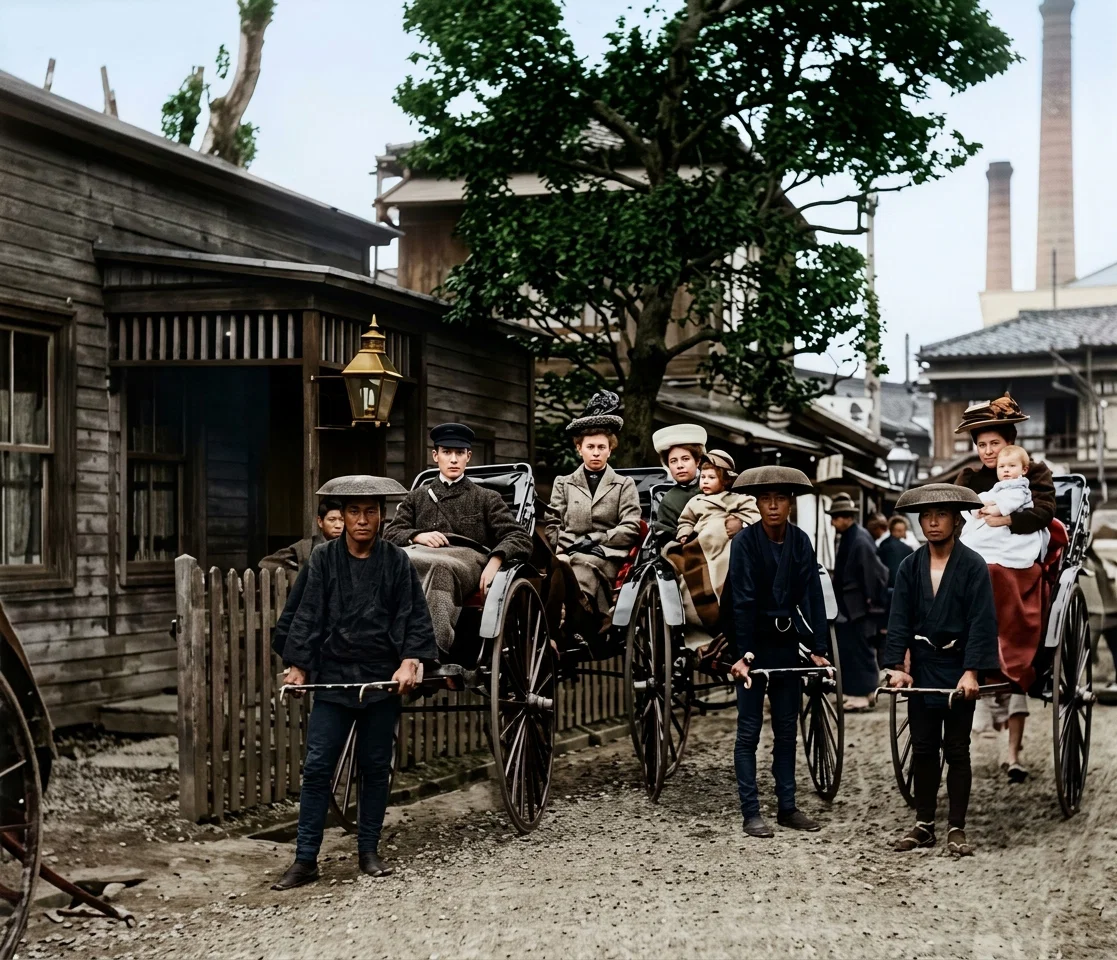
The picture of the 'rikisha men. Elder F. W. Field's house on the left. In the vehicles, naming from left, are Mr. Stafford, Mrs. Sparks, Mrs. Stafford and child, Mrs. Dr. Dunscomb and baby on the right. The picture was taken by Mr. Sparks, consequently he is not in the group.
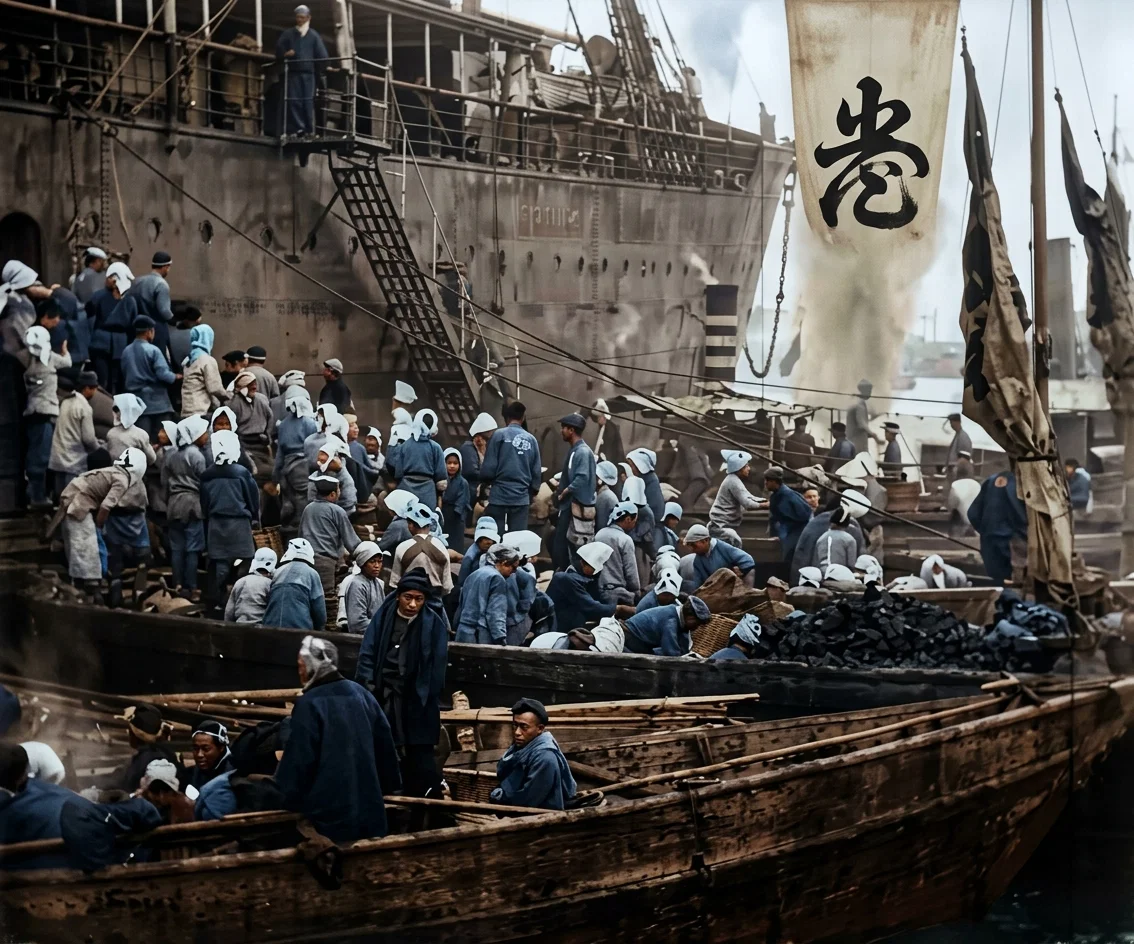
Coaling the China at Nagasaki, Japan, by hand, placing 4,500 tons of coal on the ship in 15 hours, while in coaling at San Francisco, it took the steam shovel 10 hours to deposit 650 tons. Reducing it to the same number of hours, the steam shovel placed 650 tons, the Japanese coolies 3,000 tons.
Every one goes ashore at Yokohama; and to the American traveler who is making his first visit, there are hundreds of new and novel sights. As soon as we landed we were besieged by jinrikisha men; and selecting the most desirable ones, we were taken to the Shimboshi station.
The first ride in a 'rikisha is one of the mile-posts of the Oriental traveler, and it is with mingled feelings of pity and admiration that we watch the little brown men running along with their heavy loads,—pity that a man should be doing the work of a beast of burden, and admiration for the sturdy way in which they keep up their trot for hours at a time.
No one knows how the foreigner feels, better than the 'rikisha man himself; and as a consequence, unless a person has been instructed beforehand, he will pay three or four times the proper price for his ride.
At Shimboshi station we took the little toy-like train, and after riding for an hour through beautiful gardens, rice fields, and small stations, we arrived at Tokyo, the capital of the Japanese nation. It is a large city, covering nearly thirty square miles, and having a population of almost two million.
We immediately set out to find the house of Brother F. W. Field, who has charge of all our work for the Japanese; and after being misdirected several times, we at last found the place. They are doing a splendid work, but are continually hampered for want of men and means.
As we had only a few hours to stay, we started out again to see as much of the city as possible. Tokyo being the capital city, here are located the imperial palace, the government buildings, and the imperial university. There are also a number of interesting parks and museums.
The day was dark and cloudy, therefore I was not able to take many pictures, but am sending a few which I took in Asakusa Park. Here is located a large temple; and as we saw the throngs of people bowing before these images of wood, that can do them no good, we longed to be able to talk with them, and tell them of the true God, who loves them and is ready to answer their prayers.
One image of a mother and child was supposed to cure sickness and disease; and there was a continual throng of cripples and sick, miserable people, longing for some ray of hope to lighten their way. They would rub their hands on the face of the idol and then on their own face and body, and go away expecting to be healed. This has been going on so long that the features on the face of the idol were completely worn off.
In the courtyard of the temple were many booths erected for displaying various wares, and a continual jangle of buying and selling was carried on. Many of the articles to sell were novelties and souvenirs to attract the tourist, as all travelers visit the temples.
The shopping district is very interesting; and in one large department store where we went, all the Japanese took off their shoes as they entered. Near the door were two or three coolies to check the shoes. As our shoes didn’t come off as easily as theirs, they provided a cloth covering with a rubber band to hold it on. Being furnished these, we entered the store, and inside were many beautiful and interesting wares. On the top floor was a dining-room, and we tried our hand at the chopsticks, much to the amusement of all the patrons.
Two characteristics made lasting impressions on my mind, and will always be connected with the Japanese people. The first is politeness. Of course it is a question just how much of this is sincere, and how much is the result of habit. Such a bowing and saluting one could not imagine unless he witnessed it. When acquaintances meet on the street, you would think they hadn’t seen each other for a year. When we entered a store, the proprietor bowed low; whenever we spoke, he bowed again; when we paid him, he bowed four or five times; and when we left the store, he again bowed.
The other point is the Japanese shoes. For the most part, these are made of wood, and the peculiar clattering of the wood against the pavement is one of the first things to attract the foreigner’s attention. Two straps or cords run from the center of the front of the shoe to the sides; and the stockings are made so that the great toe goes on one side of the center strap, and the other toes on the other side, so it gives the foot the appearance of a hoof divided in the center. The shoe itself is simply a flat piece of board with two cleats on the under side. These are ordinarily about one or two inches high, but on some of the shoes worn in muddy weather they are five or six inches high.
Leaving Yokohama the next day, a run of a day and a night brought us to Kobe. Here we hunted up Brother and Sister Herboltzheimer, former acquaintances of ours in Colorado, with whom we had a pleasant visit. Kobe seems to be a much cleaner city than Tokyo, and there were many beautiful foreign houses there.
The city slopes back from the water-front half way up the mountain, and I am sending a picture taken from the top. The view here was magnificent, and the photo does not do it justice.
The bubonic plague was prevalent here at the time, and the government was taking steps to eradicate it. We saw places in the infected district where the people were forced to move their goods right out into the middle of the street. The house or store would then be thoroly cleaned and disinfected, and whatever goods could not be fumigated would be burned up on the spot.
I think the most interesting sight in Kobe was the great Buddha, of which I am sending you a picture.
Between Kobe and Nagasaki is the world-famed Inland Sea. For one day, from eight in the morning till four in the afternoon, we went through places so narrow that it seemed as tho we could almost touch the shore. On each side were gardens and terraces stretching clear down to the water’s edge. We had to proceed very slowly, and the first officer stood by the anchor all the way.15ready to drop it at a second’s notice if we struck.
We had a good pilot, however, and the next morning landed safely at Nagasaki.
At this place no one is allowed to come ashore with a camera, as it is a fortified harbor, and all pictures and postcards that are permitted to be sold have the background mutilated so it is impossible to see the shape of the hills around the city.
I hired a sampan and rode around the harbor, and by the utmost caution succeeded in taking two pictures. One is a partial view of Nagasaki, and the other is a monster crane, the second largest in the world, capable of lifting a large ship out of the water. I tried to get one of the shipyards where they were building three large battle-ships, but it was too dark and was not usable.
By far the most interesting sight at this place is a coaling ship, which is done entirely by coolie labor. Early in the morning the coolies come out, men, women, and children, and swarm around the boat like ants. They rig a ladder up to the bunkers, and pass the coal up in baskets like a bucket brigade. Working on both sides of the ship at the same time, it is almost unbelievable the amount of coal they can put on. They average ten tons an hour to every gang, and work two or three gangs at every port-hole. The record on the Manchuria at one time was 4,500 tons in fifteen hours as against 650 tons in ten hours in San Francisco with a steam shovel.
Leaving Nagasaki, the next day we found ourselves in the choppy, muddy waters of the Yellow Sea. It is easy to understand why it is called yellow after once getting a look at it. That night we anchored at the mouth of the Yang-tse River. The next morning we proceeded up the river to Woosung, where we anchored and took a launch twelve miles up the Whangpoo River to Shanghai. Here we found friends, and our journey ended. I will soon have some interesting reports and pictures to send from China.