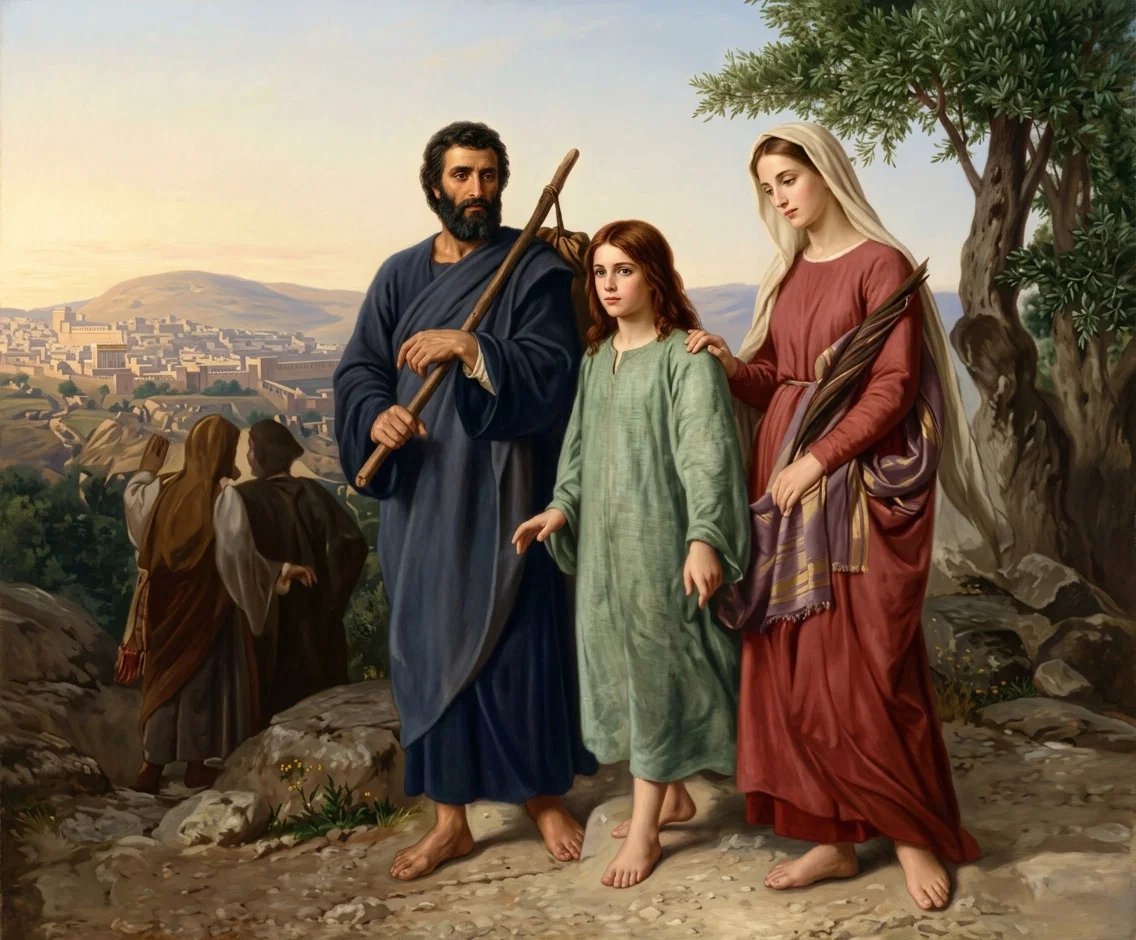
Shiloh: the Man of Sorrows

4%

Pacific Press Publishing Association · Mountain View, California · May 10, 1910

FromSigns of the Times, Vol. 37, No. 18.

Read the full edition

Shiloh: the Man of Sorrows

Copyright, 1910, Pacific Press Publishing Association
By Mrs. L. D. Avery-Stuttle
On the Way to Jerusalem

Chapter X. A Wolf in Sheep’s Clothing

“LIST, Joseph, thou carpenter of Nazareth, I have somewhat to say unto thee!” The venomous eyes of Shaphan the rabbi glowered ominously.
“Peace be unto thee, O rabbi. What hast thou to say unto me?” questioned Joseph, stepping from the tent, wherein sat a beautiful woman. “What news bringest thou? for of a truth the rabbi should be the bearer of good tidings,” and the man glanced suspiciously and uneasily at his guest.
“Thou knowest I am a teacher in Israel,” began the rabbi pompously, “and thou rememberest that I have heretofore taken it upon myself to reprove the young Lad who calleth thee father—albeit they tell me the Child is none of thine. The lad alway hath appeared to account Himself superior to His elders. Thou thyself knowest that many a time I have rebuked Him for refusing to observe the traditions of the fathers. Tell me, verily, is this Child thine—thine own Son?”
“Nay, O rabbi, He is not mine own Son,” admitted Joseph uneasily, while his kindly dark eyes were fixed upon the ground; “but He is the Son of His mother, and she loveth Him.”
“Yes, verily, all sons be the sons of their mothers; but there be some lewd women in Israel; and I have noticed that thy young wife is beautiful; how knowest thou—”
“Spare me, O rabbi, spare me!” exclaimed the carpenter almost fiercely, throwing out his hands convulsively, and grasping the rich robe of his guest.
“Of a truth, O Joseph, it behoveth thee not to forget thy dignity, and the honor thou shouldst pay to me—a rabbi,” interrupted Shaphan scornfully. “If I cause thee pain, it is for thy best good. Forget not that thou art a son of Israel, and if I mistake not, even of the kingly tribe of Judah, through whom the Messiah cometh,—Jehovah grant His coming be not long delayed, when the minions of Israel shall be free from the oppression of the Romans. But verily, I came not to discuss or to theorize; my errand is a painful one,” he whined with mock sadness, “one which it seemeth to me well to make known unto the mother of the Child, as well as unto thee. Shall we not go into thy tent?” and the rabbi rudely thrust his head between the white curtains.
“It shall be as thou wilt, O rabbi; but I entreat thee speak not roughly unto the mother of the Lad.”
With a withering look of scorn, Shaphan preceded his host into the tent. “I desire not to cause sadness in the heart of so lovely a woman,” began the rabbi, with an unpleasant leer; “but as thou knowest, I have great concern for thy Son; and to-night,” he continued, lowering his voice ominously, “to-night I saw Him wandering to the mountains alone,—nay, do not interrupt me,—and I determined to follow Him. He will not submit to be led by His teachers, as thou knowest, and refuseth to listen to the traditions of the fathers. So I said, ‘I will follow the Lad; it may hap He keepeth the company of evil-doers;’ and well was I rewarded for my pains. Thy Son, O Nazarene,” turning impressively toward Joseph, “thy Son keepeth the company of robbers and villains! In the mountains I saw Him giving bread to one who called himself Barabbas,—without doubt the fierce young robber whose lawless hand infesteth Galilee, and for whose ungodly head Antipas offereth large rewards. It would be well, O Nazarene, to look to thy Son!”
As no reply was given to this tirade, the rabbi continued:
“Why should bread be given to one whom even the idolatrous Romans account accursed? Pray what is the duty of a true son of Israel?”
Rabbi Shaphan paused for a moment, as if overcome by the power of his own eloquence. His host and hostess were silent, as if they were not able to answer such words of wisdom. The richly robed rabbi was apparently gratified over their evident embarrassment. Again he repeated the question with impressive dignity: “What, O Nazarene, is the duty of a true son of Israel?”
At that moment the curtain of the tent was softly lifted, and a slight figure stood in the doorway. The bright rays of the full moon streamed in through the parted drapery, and fell upon the bared head of the Lad, as in a voice soft and gentle He undertook to answer the question of the haughty rabbi. But there was no bitterness nor exultation in His tones, only gentleness and meekness and reverence, as He repeated the question:
“What, O rabbi, is the duty of a son of Israel? ‘Is it not to deal thy bread to the hungry, and that thou bring the poor that are cast out to thy house? when thou seest the naked, that thou cover him? Then shalt thou call, and the Lord shall answer; thou shalt cry, and He shall say, Here I am. . . . If thou draw out thy soul to the hungry, and satisfy the afflicted soul; then shall thy light rise in obscurity, and thy darkness be as the noonday: and the Lord shall guide thee continually, and satisfy thy soul in drouth, and make fat thy bones: and thou shalt be like a watered garden, and like a spring of water, whose waters fail not.’”
With a vicious growl, like that of a maddened animal, Rabbi Shaphan gathered his rich robes about his lean form, and arose to leave the tent. But he was not content to depart without first hurling a word of venom like the sting of a poisoned arrow into the already sensitive and wounded hearts of his hearers:
“Who art Thou, Lad, that Thou shouldst prate against Thine elders and thy betters? for all Nazareth and Galilee know that Thou art the Son of Mary—but who knoweth Thy father! Yet Thou scornest me, Shaphan, a master in Israel, a man who pointeth with pride to his father and his mother, and sayeth, ‘Behold, I be not born of fornication!’”
The crimson flush which suffused the delicate cheek of the Lad, told Shaphan that the cruel dart he had aimed with such fiendish care, had not fallen upon a callous or an unfeeling heart.
But no word escaped the lips of the Child, the cheek of Mary turned white as the snows of Lebanon; for the words of Simeon the prophet, which already had begun to be fulfilled, rang in her ears:
“Yea, a sword shall pierce through thine own soul also.”
(To be continued)