JAPAN is now confused by the multiplicity of its advisers in regard to a moral base for her people. One says, “You must have this,” while another says, “You ought to have that;” but after all, no one can offer any real enlightenment save only on the basis of Christianity. I Cor. 3:11. The Japanese are now conscious of their moral degeneration, and the danger to their national morality without a substantial faith. In Japan there is no fixed religion, hence, no fixed moral standing. What she most seriously needs is the new light, the new life; that will save her by reconstruction from the very foundation.
Her original religion, Shintoism, is merely preserved as a rite. Buddhism only exists among aged persons. The agnostic Confucianism no longer has influence, and the numerous other religions and doctrines have all lost the confidence of the people.
“What are the current remedies?” “What is the religion of the new age?” “What can Buddhism or Shintoism do for the generation?” “What can Christianity accomplish?” Such are the subjects often discussed, and still unsolved. These questions are treated in a rather academic way, by prominent scholars and writers.
The most of the philosophists in Japan, as of many other countries to-day, declare that the religion of the future must be based on ethical principles. This opinion is advocated by the majority of eminent men. While on the other hand there are the declarations that Shintoism should be improved and preserved as a national religion, since it is their original religion, while some urge that Buddhism should be encouraged; and still another, that the Bushido should be the base of their national morality.
Thus are presented many different views, each treated in the various ways, and the conflict still goes on.
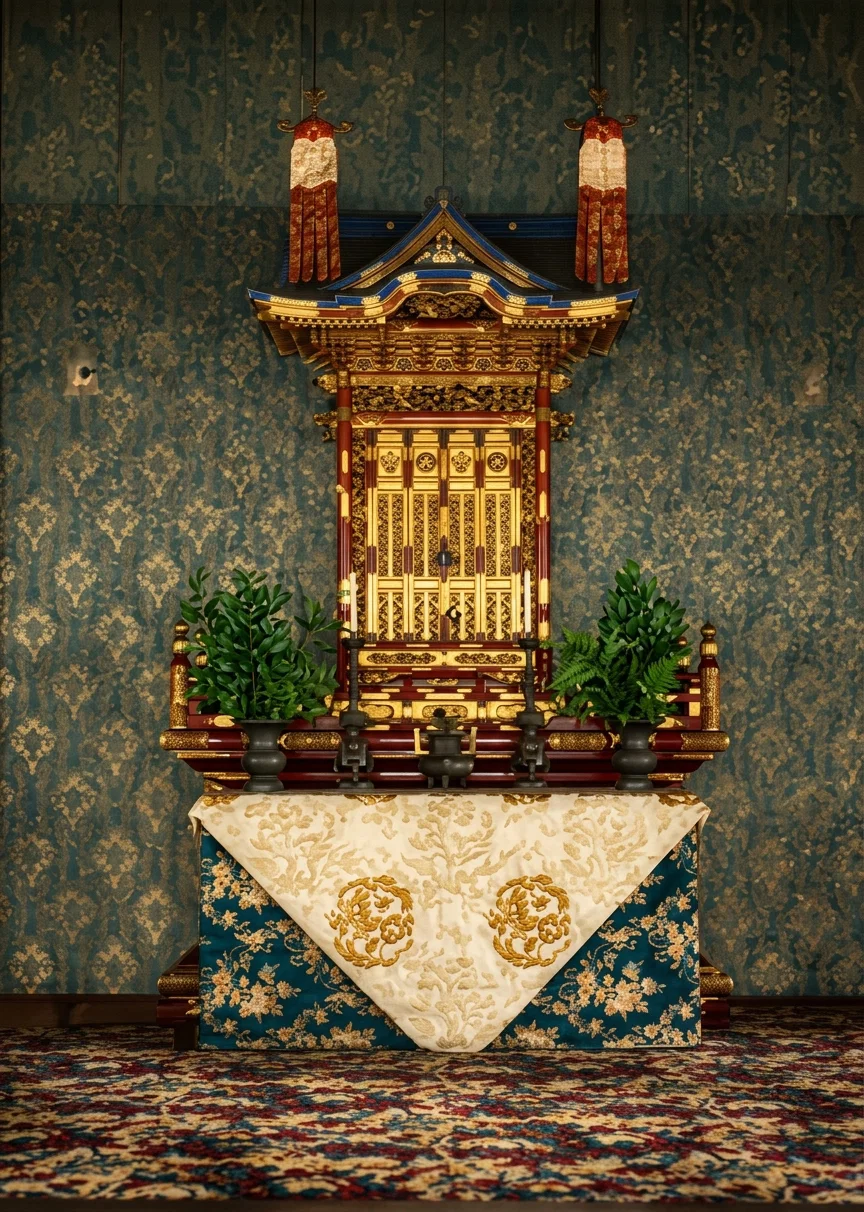
Shrine in a Buddhist Temple.
This is not, however, a matter of surprise; for the time when Christianity was first introduced was one of transition and conflict. Everything was in confusion and one could hardly have a chance to think soberly of the deep questions of life. Men simply wanted to know something about new things—new civilization and new political and material life, of which they were full of admiration. To know was all that was desired, and the idea of thinking was almost entirely put aside; they were too busy acquiring and adopting the new things. In this way the Japanese acquired the occidental civilization wonderfully fast, but paying slight attention to its more profound theories of life.
But the time has come when they ought to think and decide these questions. When Japan imported the Chinese civilization many centuries ago, the religious civilization was imported at the same time; but it seems that the practical religion of the West was left behind the rushing tide of western civilization. Perhaps Japan’s leaders think they have a national ideal and moral code even better and broader and more consistent than that of the West, because based upon a clearer perception of truth than the Westerners have yet reached. Perhaps they think they have a better religion, and are not anxious to adopt any other. They might acquire and adopt a new civilization without Christianity—the real religion of man—but there would still be lack of moral base.
I have described her religious situation rather as in a serious conflict, which many Japanese would not admit; but it is really the most serious defect of her present condition.
Yet, God’s grace is abundant there as everywhere, and many souls have found and accepted the true basis of morality. We sincerely appreciate the faithful efforts of our brothers of America which have been to this end. As the fruits of their work, there are now many Christian schools and institutions that shed forth the light of God. There are many indications that the fruit will be abundant.
Recent good tidings from Japan say, “Our work is making steady progress, altho it is only an acorn that has begun to grow. . . . We ask for your prayers that we may accomplish the work of God in due time.”