Where Darwin and I Disagree

4%

Signs Publishing Co. · Melbourne, Victoria · Jul 5, 1920

FromAustraliasian Signs of the Times, Vol. 35, No. 27.

Read the full edition

Where Darwin and I Disagree

WILLIAM JENNINGS BRYAN
The paramount need of the world today, as it was nineteen hundred years ago, is a whole-hearted, whole-souled, whole-minded faith in the living God. A hesitating admission that there is a God is not sufficient; man must love with all his heart, and with all his soul, and with all his mind—and to love, he must believe. His belief in God must be a conviction that takes hold of his very life, grips every nerve and fibre of his being, and dominates his every impulse and energy. The thought of God is the greatest thought that can enter a human mind or heart, and a sense of responsibility to God the most potent influence that acts upon a life.
Some instructors speak lightly of religion, and, by clothing infidelity in the attractive garb of science and philosophy, lead their pupils into agnosticism—a tragedy which is the more distressing when we remember that college men not only have a prominence far out of proportion to their numbers, but exert an influence upon a still larger circle whose members look up to them for example.
How shall we aid the young man? How can his feet be set upon the solid rock? If he has felt the benumbing influence of the theory that links man in generations with the ape—a theory which has paralysed religious thought and the usefulness of so many of the intellectuals of the world during the past half century—the poison of this false doctrine must be extracted from his system before he can understand life and his relation to the world. That man bears the image of God and not the likeness of the animals below him, is the foundation stone upon which he must build.
The theory advanced by Darwin puts God so far away that man loses the consciousness of His presence in daily life. Prayer becomes a mockery if, for millions of years, the Lord has never touched a human life or laid His hand upon the history of a nation. If we accept the theory that man has reached his present eminence by the cruel law under which the strong kill off the weak, then, if there is any logic that can bind the human mind, we must turn backward toward the brute if we dare to substitute the law of love for the law of hate. As Christianity is built upon the doctrine of love and has for its object the establishing of a universal brotherhood, the Darwinian theory can have no claim upon the mind or conscience of a follower of the Nazarene.
And it should not have upon any one else, for there is not one single fact in nature to support it. It is not one “link” only that is missing—all the links are gone. It is as contrary to the law of the universe as it is to the teachings of the Saviour.

How to Corner the Atheist

We give the atheist too much latitude; we allow him to ask all the questions and we try to answer them. I know of no reason why the Christian should take upon himself the difficult task of answering all questions, and give the atheist the easy task of asking them. Any one can ask questions, but not every question can be answered. If I am to discuss creation with an atheist, it will be on condition that we ask question about. He may ask the first one if he wishes, but he shall not ask a second one until he answers my first.
What is the first question the atheist asks the Christian? There is but one first question: Where do you begin? I answer, “I begin where the Bible begins.” And where does the Bible begin? “In the beginning God created the heavens and the earth.” I begin with God, all-powerful, all-wise, all-loving. I begin with a Creative Cause that is sufficient for anything that can come thereafter.
Having answered the atheist’s first question, it is now my turn, and I ask my first question of the atheist,—“Where do you begin?” Then his trouble begins. Did you ever hear an atheist explain creation? He cannot begin with God, because he denies the existence of a God. But he must begin somewhere. It is just as necessary that the atheist shall have a beginning point for his philosophy as that the Christian shall.

Shall We Begin With God or Dirt?

Where does the atheist begin? I have never known any of them to begin farther back than the nebular hypothesis. And where does that begin? In the beginning?—No. It begins by assuming that two things existed, which the theory does not try to explain. It assumes that matter and force existed, but it does not tell us how matter and force came into existence, where they came from, or why they came. The theory begins by saying, Let us suppose that matter and force are here. Then the theory begins to work; and, according to the theory, force, working on matter, created a world. I have just as much right to begin with an assumption as the atheist has; and I would rather begin with God, and reason down, than begin with a piece of dirt, and reason up. The difference between the Christian theory and the materialistic theory is that the Christian begins with God, while the materialist begins with dull, inanimate matter. I know of no theory that has ever been suggested as a substitute for the Bible theory, that was as rational and as easy to believe.
If the atheist asks me if I can understand God, I answer that it is not necessary that my little mind shall comprehend the infinite mind before I admit that there is an infinite mind, any more than it is necessary that I should understand the sun before I can admit that there is a sun. We must deal with the facts about us whether we can understand them or not.
If the atheist tells me that I have no right to believe in God until I can understand Him, I will take his own logic and drive him to suicide; for, by that logic, what right has an atheist to live unless he can understand the mystery of his own life? Does the atheist understand the mystery of the life he lives? Bring me the most learned atheist, and when he has gathered all the information that this earth can give, I will have a little child lead him out and show him the grass upon the ground, the leaves upon the trees, the birds that fly in the air, and the fishes in the deep, and the little child will mock him, and tell him, and tell him truly, that he, the little child, knows just as much about the mystery of life as does the most learned atheist. Today we have our thoughts, our hopes, our fears; yet we know that in a moment a change may come over any one of us which will convert a living, breathing human being into a mass of lifeless clay. What is it that, having, we live, and, having not, we are as the clod? We know as little of the mysteries of life today as they knew in the dawn of creation; yet behold the civilisation that man has wrought!
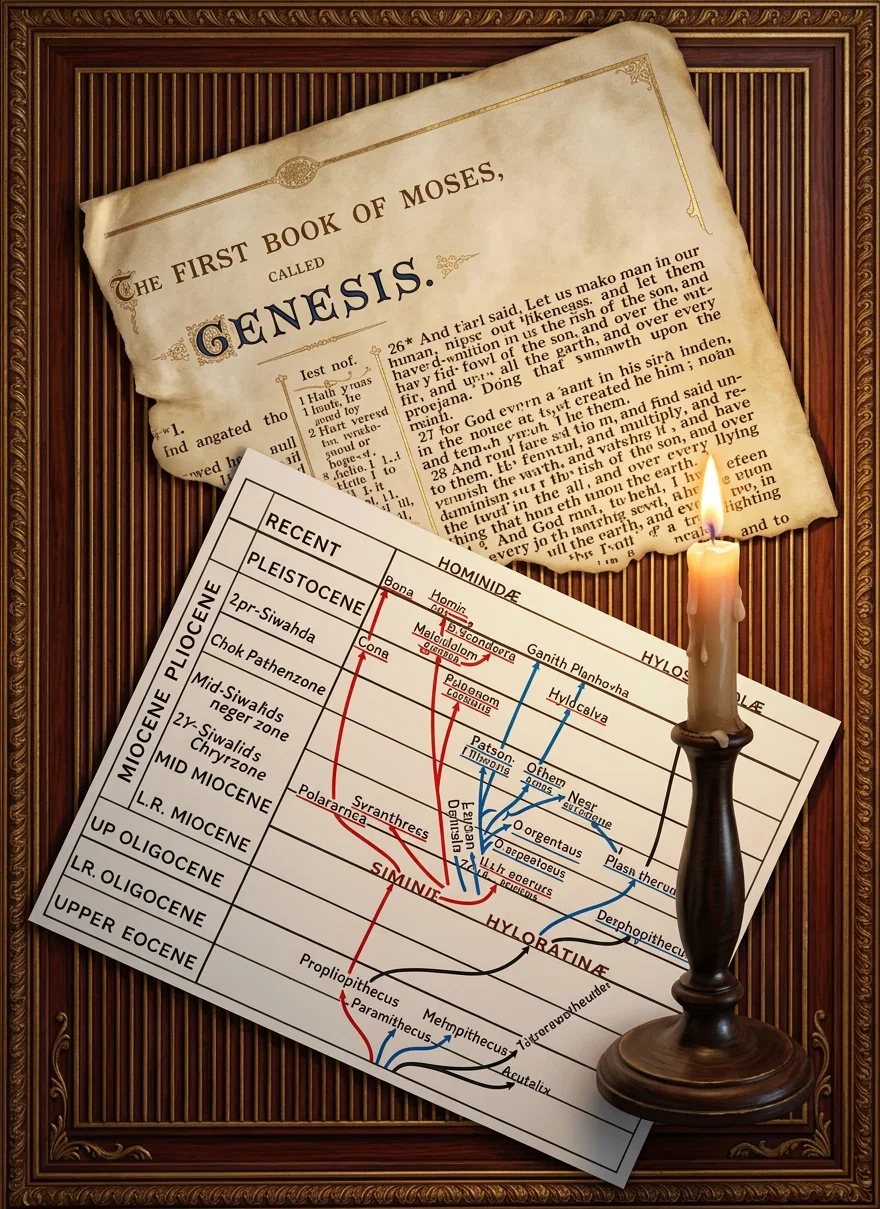
Here are contrasted the man-story of the evolution of man, and the God-story of the creation of man. The former is taken from Current Opinion for December, 1919, and is a diagrammatic representation of the successive geologic periods and the lines of descent of man and apes. Notice that Genesis gives the story complete, there is no missing evidence, the beginning is laid bare, while the evolutionist’s diagram does not even attempt to show a beginning. The four lines at the bottom cannot be traced back to a common beginning. Which of the two stories is the most clear and simple, the most believable? For which is there the most proof? Which is most scientific?
And love that makes life worth living is also a mystery. Have you ever read a scientific definition of love?—No, and you never will. Why?—Because a man does not know what love is until he gets into it, and then he is not scientific until he gets out again. And even if we could understand the mysterious tie that brings two hearts together from out the multitude, and on a united life build the home, earth’s only paradise, we still would be unable to understand that larger mystery which manifests itself when a human heart reaches out and links itself to every other heart.

We Are Surrounded by the Mysterious

We are encouraging children to raise vegetables, and a little child can learn how to raise the vegetable, but no grown person understands the mystery that is wrapped up in every vegetable that grows. Let me illustrate: I am fond of radishes; my good wife knows it, and keeps me supplied with them when she can. I eat radishes in the morning, I eat radishes at noon, I eat radishes at night, I eat radishes between meals—I like radishes. I plant radish seed—put the little seed in the ground—and go out in a few days and find a full-grown radish. The top is green, the body of the root is white and almost transparent, and around the outside of the root I sometimes find a delicate pink or red. Whose hand caught the hues of a summer sunset and wrapped them around the radish root down there in the darkness in the ground? I cannot understand a radish. Can you? But I like radishes. Don’t you? If one refused to eat anything until he could understand the mystery of its growth, he would die of starvation; but mystery does not bother us in the dining room—it is only in the Church that mystery seems to give us trouble.

The Watermelon Miracle

If there is among you anyone who has been presumptuous enough to attempt to confine the power and purpose of God by man’s puny understanding, let me persuade him to abandon this absurd purpose, by the use of anillustration which I once found in a watermelon. I was passing through Columbus, Ohio, some years ago, and stopped to eat in the restaurant in the depot. My attention was called to a slice of watermelon, and I ordered it and ate it. I was so pleased with the melon that I asked the waiter to dry some of the seeds, that I might take them home and plant them in my garden. That night a thought came into my mind—I would use that watermelon as an illustration. So the next morning, when I reached Chicago, I had enough seeds weighed to find out that it would take about five thousand watermelon seeds to weigh a pound, and I estimated that the watermelon weighed about four pounds. Then I applied mathematics to the watermelon. A few weeks before, some one, I knew not who, had planted a little seed in the ground. Under the influence of sunshine and shower, that little watermelon seed had taken off its coat and gone to work; it had gathered from somewhere two hundred thousand times its own weight, and forced that enormous weight through a tiny stem and built a watermelon. On the outside it had put a covering of green, within that a rind of white, and within that a core of red, and then it had scattered through the red, little seeds, each one capable of doing the same work over again. What architect drew the plan? Where did that little watermelon seed get its tremendous strength? Where did it find its flavouring extract and its colouring matter? How did it build a watermelon? Until you can explain a watermelon, do not be too sure that you can set limits to the power of the Almighty, or tell just what He could do, or how He would do it. The most learned man in the world cannot explain a watermelon, but the most ignorant man can eat a watermelon and enjoy it. God has given us the things that we need, and He has given us the knowledge necessary to use those things, and the truth that He has revealed to us is infinitely more important for our welfare than it would be to understand the mysteries He has seen fit to conceal from us.

Here Is Good Advice for the Critic

So with religion; if you ask me if I can understand everything in the Bible, I answer: No. I understand some things today that I did not understand ten years ago; and if I live ten years longer, I hope some things will be clear that are now obscure. But there is something more important than understanding everything in the Bible. It is this: If we will only try to live up to the things that we do understand, we shall be kept so busy doing good that we will not have time to worry about the things we do not understand.
In Fred Emerson Brooks’s poem “The Grave Digger,” there is one stanza that is in point here:—
If Chance could fashion but a little flower, With perfume for each tiny thief, And furnish it with sunshine and with shower, Then Chance would be creator, with the power To build a world for mankind.
But Chance cannot fashion even a little flower; Chance cannot create one single thing that grows. Every living thing bears testimony to a living God; and if there be a God, then every human life is a part of that God’s plan. And if this be true, then the highest duty of man, as it should be his greatest pleasure, is to try to find out God’s will concerning him and do it.
If one accepts the miracle as a manifestation of God’s power, he grows in his appreciation of that power as he contemplates its infinitude. He beholds it in the far-flung limits of the universe,—in blazing suns and whirling planets and myriad stars, each moving in silent obedience to the Creator’s will; he feels it in the earthquake and in the trembling of the volcano; he measures it in the lightning’s flash and in the storm at sea; and he finds inspiration in the rocky peak, the deep gorges, and the waterfalls that abound in the land “where the hand of God is seen.”
And who can study God’s plan, comprehending the universe and yet minute in detail, without being overwhelmed by the presence of an infinite mind that designed the whole and without whose continued care the world would be engulfed in chaos? Not a heart could beat nor could the lungs expand if the movement of these organs were left to the voluntary act of man. But God has relieved His creatures of concern about blood and breath, that man, freed from a labour beyond his power, may employ his time in the service of his Maker.