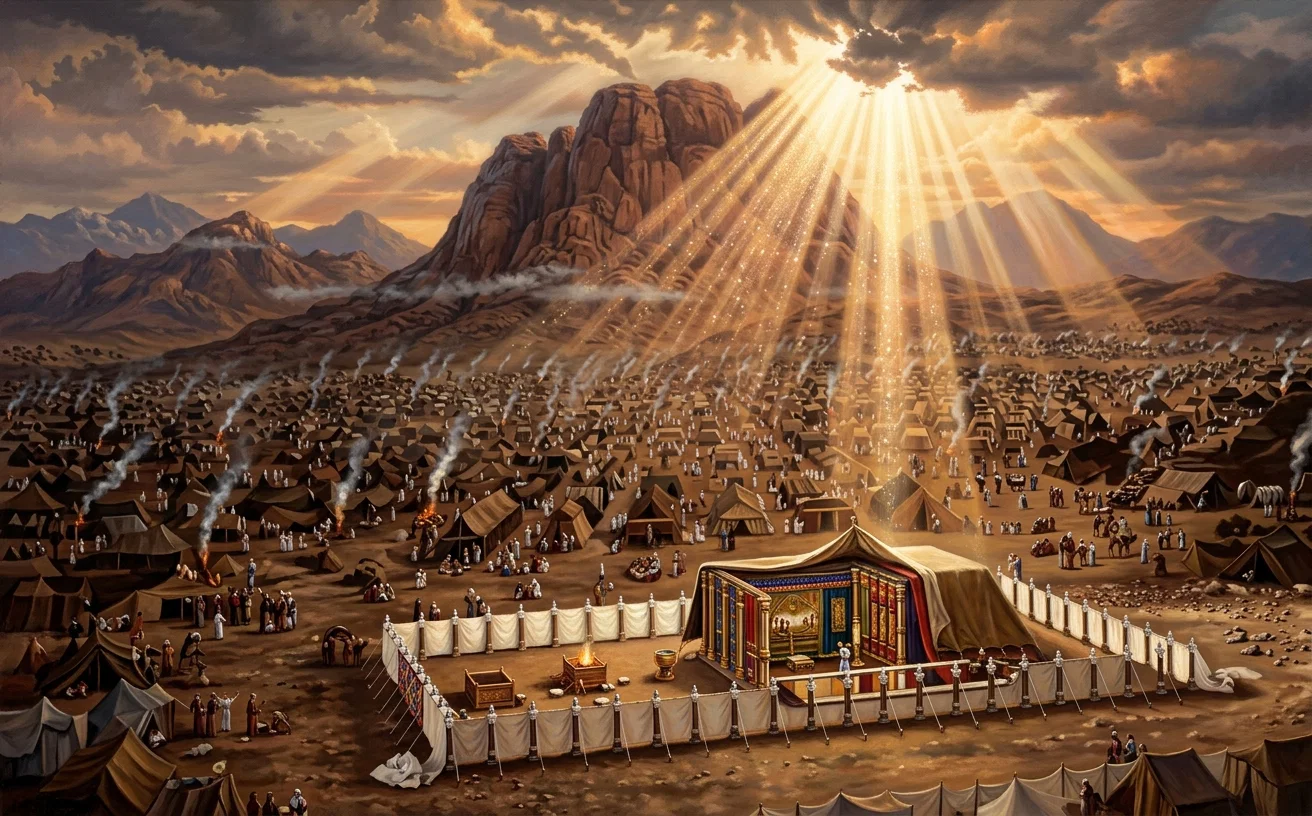
“And let them make Me a sanctuary; that I may dwell among them.”
II. Its Daily Services
AND let them make Me a sanctuary; that I may dwell among them.” Ex. 25:8. These were the words of the Lord to His servant Moses after Israel had reached Mount Sinai on their way to Canaan. Till then the sacrificial offerings had been presented on rude stone altars erected by the worshiper to suit his convenience wherever he might dwell. Henceforth the Lord was to have a dwelling-place among His people, their offerings were to follow a prescribed form, and were to be far more elaborate than hitherto.
Beginning with Abraham, the people of God were more emphatically separated from the rest of the world. God was preparing them to occupy the land He had promised to His servant. For a time the descendants of Abraham dwelt in Egypt; but when the time of the promise drew near, the Lord raised up Moses to lead forth His people from the land of their bondage to the land of Canaan, where for many centuries they made their home, and where in due time the Saviour was born. From the dedication of the tabernacle at Sinai to Christ, tent and temple served as His visible habitation among men. Much of this time the Lord’s presence was manifested in the shekinah glory of the sanctuary. Never has the Lord given to men more marvelous manifestation of His great power and goodness than when Israel’s invisible King dwelt with His people in the sanctuary.
Specific Directions about Its Use
When “the Lord spake unto Moses, saying, . . . Let them make Me a sanctuary; and that I may dwell among them.” He gave specific instruction as to how it should be built. “According to all that I show thee, after the pattern of the tabernacle, and the pattern of all the instruments thereof, even so shall ye make it.” Ex. 25:9. When the work was finished and the sanctuary was ready for dedication, Inspiration declares: “According to all that the Lord commanded Moses, so the children of Israel made all the work. And Moses did look upon all the work, and, behold, they had done it as the Lord had commanded, even so had they done it; and Moses blessed them.” Ex. 39: 42, 43.
The sanctuary was a movable structure, which could easily be taken down and transported from place to place. Its walls were made of detachable boards set upright and joined together with bars. All the wood of the building was overlaid with gold. At the entrance were five pillars upon which was suspended a richly embroidered curtain which formed the door of the tabernacle. Over the sanctuary were four coverings. The inner covering was of “fine-twined linen, and blue, and purple, and scarlet; with cherubims of cunning work.” The other three were made of goats’ hair, or rams’ skins dyed red, and of badgers’ skins so arranged as to afford complete protection. The building was thirty cubits in length, ten in width, and ten in height. It was divided into two apartments by a beautiful curtain or veil suspended from four pillars overlaid with gold. This, with the veil at the entrance, and the inner covering which formed the ceiling, was of blue and purple and scarlet; inwrought with threads of gold and silver were cherubim.
The First Apartment
In the first apartment, or holy place, were the golden candlestick, the table of showbread and the golden altar of incense. The candlestick was of beaten gold with seven lamps, some of which were kept burning continuously for the purpose of lighting the sanctuary. The table of showbread and the4altar of incense were made of acacia wood and overlaid with gold. Upon the table of showbread twelve cakes sprinkled with frankincense were placed every Sabbath day. Those that were removed were eaten by the priests in the holy place. Before the veil separating the holy from the most holy place stood the golden altar of incense. Upon it was burnt sweet incense every morning and evening. The fire upon this altar was kindled by God Himself, and was never permitted to go out.
The Second Apartment
In the second apartment, or most holy place, was found the ark of the testimony, so called because it contained the “two tables of testimony, tables of stone, written with the finger of God.” Ex. 25:16, 21; 31:18. The ark was made of acacia wood and was overlaid within and without with pure gold. Within this sacred chest were deposited the tables of stone upon which God Himself had inscribed the ten holy precepts. Above the law of God and forming a cover to the ark was placed the mercy-seat. This was wrought of one solid piece of gold, surmounted on either end by a golden cherub. Above the ark, over the mercy-seat and between the cherubim, was the shekinah, the manifestation of the divine presence.
The Outer Court
Within the court that surrounded the sanctuary and before the door of the tabernacle of the congregation stood the brazen altar of burnt offering, upon which the bodies of certain of the offerings were burned, and at the base of which the blood was poured out. Between the altar and the door stood the laver where the priests bathed themselves before entering the sanctuary in their daily ministration.
“No language can describe the glory of the scene presented within the sanctuary,—the gold-plated walls reflecting the light from the golden candlestick, the brilliant hues of the richly embroidered curtains with their shining angels, the table, and the altar of incense, glittering with gold; beyond the second veil the sacred ark, with its mystic cherubim, and above it the holy shekinah, the visible manifestation of Jehovah’s presence; all but a dim reflection of the glories of the temple of God in heaven, the great center of the work for man’s redemption.” (“Patriarchs and Prophets,” page 349.)
Significance of the Service
We are now brought in our brief study of this subject to that which is of special significance,—the daily service. When the sanctuary was completed, and all things were found to be according to the pattern shown to Moses in the mount, “then a cloud covered the tent of the congregation, and the glory of the Lord filled the tabernacle.” The majesty of heaven was revealed. The people were thus assured that the work of their hands was accepted, and that God would henceforth abide with them. Heb. 8:5; Ex. 40:34.
By divine direction the tribe of Levi was set apart for the service of the sanctuary, but the priesthood was restricted to the family of Aaron. A special dress indicative of their holy office was provided for the priests. The priest stood as a mediator between God and man. He was the representative of the people in “things pertaining to God.” The daily burnt offering consisted of two lambs of the first year, one offered in the morning and the other in the evening. At the same time sweet incense was offered on the golden altar. There were also special offerings for individual sins, besides those that were made on the Sabbath, the new moon, and on special feasts.
Every morning and evening the priest brought a lamb in which was no blemish and burned it upon the brazen altar within the court. This offering symbolized the daily consecration of Israel to God, and was an expression on their part of their entire dependence upon Him. While the smoke of this offering was ascending from the brazen altar, the priest reverently approached the golden altar before the inner veil that separated him from the law of God and the holy shekinah, and offered sweet incense. As the cloud of incense ascended, the divine glory descended upon the mercy-seat and filled the most holy place. Far out over the camp of Israel floated the fragrance of the burning incense, which represented the righteousness of the coming Messiah and which by faith was imputed to them. Here we have an example by divine appointment for morning and evening worship. The Lord to-day looks with pleasure upon the household where the family altar is erected, where morning and evening His Word is read, and where with songs of praise and prayer the throne of grace is approached.
Another important feature of the daily service in the sanctuary was that which was performed in behalf of the individual. The penitent transgressor brought his offering to the door of the tabernacle, and after placing his hands upon its head confessed his sin over it, thus in figure transferring his sin from himself to the innocent victim. The sinner with his own hand took its life, and the blood was carried by the priest into the holy place and sprinkled before the veil. In figure the sin was thus transferred to the sanctuary, where it rested till the great day of atonement. In certain cases the blood was not taken into the sanctuary, but instead the flesh of the offering was eaten by the priest in the holy place. Lev. 10:17. In either case, however, the sin was figuratively borne into the sanctuary. This constituted the daily round of service in the sanctuary, every part of which was fraught with deep meaning. The full import of this service, however, must be left for future articles.