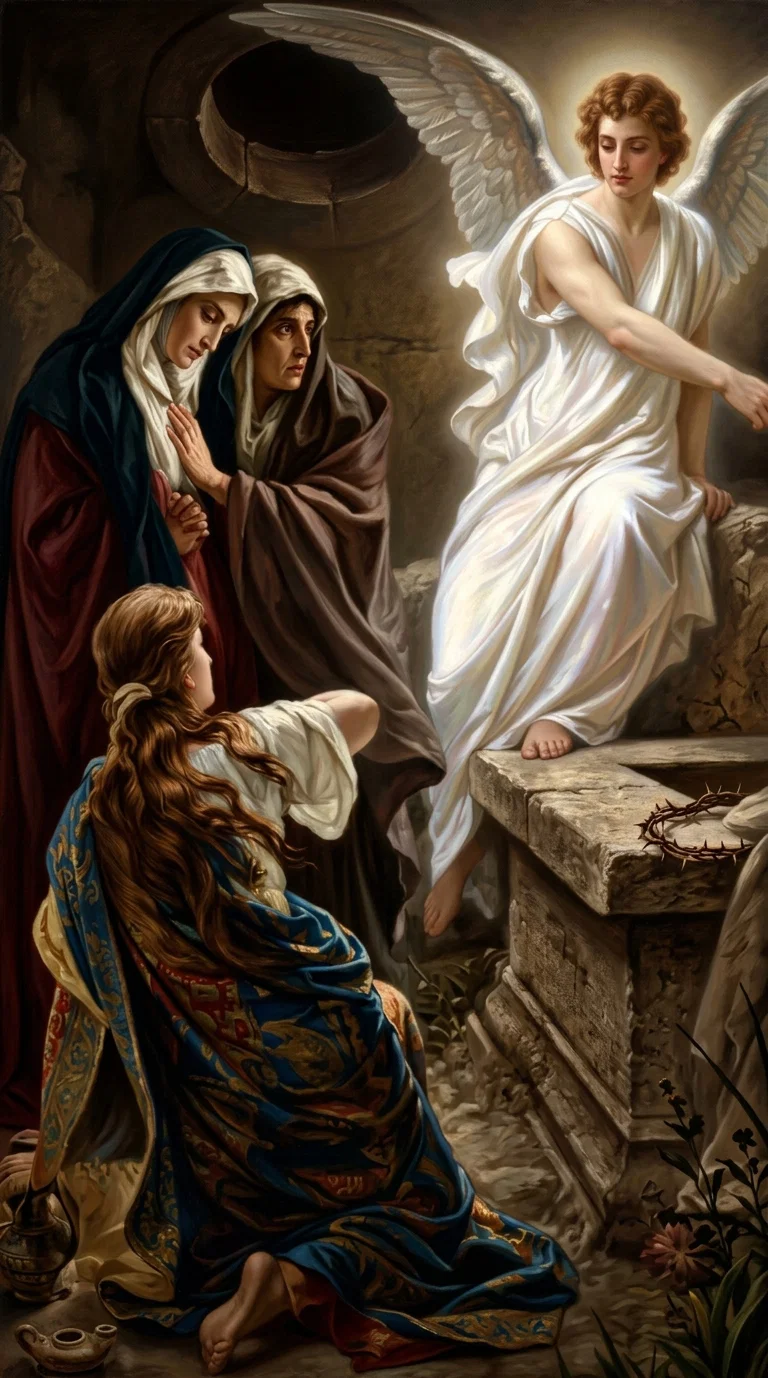
“Why seek ye the living among the dead? He is not here, but is risen.”
The Day or the Life
SUNDAY, March 23, there will be many sermons preached on the resurrection of Jesus Christ,—good, bad, and indifferent. There will be “Easter” hats and “Easter” bonnets and “Easter” dresses and “Easter” ties and “Easter” eggs and “Easter” flowers galore. The long, man-imposed fast, beneficial in many respects to the high livers after the winter’s idleness and gorging, will be over. The strictly wealthy ritualist will then lay aside her somber garments and don her robes from the fashion purveyors of the world. But the world is not moved a fraction of a fathom nearer heaven.
THE term “Easter” is idolatrous in origin, coming from the Anglo-Saxon Easter, from Eostra, the goddess of dawn. The Editor’s Encyclopædia says “that as a church festival it is not traceable to the times of the apostles, and that many of the popular observances connected with Easter are clearly of pagan origin.” “The Anglo-Saxon name for April was Estormonath; and it is still known in Germany as Ostermonath.” The same authority says: “It was the usual policy of the ancient church, seeking to convert surrounding pagans, to endeavor to give a Christian significance to such of the rites as could not be rooted out, and in this case the conversion was particularly easy.”
THUS it was that many errors crept into the church, and many of the ritual observances that are in some of the branches of the professed Christian church to-day may be traced back into paganism. They were supposed to be harmless among the heathen, and they were adopted in order better to convert the heathen; but almost invariably these observances hid from the worshiper some great and vital truth. And so in this case the result was that the backslidden Christian church got the pagan customs and the pagan name, and the pagans themselves formed a wrong conception of Christianity, and those who accepted it accepted of a perverted form.
NO doubt many of those early Christians thought that the observance of one day in the year was honoring God, and so also doubtless many believe now. Why is it not a good thing to set aside one Sunday in the year in honor of the resurrection of Jesus Christ? But like all ordinances and observances not enjoined of God, it hides from those who hold it clearer light and greater blessings.
FOR, first of all, Jesus Christ did not rise for a day, but forevermore. Hear His own words: “I am He that liveth, and was dead; and, behold, I am alive forevermore; . . . and have the keys of hell and of death.” Rev. 1:18. His new or resurrection life was a life eternal. It does not abide in the traditions of men, in the customs of ages, or the precepts of church councils or popes. It rests in Him—a personal living Christ—given to the believer not that he may honor it by a day, not that once a year he may recall his risen Lord, but given to the believer for every day and every moment through all time.
JESUS CHRIST is not to be sought in the institutions or traditions or expediences of men, yet many are seeking Him there to-day. The places where He once walked with hallowed feet, the ground over which He passed in His teaching and miracle working, the stone sepulcher in which His body was at last laid, have been places for which millions of lives have been sacrificed and in which and from which millions more have sought relief and blessing. The crusades of four centuries fought to recover the holy sepulcher, and yet if men knew where that sepulcher was located, if they could find the very place where the Lord lay, if it had been untouched by the hand of the spoiler, or not desecrated in any way by the wickedness of men, from that day to this, there is no potency, no power, no life in it for the believer.
THAT was the lesson that Jesus taught nearly two thousand years ago. It is a potent lesson still. When He arose from the dead on that first-day morning His disciples could not believe it, and they rushed to the sepulcher. They found there the angels of the Lord, and the angels asked them the question, “Why seek ye the living among the dead? He is not here, but is risen.” As given by Mark, the angel knew the longing heart of the disciples. He said to them, “Be not amazed: ye seek Jesus, the Nazarene, who hath been crucified: He is risen; He is not here: behold, the place where they laid Him!” Matthew develops another thought most beautifully: “Fear not ye; for I know that ye seek Jesus, who hath been crucified. He is not here; for He is risen, even as He said. . . . And go quickly, and tell His disciples, He is risen from the dead; and lo, He goeth before you into Galilee;4there shall ye see Him: lo, I have told you.”
THE resurrection of Jesus therefore meant life, not death; action, not idleness. It presents to His disciples a forward look, not a backward; progress in God’s work, not retrogression; a great, broad outlook of service in the world, and not self-serving. “Jesus was not to be found among the graves, either of material bodies or of dead traditions, but in the great, living, progressive truth of God and in the great, living, progressive missionary effort for the needy world. ‘He goeth before you into Galilee.’ Out among the needy nations of the earth, there they would find Him; and there He is found still.”
IT need not be said that the observance of a day once a year is not the manifestation to the world of the resurrection of Christ which the Master designed. He has given us something better than that, and that is the life of the believer which begins at baptism,—baptism, the marriage ceremony which unites the believer with Christ (Rom. 7:4; Gal. 3:27) and sets forth in its symbolism the three great facts of the gospel. The apostle Paul writes, “For I delivered unto you first of all that which also I received: that Christ died for our sins according to the Scriptures; and that He was buried; and that He hath been raised on the third day according to the Scriptures” (I Cor. 15:3); and then follows his masterly argument on the resurrection. But these three great facts are symbolized by the baptism of the believer, and so the apostle writes elsewhere: “Or are ye ignorant that all we who were baptized into Christ Jesus were baptized into His death? We were buried therefore with Him through baptism into death: that like as Christ was raised from the dead through the glory of the Father, so we also might walk in newness of life. For if we have become united with Him in the likeness of His death, we shall be also in the likeness of His resurrection.” Rom. 6:3-5. Again: “Having been buried with Him in baptism, wherein ye were also raised with Him through faith in the working of God, who raised Him from the dead.” “If then ye were raised together with Christ, seek the things that are above, where Christ is, seated on the right hand of God.” Col. 2:12; 3:1.
HOW beautifully Bible baptism sets forth the great facts of the Gospel. The convicted sinner accepts of the Lord Jesus Christ, he believes in the death of our Lord for reconciliation to God, he accepts the life of the Lord Jesus Christ as his life, he yields himself to this belief, and in the beautiful symbolism of immersion goes forward declaring to the world his faith, his union with his risen Lord. And so the life of the believer becomes a testimony to the resurrection of Jesus Christ. The matter of baptism alone, the mere form or ceremony, is nothing of itself. That of itself might be as dead and cold as the sepulcher in which Christ lay and of which it could be said, “He is not here;” but if that baptism is connected with a genuine faith in the Lord Jesus, it issues in a life of power and service for God, so that that life of the believer, wherever he goes, is a vital testimony to the power of the risen Lord.
AND, therefore, the mightiest testimony for the resurrection of Christ is a living, growing, consecrated, progressive church; it is the mightiest testimony that can be given to a sinful and gainsaying world. Those who thus compose such a church as that are living epistles, “known and read of all.” They are a demonstration of the life and the power of God. They have died to sin, and the old man, with all his powerful control in passion and unsanctified desire is buried. The individual is seeking the things which are above, where Christ sitteth on the right hand of God. While living in this earth as other mortals live, to a greater or less extent, they are still witnessing to that which other mortals have not,—the power of an endless life.
HOW much better this is than a single day in the year. How much better is the term “resurrection” than “Easter.” How much better every day in the year instead of one day in the year. How much better is a life than a mere empty day of forms. It is the prayer of the writer that the great thought of the resurrection may so take hold upon the readers of the SIGNS OF THE TIMES that man-appointed days shall sink into utter insignificance, and that the great life of the Master may control every day of the year.