We are now about a half century away from the struggle that engaged this nation over the question of slavery, and as to whether there should be two nations within the confines of the United States, rather than one. The lapse of time has taken out much of the rancor that was in the hearts of men on both sides of the contest, so that the issue can be discussed coolly and with fair-mindedness, both North and South. We have passed the time when the men in the North go out of their way to say hateful things about the men of the South, and when the men of the South would seek to defend themselves by making equally uncomplimentary remarks concerning those in the North.
We are all agreed that it was an awful war. A civil war that divides a nation is the worst thing into which the war gods can plunge humanity. Those that are bound by the dearest ties of either friendship or nature are broken up into opposing camps, seeking with all their might to kill each other. War is always cruel, but this kind of war is the cruelest of all.
The strife in that time had for its great center the question of property. This nation had permitted slavery to grow up within its borders, and thousands of men had come to own some of their less fortunate fellow creatures the same as they owned their cattle and horses, and worked them upon much the same plan.
Of course there were other questions involved in the strife, but it is doubtful if war had ever been declared but for the slavery problem. Lincoln and those associated with him in the North had no property interest in the matter, and saw with perfect clearness that it was wrong for one man to own another. They saw just as perfectly that the question, if permitted to go much farther, would eventually split the nation. As Lincoln expressed it, we could not have a country half slave and half free. It would soon be one or the other.
Supplied by Underwood & Underwood, N. Y.
The men in the South, however, had personal property interests involved in the contest. No matter whether it was right or wrong, the nation had permitted them to acquire and own slaves. In many instances their wealth consisted largely in the slaves that they owned; for if they had not had the slaves with which to till their soil, or to do the work that they had in hand, they would have been broken up in business. So it was a question of property right and justice with them, as the matter was viewed from their standpoint. They entered into the struggle bravely and heroically. They were the same class of vigorous, strong men that made up the armies of the North, and the struggle was a fearful and bitter one.
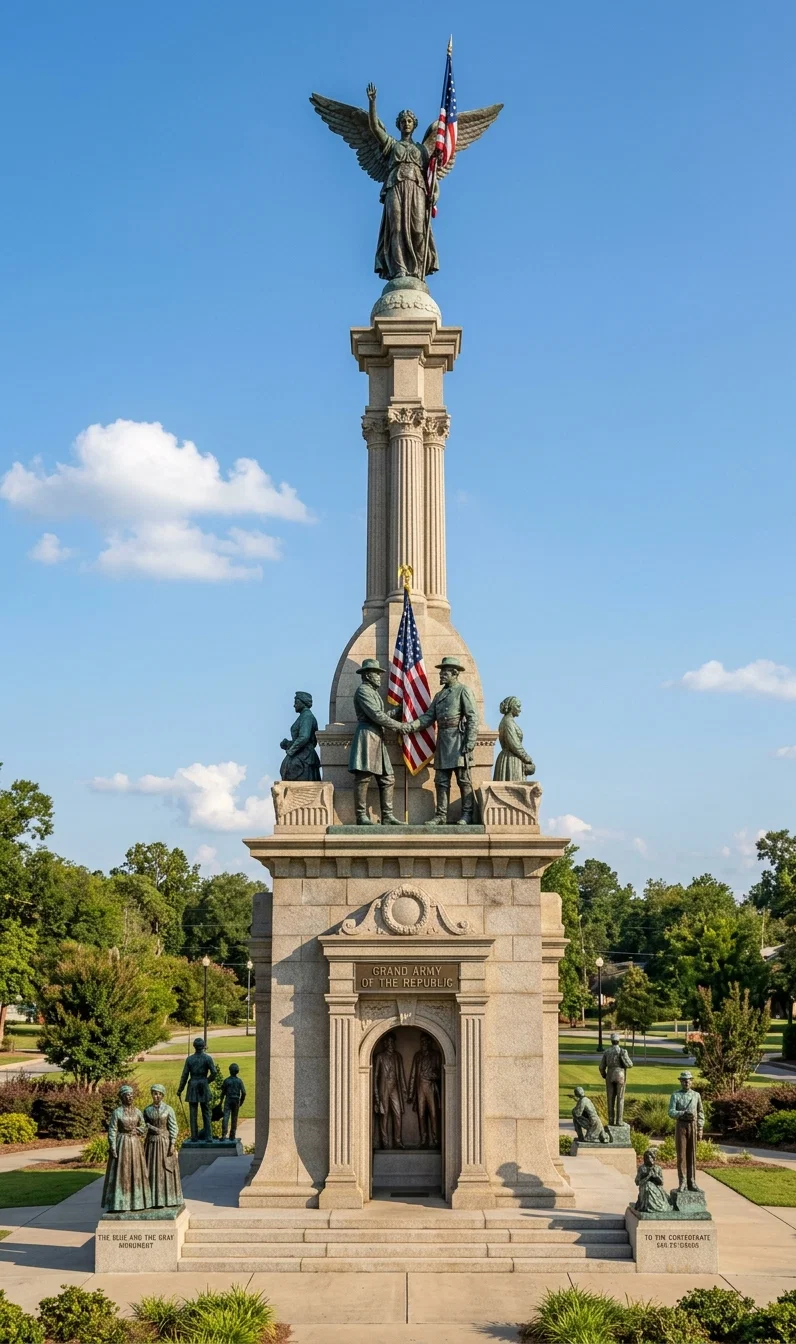
But we should all be thankful that it has been settled with the nation still a unity, and with the feeling of rancor so completely dying out that even in the southland itself, where the awful blight of the war was felt the worst, they are erecting monuments to both the Blue and the Gray, as is noted in the illustration on this page. It is a grand thing that the nation can again come together, and not only as citizens but as brothers, in the great commonwealth, can march side by side in the pursuits of peace.
We would that it could always remain so amicable, and that these pacific sentiments might become stronger and stronger. But there are other questions coming up now in the nation, that involve some of the same principles that caused the Civil War; and in the difficulty that confronts us, it will not be the North engaged against the South. These strifes will be interwoven into almost every community throughout the nation, so that each neighborhood will become the battle-ground of the discontented masses.
In that time, as already noted, the question of property was the one that was the center of the9controversy. In the conflicts that are now looming up, property is again the question. In that time, the men who had property interests, it must be agreed by us all, were often blinded by their possessions, so that they could not see the real principles that were at stake. In these times, we have other property interests that are causing mighty rumblings of revolution all through the nation. Men of colossal wealth have organized and are in control. Men of strong intellect and determination are organizing the forces of labor. They are in a deadly combat over this question of property.
Can we not learn a lesson from the Civil War period? There was a generation of discussion, of platform speaking, of the creating of sentiment, and then the mighty Civil War in this nation broke out, with all of its bloodshed and sufferings. We have had another generation of discussions. Through the press and on the platform, sentiment is being formed; it is becoming intense. Who can not see that we are even now in the very border-lands of the time when violent revolutions must break out! And when the thing becomes general, it will not be one side of the nation carrying war into another side, but neighborhoods will be divided among themselves in the grip of this deadly strife.
This is no visionary picture. This is no wail of a pessimist. It is simply the statement of the sober conditions as they are confronting us. We ought to learn lessons from the past, and seek to avert these calamities before they become unmanageable. But seeing that the nation as a whole will not learn the lesson, individuals should study to know the meaning of it, and should stand on the safe ground that has always been provided by divine Providence for men who will seek it. T.