One of the saddest and most discouraging elements in ordinary life to-day is not the striking evidences that are brought out now and then of deplorable corruption in a certain city, of a malefactor among congressmen, of roguery in high places; it is that society itself, the whole social life of the republic, is becoming honeycombed with essential dishonesty. We are sure that our older readers can remember the day when the horse-jockey was about the most disreputable character of any in a community, that a man who dealt in trading horses would cheat if he could, but when pinned down and his opinion really demanded, very few questioned his word,—there were few that were wholly unscrupulous,—but that is not the case in trade circles to-day. Society lies, of course everybody knows; there are enough of them, and always in evidence. But trade lies were a minus quantity in the olden days. If a dealer told you eggs were fresh you believed him; but it is common to see items in the paper of people who buy eggs and are assured by the grocer of whom they purchased them that they are absolutely fresh, and yet find dates on them running from three months to two years back.
We have a striking illustration of this in the March number of the “Ladies’ Home Journal,” entitled “The Dishonest Paris Label; How American Women Are Being Fooled by a Country-Wide Swindle.” The article is written by Samuel Hopkins Adams, who made a special investigation of the matter; and he questioned seriously whether such labels as he knew were forged labels could be purchased. He thought it would be with difficulty that these labels could be obtained; but he found that they were for sale by the thousand by the wholesalers, and he could go to retailers and secure them in smaller lots. He declares that a “conservative estimate would indicate that not fewer than two million and a half hats, gowns, and cloaks, are on sale under fraudulent labels to the American public.” He says, “The American woman’s slavish and insistent demand for things Parisian has brought about a SWINDLE THAT TO-DAY PERMEATES ALMOST THE ENTIRE DRESSMAKING AND MILLINERY BUSINESS IN THE UNITED STATES.” He continues: “If, for example, a woman has a so-called imported gown with a ‘Worth’ label sewed in it, the odds are overwhelming that it is fraudulent; or a Paquin or a Drecoll or a Doucet label, or any other French label. If she has in her hat a Georgette, a Talbot, a Reboux, a Marie Louise, or any other Paris label, it’s a hundred chances to one that the hat was made in America and the label is a forgery.”
When asking regarding these trademarks which he could buy by the thousand, he inquired: “How do I know that these are correct?” The reply was, “They are made from photographs. They are accurate, and the colors we guarantee.” And they were for sale, as before remarked, by the thousand.
Profits of Forgery
He tells the story of an acquaintance of his who was buying a number of hats for a charity bazaar, and went into a wholesale house. A number of these hats she tried on. Later, missing a valuable hatpin, she recalled that she had used it in trying on one of the rejected hats, and so returned to the wholesaler’s in quest of it; but they informed her that they had sold it to a store not far away and her pin probably went with it, hidden under one of the bows. She inquired of the manager if he thought she could get it if she went to the store. He said she could, but not to say anything to them about the pin. “Just describe the kind of hat you want to see,” and then she would probably find her pin in it, intimating that if she told them that she had left a pin in one of the hats she would never see it. The pin would be taken and then the declaration made that there was no such pin there. She found her hat, however, and found her pin. She was told that the hat was one of their recent importations, that their buyer had just brought it from Paris, and it bore the trademark of a world-famous milliner. She inquired the price. “Forty-five dollars, and a real bargain;” and yet at the wholesaler’s, five blocks away, the lady had rejected that hat for a price under five dollars. A good retail price for the hat would have been $10.00; the extra $35.00 “represented the profits of forgery.”
$10,000 a Yard
Another friend of Mr. Adams bought a new imported cloak which she proudly brought out for inspection. She thought it was a wonderful bargain — $175.00. “It cost more than that in Paris.” A gentleman to whom it was shown said, “It might have, if it had ever been in Paris.” The hostess held the label up under his nose. “That is very well done,” he said, “and it is a very good name, but a highly expensive bit of cloth,”—that is, the label. He figured for a moment. “It comes to about ten thousand dollars a square yard,” he concluded. “What does?” the lady demanded. He replied, “That forgery which you suppose to be a Paris label. Your cloak was made in America; the finish shows that. Without the label it would have cost perhaps one hundred dollars. Therefore you really paid seventy-five dollars for that little bit of cloth, about three by three inches. Next time, why not buy the whole garment on an American-price basis?”
“Genuine” French Goods
Again. A woman partner in a wholesale dress-making establishment, wishing to get one of the new French gowns last autumn, went to a certain New York department store, “one of those that insistently vaunts the genuineness of its goods.” The second dress shown her attracted her attention. “Is this an importation?” she asked. “Yes; it is from Paris,” replied the saleswoman, indicating the label to that effect. The prospective customer turned up the bottom of the garment to examine the hem. “O,” said the saleswoman hastily, “you can’t tell anything by that. The Paris modistes are finishing their models for exportation in the American fashion.” The lady responded, “Indeed! I would like to speak to the buyer.” He was called. He assured her that it was a Paris label, that it came from Paris; but she replied, “That doesn’t look like Paris finishing. It’s too good and solid.” But the buyer said, “To show you how far wrong you are, I bought that gown myself when I was in Paris three months ago.” The lady responded, “That’s very curious,” and left with a broad smile. The reason of the smile was that the misbranded dress had been turned out at her own establishment not three months previously.
$20.00 for a Label
Another instance. A woman went into a New York hat shop and tried on a hat not having in the lining a Paris label. She asked the salesgirl, “Don’t you think it is a little—well, ordinary? Rather American?” The salesgirl replied, “I can get you from the workroom the Paris model from which this is taken, and then you can compare the two.” There were other hats, of course, exactly like it in the workroom, and into one of those the11girl quickly sewed a Paris label. The hat was precisely like the one she tried on. “This is the Paris hat,” unblushingly announced the salesgirl. “Of course it is better made and all that, and has that chic that our American hats lack; but that is what makes this Paris hat cost twenty dollars more than the American copy.” And the woman took it and paid $20.00 for a Paris label, and still had an American hat.
And thus instance after instance, instance after instance, is given of the dishonesty that there is in this branch of the work. And Mr. Adams tells us, “SO MUCH HAS IT BECOME A RECOGNIZED HABIT OF TRADE THAT MANY DEFEND IT, or at least resent with a lively show of wrath any criticism of it.” And the editors of the “Ladies’ Home Journal” declare, “The list of firms and stores where dishonesty in labels was practised is too large to give space to.” The shops in New York City, for instance, both large and small, where the labels could be accepted as absolutely honest, were almost negligible, so wide-spread has become the dishonest use of labels. Eleven large firms are given who can be depended upon, three of these under one company.
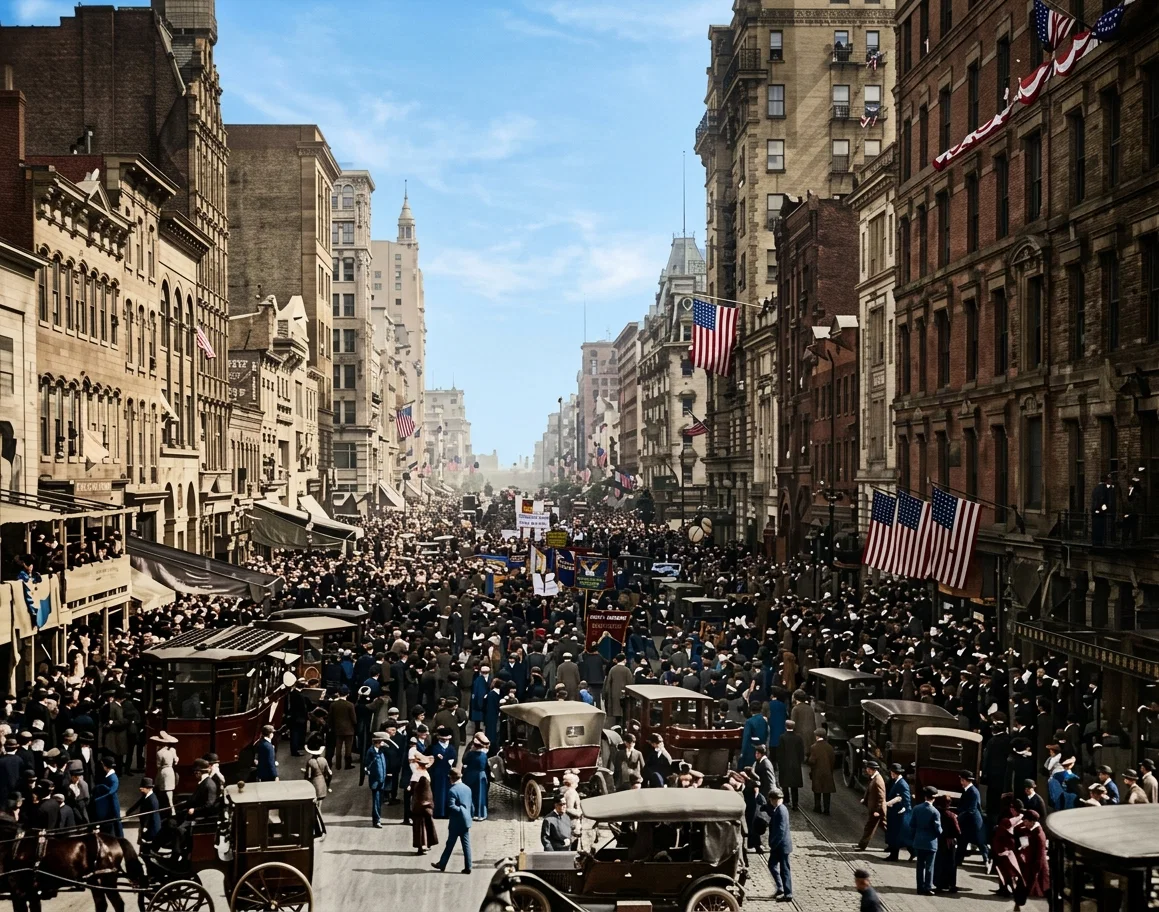
Among the noted events in Washington was the great Suffragette Procession, witnessed at times, we are told, by more than 500,000 people. It is said that sometimes the conduct of the beholders was disgraceful. In other places they were received with cheering and respect. After all, it is a real question whether they gained anything by such demonstrations. There is a strong organization of the antisuffrage association who have been, and are opposing the movement. Altho the latter were not so much in evidence in Washington at this time, evidently their influence was more or less felt.
True to Profession
Marshall Field’s house is named as among those that can be depended upon, and an instance is given of what occurred in the store of that company. A lady came in and asked for a genuine importation, and she was shown a hat the price of which was $65.00. The customer felt that she could not pay that price, and asked if it could be copied for her. “Certainly,” was the reply. “Could anybody tell the difference?” “Nobody but an expert. Our workmanship would be a little better finished.” “How much would the copy be?” “Eighteen dollars.” “And it would have the name of the French firm in it?” “No, madam.” “No? what label would it have?” “Marshall Field & Company.” “If I paid a little more?” “No, madam. Every hat made by us carries our label. Every hat imported by us carries its own label. That is the rule of the house.”
A few men in leading position may become dishonest and the country may not suffer. Men trusted in office may fail; but if the strong moral sense of the people in general stands, there is hope. But when the people themselves become honeycombed with essential dishonesty, what hope is there of the nation and the world? It is such things as these, foretold by Inspiration, that should be a warning to the people that the old earth is nearing its end. There is no hope of reform in a people who do not know essential integrity. There is no basis for reform. That perhaps is a little too broad: there is ONE basis of reform, and only one; but the world is turning from that,—that lies in the regenerating power of the Lord Jesus Christ. Through the creative power of God the dishonest heart may be made honest, and the dishonorable character may be made honorable; there is no other way.