A Latter-Day Prophecy

8%

Pacific Press Publishing Association · Mountain View, California · Oct 13, 1909

FromSigns of the Times, Vol. 36, No. 40.

Read the full edition

A Latter-Day Prophecy

Now therefore thus saith the Lord of Hosts; Consider your ways. Ye have sown much, and bring in little; ye eat, but ye have not enough; ye drink, but ye are not filled with drink; ye clothe you, but there is none warm; and he that earneth wages earneth wages to put into a bag with holes. Thus saith the Lord of Hosts; Consider your ways. Go up to the mountain, and bring wood, and build the house; and I will take pleasure in it, and I will be glorified, saith the Lord.” Hag. 1: 5-8.
We find, by reading the book of Haggai, that after God had called His people to come out of Babylon, they settled down in Jerusalem, and built comfortable houses for themselves; but as to the Lord’s house, they said, “The time is not come, the time that the Lord’s house should be built.” Hag. 1: 2. Filled with selfishness and love for the things of this world, they were so busy sowing and reaping, planting vineyards and orchards, and taking care of the fruit thereof, that they thought they could spare neither time nor means to do the Lord’s work or to build the Lord’s house. They built ceiled dwellings for themselves, but so quickly forgot the goodness and mercy that God had manifested toward them in calling them out of Babylon, that they made no effort to rebuild His temple and glorify His name.
But their policy, even from the standpoint of temporal gain, was a failure. The blessing of God was not with them; their crops were poor, their fruit and oil spoiled, and they did not even enjoy that which they had. And as we read God’s warning messages to them, and see how much better it would have been if they had sought to do God’s work more and their own a little less, we can’t help but think that they were a foolish and ungrateful people. How much better off they would have been in every way if their actions had been such as to receive the blessing instead of the curse of God!
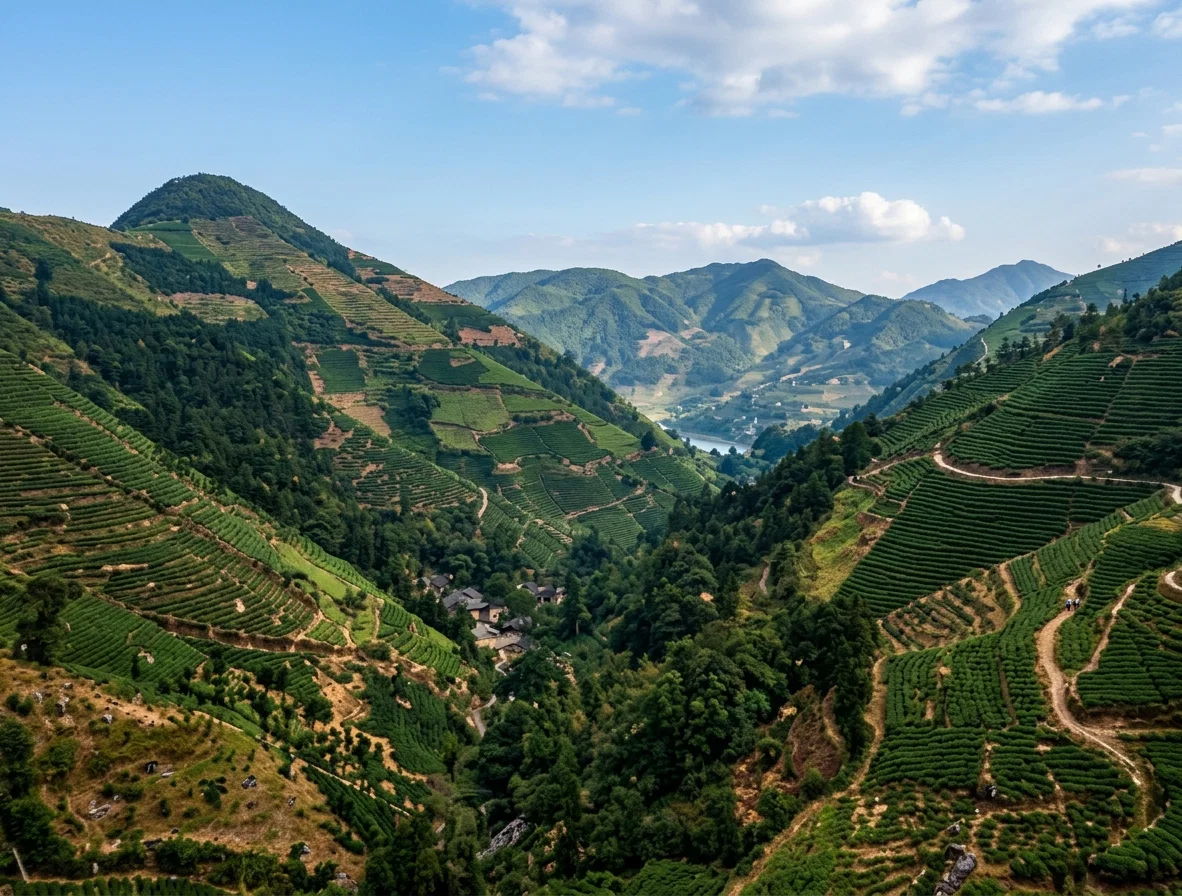
Tea Plantation on the Yangtze River, China
But there is another people that God has called out of Babylon. Rev. 18:1-4. And they, too, are the Israel of God. They are camping just on the border of the promised land. There is yet a little work to be done, a few more foes to conquer, a little longer to wait, and then they will have a glorious entrance into the New Jerusalem. I will not stop here to speak about the beauties of that city and the country in which it is situated; you have all read about it in God’s Word. Neither will I try to picture the joy and the blessings of those who gain an entrance to that wonderful place; you have read about that, too. But what I would like to call your attention to is the attitude of those who say they are waiting to enter that heavenly land. See! some are engaged in business, and hardly cast a glance at the promised land. Others are busy piling up money in banks; and when the servants of God tell of the need of funds to finish the preparations to enter the city, these add thousands to their bank-account while grudgingly donating a few cents toward the progress of the work.
Many have their backs turned toward the holy city, and are engrossed in the pleasures of this world. Some seem to be discouraged because of the hardness of the way, and are almost ready to believe that the beautiful city just before them is only a mirage. But some, looking forward with eyes of faith, see that the heavenly Canaan is almost reached; and they are using their strength, their means, and even their lives in their efforts to reach it, and in encouraging others to reach it. They count their means as useless, unless they are being used to hasten the time when the gates of the New Jerusalem shall open to receive the redeemed ones. They count their lives as wasted, unless in some way they have helped others to press on to the promised land.
And it is this latter class that I want to tell of an opportunity to hasten that glad day. Here in the land of China are about one fourth of the inhabitants of the world, most of whom have not heard anything of this “Gospel of the kingdom” that must go to “all the world as a witness unto all nations” before the King of Glory can receive His people into His kingdom.
We can not expect to come into personal contact with such a vast number of people in the short time that is left before the Lord comes, and yet they must be warned. And it seems that the only possible way to reach them is through the printed page. This last message of mercy is already being printed in books and tracts, which are sold by the thousands, and also in a monthly magazine which has quite a large circulation. But our printing-plant is taxed to its utmost capacity to take care of the work in hand, and the work in the whole field bids fair to suffer unless a place is soon provided where a better quality and a larger quantity of work can be done. A printer in America would not think he could do any work at all in such quarters and with such tools as we now have. We need a suitable building and proper machinery. Our present quarters are wholly inadequate.
Millions are dying daily who know nothing of that heavenly Canaan that is just before us, and nothing of the soon coming of our Saviour. We are doing all we can to tell them about these things and to get them to prepare to meet their God; but we needof such an institution? And can you realize the benefit such an institution would be to our work here?
Please read the second chapter of Haggai and apply its teaching to God’s people today. Now is the time for God’s people to “be strong” “and work: for I am with you, saith the Lord of Hosts.” Verse 4. Surely this is the time spoken of in verses 6 and 7, and the coming of the “Desire of all nations” is just before us. Then let us yield ourselves and all we have to God’s service. The time is just before us when we will have no need for the wealth of this world, for we shall have entered into our kingdom. Let us hasten that glad day by every means in our power, and we will have God’s rich blessings here as well as a home in His eternal kingdom.
W. C. HANKINS.