The fifth United States census of religious bodies in this country, completed in 1906, is about to be issued as a Census Bulletin. We have received, however, from the Department of Commerce and Labor, an abstract of the first report, many items of which, we believe, will be of interest to our readers. According to this census there are 186 religious denominations; 212,230 local religious organizations; 32,936,445 church-members. There is invested in church buildings $1,257,575,867. One interesting item regarding church-membership is that the males form but 43.1 per cent of the total church-membership, the females forming 56.9 per cent. This varied greatly in different denominations.
Percentage of the Sexes
In the Protestant bodies the male membership was 39.3 per cent, the female membership 60.7 per cent; while in the Roman Catholic Church the membership was nearly equally divided between the sexes, 49.3 per cent being male, and 50.7 per cent being female. This is also true of the Mormon Church, which reports 48.6 per cent male. The largest percentage of males shown for any denomination was the Greek Orthodox Church, 93.9 per cent, which is due to the fact that practically all the Greek immigrants have been males.
The Lutheran bodies showed 46.1 per cent males; the Methodist and Baptist bodies, 38.5 per cent each; the Presbyterian bodies, 37.9 per cent; Protestant Episcopal Church, 35.5 per cent. The denominations showing the smallest percentage of males were the Christian Scientists, 27.6 per cent, and the Shakers, 21.3.
The Increase
The increase between 1890 and 1906, for all denominations, amounted to 12,367,530, or 60.4 per cent. The Protestant bodies reported an increase of 6,280,555, or 44.8 per cent. The Disciples, or Christians, report an increase of 78.2 per cent. The increase of the Adventist bodies amounted to 53.3. Next come the Baptists, an increase of 52.5 per cent. The Baptist body now numbers 5,662,234 members. In some of the Protestant denominations the increase was very low; as for instance, in the Christian Connection it was but 6.2 per cent; the Friends, 6.1 per cent; and the Unitarians, but 4.1 per cent, and yet probably the Unitarian belief has increased more rapidly than that of any other so-called Protestant denomination. They have multiplied believers in other denominations by the thousands as a result of Higher Criticism.
On account of the way the Jews reported in 1890, it is impossible to tell what their increase has been.
Protestants and Roman Catholics
Of the total number of members reported, 61.6 per cent were returned by the Protestant bodies, 36.7 per cent by the Roman Catholic Church, and 1.7 per cent by all other bodies together. In 1890 the Protestant bodies reported 68 per cent, and the Roman Catholic Church 30.3 per cent, and all other bodies 1.7 per cent.
The rate of increase shown for the Roman Catholic Church was 93.5 per cent, more than twice that for all Protestant bodies taken together,—44.8 per cent. This seems startling on the face of it; yet it is well to remember that much of this Roman Catholic increase has been through immigration.
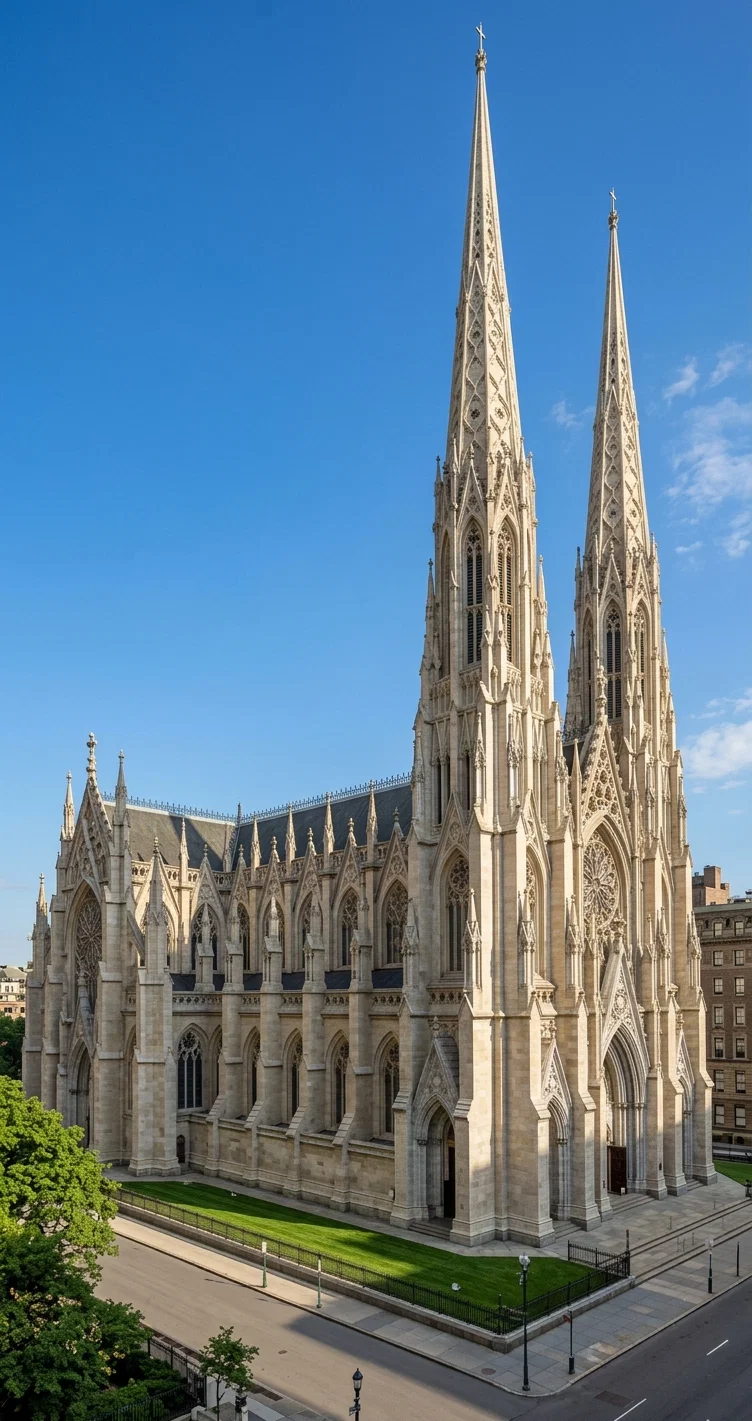
St. Patrick's Cathedral, New York City
Among the Protestants, the Methodist bodies ranked first in number of members, 17.5 per cent of the total for all religious denominations. The Baptist bodies are a close second with 17.2 per cent. These two families together constitute somewhat more than one third of the entire Protestant membership of the country. If to these are added the Lutheran bodies, the Presbyterian, and the Disciples, the five denominational families combined would include 16,497,480 members, a little more than one half the total membership of the country, and more than four fifths of all the Protestant membership.
The Christian Science percentage of increase is reported to be 8,825. The abstract informs us that the percentage of the Christian Scientists is probably too high, for the reason that many are counted as members of the “mother church” in Boston, who are also members of local churches elsewhere, and therefore would be counted twice. In fact it is said that nearly if not quite one half of the membership, 41,634, is duplicated in the “mother church.” Many scattered believers, too, have been of late years organized.
The average to the local church is highest among Roman Catholics; namely, 969; among the Protestant bodies, 104.
New and Extinct Denominations
During the sixteen years covered by the report, 12 denominations ceased to exist, 4 were consolidated with others, and 4 disappeared through changes in classification, leaving 126 reported both in 1890 and 1906; but there were divisions of denominations which numbered 13, and 48 other new denominations brought the total new ones up to 61, making 186 the grand total of all denominations reported in 1906. Of the 48 new denominations, 11 are the result of immigration, while most of the remainder are the result of the organization of entirely new cults.
Rank of Religious Bodies in Numbers of Churches
In this, Methodists stand first, with 64,701 organizations or local churches or companies; Baptists second, 54,880; Presbyterians follow with 15,506; Lutherans, 12,703; Roman Catholics, 12,482; Disciples, or Christians, 10,942; Protestant Episcopalians, 6,845; Congregationalists, 5,713; United Brethren, 4,304; Evangelical Association, 2,738; Reformed, 2,585; Adventists, 2,551; Jewish, 1,769; Christian Connection, 1,379; German Evangelical Synod, 1,205; Mormons, 1,184; Friends, 1,147; Dunkards, 1,097.
The increase in church buildings was 50,308, an average of 60 new church edifices each week, or 8 each day, for the 16-year period. The total seating capacity of church edifices is reported to be 58,536,830; for the Protestant bodies, 53,282,445; for the Roman Catholic Church, 4,494,377. With the exception of the Roman Catholic Church all the denominations showed an average seating capacity in excess of the average membership, amounting to three times the average membership in the Protestant bodies; while for the Roman Catholic Church the average membership was almost two and one fourth times the average seating capacity. The members of that church are accommodated at the different services; that is, members of families dividing up between different services.
The Roman Catholic Church reports as members all baptized persons, including infants. Therefore 15 per cent has been deducted from the membership, to cover those under nine years of age.
In 29 states the majority of the members belong to the Protestant bodies; in 16 states, to the Roman Catholic Church; and in one state, Utah, to the Latter-day Saints.
Here are the states in which the Roman Catholic membership is reported to be in majority: New Mexico, Rhode Island, Montana, Massachusetts, Nevada, Arizona, New York, New Hampshire, Louisiana, Connecticut, California, Vermont, Maine, New Jersey, Wisconsin, Michigan.
In Georgia 57.9 per cent of the religious population belong to the Baptist bodies; in Mississippi, 56.5; in Alabama, 54.9; in Virginia, 52.4; and in South Carolina, 51.3. Delaware shows a high percentage for Methodists, 45.5.
The Census Bureau recognizes that even this is not a fair showing, because there are many who really regard themselves affiliated with Protestant bodies who are not included in the enumeration, as they have not fulfilled the requirements of membership; whereas the figures for the Roman Catholic Church include practically all adherents above nine years of age. Still the increase in the Roman Catholic Church has been tremendous.
This also ought to be taken into consideration: The Roman Catholic Church is a united body. During the last sixteen years various influences have had a tendency to weaken the Protestant churches; notably Higher Criticism, Unitarianism, New Thought, Christian Science, etc. The Roman Catholic Church stands as a united body; the Protestant churches are tremendously broken.
Church-Membership and Population
The church-membership has increased more rapidly than the population. The population who were church-members in 1906 was larger by 6.4 per cent than in 1890. The relative gain in religious membership as compared with the population of the country is as follows: Protestant bodies, 1.8 per cent; Roman Catholic11Church, 4.4. It can be readily seen how some of these denominations can control politics in these states. For instance, 56.2 per cent of all the people in New Mexico are Roman Catholics, having an actual majority of the population. In Utah 47.9 per cent of the whole population are members of the church of Latter-day Saints; while the Baptists, who have such a preponderating percentage in some of the Southern States as regards the religious population, have at the very highest but 24.4 per cent of the entire population.
Not Numbers but Character
The great lesson, however, for Christians to take to heart, is that it is not numbers which count in the great moral forces of the world. Some of the darkest periods of earth’s history, some of the darkest chapters of Christendom, were written in blood at a time when the majority of the population professed the religion of the Bible. The great and important question is, How much of vital godliness is represented in this increase? That is the only thing which will tell for the uplifting of the cross. The mightiest storehouses of the world might be filled with salt, but if its savor be gone it is worthless for the preservation of anything for which it might be used. God’s church is the salt of the earth. If that salt have lost its savor, the savor of godliness, of true piety, of devotion to their Master, of faithful obedience to His Word, there can be written upon her escutcheon “Ichabod,” the glory is departed. Better was the little company of the 300 which could go whole-hearted with Gideon, than the thousands who were left behind. Thousands of faithless ones but encumber the progress of the church. That church or that religious body only is strong that is strong in the Lord Jesus Christ.