The Age of Apostasy

3%

Pacific Press Publishing Association · Mountain View, California · Oct 6, 1909

FromSigns of the Times, Vol. 36, No. 39.

Read the full edition

The Age of Apostasy

THREE recent events mark a tendency in the religious world to-day. These three events are the following:
1. Not long ago the New York Presbytery admitted into the ministry three young men, each one of whom rejected some of the most cardinal points of the old orthodoxy. They understood that the story of Adam and Eve in the Garden of Eden was allegorical; that man did not fall, but began in a state of sin; they did not accept the literal interpretation of Christ’s birth from a virgin; believed in a spiritual resurrection, but not that His body rose from the tomb; that Lazarus was resurrected only spiritually.
2. The second event was the stir in the Baptist Church over Prof. George Burman Foster, of the University of Chicago, who in a recent book stirred certain Chicago Baptists to a high pitch of resentment by denying the divinity of Christ, and by making other statements inconsistent with the old Baptist faith. With the Unitarians, he does not think Christ the equal with God; considers all men divine in creation, and divine in creative power. He says: “The application of a little water to a man’s head or body will not make him a Christian; and as for the Baptist dogmas, I repudiate them absolutely.”
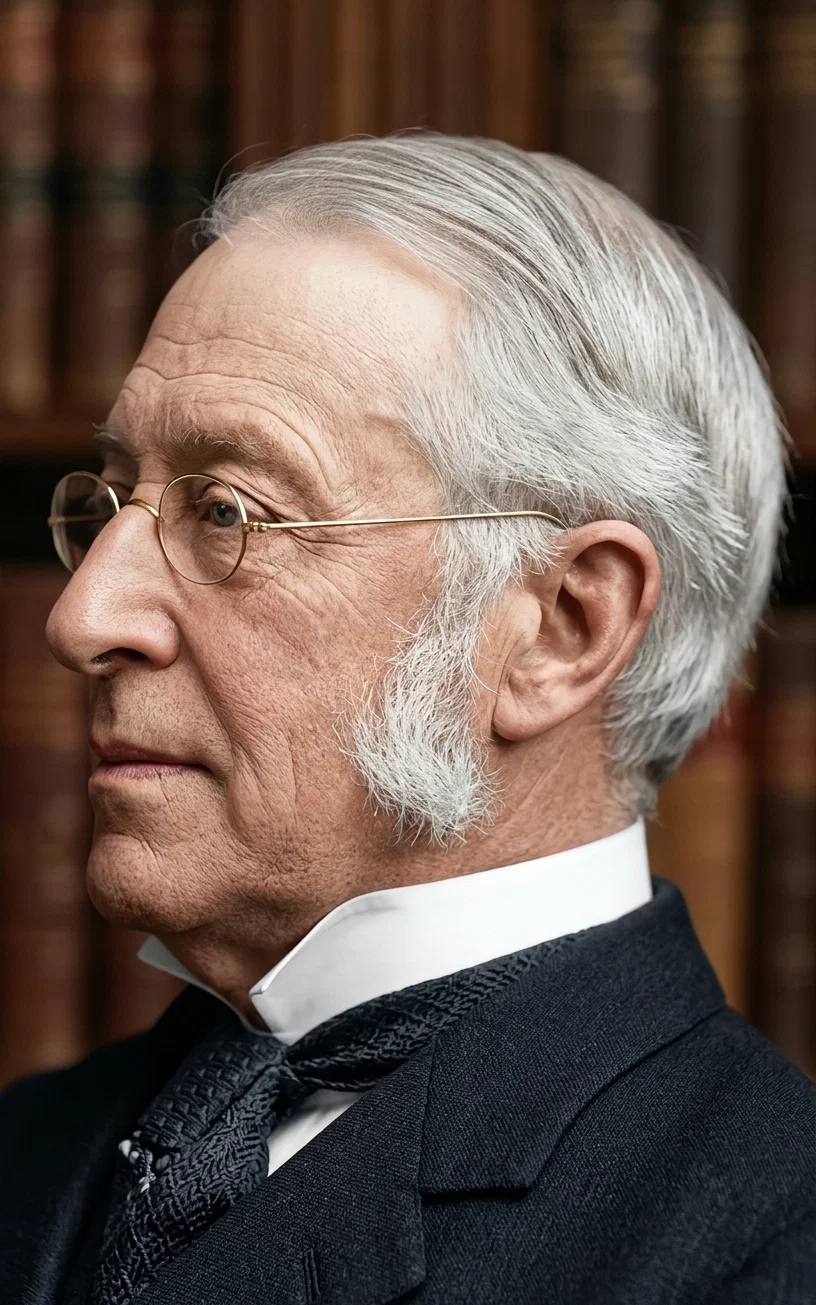
President Eliot
President Eliot
3. The third event is an announcement by Charles W. Eliot, President Emeritus of Harvard, in an address before the Harvard Summer School of Theology, July 22, in which he prophesied the advent of a new religion. He declared:
“It will not be dogma or creed. Its workings will be simple; but its field of action, limitless. There will be no supernatural element; it will place no reliance upon anything but the laws of nature. The new religion will not teach that character can be changed quickly,” etc. All of which is plainly a denial of the orthodoxy of the evangelical churches.

A Strong Tendency

These events as mere happenings might not mean much; but when considered in the light of the fact that these things are marking a strong tendency among religious teachers in general, they are marvelously significant. Many ministers, a number of them of prominence, receive all these statements with composure. The Presbytery which admitted the three young men, has in that act declared that there are no fixed tenets of belief on the part of its ministry; and thus practically every Presbyterian minister, within the bounds of that act, becomes a law unto himself.

Comments by the Ministry

It will be of interest to know something of how these things are taken by the press and the pulpit. We therefore give some published statements with reference to the matter. Thus a religious exchange says with reference to the three young men admitted into the Presbyterian ministry:
“Some of the conservative ministers were horrified at the daring views held by the youthful trio. Others declared that the modern trend in the Presbyterian Church was to allow much more liberality of thought than was formerly the case.
“Think of John Knox, the noble founder of this sect, weeping over the lost till the ground was kept wet in the corner of his garden where he retired for secret prayer! How would he feel over such things as the above? He made the devil tremble in his time. The wicked queen on her throne declared she feared his prayers more than she did the bullets of an enemy. But these young men will never disturb the devil’s kingdom, unless, perchance, it should be convulsed with delight at such a downfall. Like Samson shorn of his locks, they may go out and shake themselves; they will be sure to shake nothing else.”
Consider this also from “The Herald of Gospel Liberty:”
“We are now in an era of wildest theology. Of course there is an attempt to pass it for the real thing, but it is like the money of bad memory. It lacks a basis of confidence.”
Another exchange, in speaking of the announcement made by Ex-President Eliot, says:
“Coming down to the heart of the question, this is just a tendency of the times. The battle is raging round the divinity of Jesus. The last great battle is being joined. Believing as we do, it behooves us to stand like a stone wall against every innovation. The crisis is approaching, and we must be true.”
“The Word and Way” has this to say of the present tendency:
“These are perilous times doctrinally. There is a distinct and tremendous drift away from the old and true faith. Many there are who will no longer endure sound doctrine.”
This is evidently a reference to the prophecy of Paul in which he admonished the ministry to preach the Word, for the time would come when men would not endure sound doctrine, but should “heap to themselves teachers, having itching ears.” 2 Tim. 4:3.
Dr. George W. Knox, professor of the philosophy of religions in the Union Theological Seminary, characterizes Dr. Eliot’s address as “A VERY ABLE SUMMARY of what the INTELLIGENT MEN of the present day think; whether they are in or out of the churches.”
“The Christian Register,” the Boston Unitarian weekly, regards Dr. Eliot’s utterances as “a frank, concise, and thoroughgoing exposition of ethical and religious principles,” which “can not fail to produce a profound impression.”

Who Are with Him

Elbert Hubbard, in defending Dr. Eliot’s position, tells us the company that the doctoris in, in making his pronouncement. He says:
“The truths that Dr. Eliot now expresses were first uttered by Pythagoras 600 years before Christ; by Socrates; by Jesus of Nazareth; by Seneca the aristocrat; by Epictetus the slave; by Marcus Aurelius the Roman emperor; by Hypatia the first martyr to the New Thought—torn limb from limb in a Christian church; in degree by Cassiodorus; by St. Benedict, and Francis of Assisi; by Bruno and Galileo; by David Hume; by Thomas Paine, Benjamin Franklin, Thomas Jefferson, Voltaire, and Jean Jacques Rousseau.
“Dr. Eliot, President Emeritus of Harvard, is the most conspicuous intellectual figure before the American people to-day. His position is one of singular dignity. A million intellectuals in America look to him for guidance. For them he keys the cosmic symphony. He represents the established order. He keeps step with the procession. He is in the front rank—but never ahead of it. He is a mouthpiece, not of radicals or idealists or dreamers, but of practical educated men of affairs.
“He is a teacher of teachers.
“His social and intellectual position is secure and unassailable.
“So much for the man.
“As for the audience to whom he delivered his pronouncement, it was, bear in mind, a divinity school, made up of preachers, old and young, representing various Protestant denominations.
“And now comes a man who has been at the head of Harvard College for just forty years, and explains to the students of this divinity school that its teachings of the supernatural have been founded on a fallacy, and that God is the great Unconscious, working toward the Conscious, with man as His chiefest instrument.”

Skepticism in Pew and Pulpit

If this man is at all correct in his statements of the present trend—and barring the fact that he puts Jesus Christ among the teachers of New Thought, we believe he is—then it is easy to see where we are to-day in theological beliefs. How true indeed are the words of John Fiske which he left behind him in his book “Through Nature to God.” He says (pages 145, 146):
“Skepticism of our day is rather sad than frivolous; it drags people from long cherished notions in spite of themselves; it spares but few that are active minded; it invades the church, and doesn’t stop in the pews to listen, but ascends the pulpit and preaches.”
“There is no refuge anywhere from this doubting and testing spirit of the age. In the attitude of civilized men towards the world in which we live, the change of front has been stupendous. The old cosmology has been overthrown in headlong ruin, attacks upon doctrines have multiplied, and rituals, creeds, and Scriptures are overhauled and criticized, until a young generation grows up knowing nothing of the sturdy faith of its grandfathers save by hearsay; for it sees everything in heaven and earth called upon to show its credentials.”
Ray Stannard Baker has been giving special study to this, as he calls it, “spiritual unrest.” In speaking of present conditions, under the title of “A Time of Restless Inquiry,” he says:
“Modernism among the Roman Catholics, the Reform Movement among the Jews, the ‘higher criticism’ in all the churches, have been tearing down old structures of belief and tentatively offering new. Strange experiments are everywhere being tried—experiments such as Christian Science, Emmanuelism, Theosophy, the ‘Holy Ghosters,’ the Millennialites. Various Oriental and exotic cults, transplanted upon our hardy soil, find many to water and care for them. It is a time of troubled and restless inquiry. Escaping from the churches, how the religious principle, as Carlyle once said, ‘either lies unseen in the hearts of good men, looking and longing and silently working toward some new revelation, or else wanders homeless over the world, like a disembodied soul seeking its terrestrial organization.’”
Here is another very significant comment on the present stage of religious belief:
“Since we have discovered that past ages of religious thinking have been held by slavish subserviency to a past further back, and in the supposition that God has not spoken since the first century of the Christian era, we have reacted from that slavish subserviency and supposition to the extreme opposite supposition that God has never spoken until now, and that the compelling spiritual dictates of the age in which we live are the first and only voice of the living God.”
So says Rev. Samuel H. Bishop, of New York City, as reported in “The American Journal of Theology,” July, 1909.